Elizabeth George - Just One Evil Act
Здесь есть возможность читать онлайн «Elizabeth George - Just One Evil Act» весь текст электронной книги совершенно бесплатно (целиком полную версию без сокращений). В некоторых случаях можно слушать аудио, скачать через торрент в формате fb2 и присутствует краткое содержание. Год выпуска: 2013, ISBN: 2013, Издательство: Dutton, Жанр: Детектив, на английском языке. Описание произведения, (предисловие) а так же отзывы посетителей доступны на портале библиотеки ЛибКат.
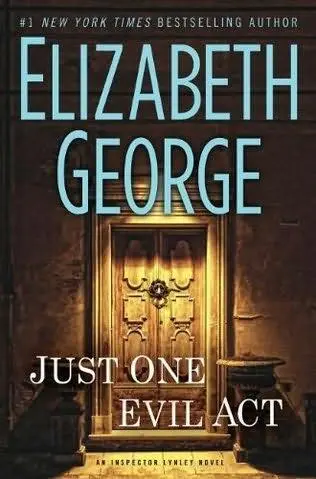
- Название:Just One Evil Act
- Автор:
- Издательство:Dutton
- Жанр:
- Год:2013
- ISBN:978-0-698-13828-5
- Рейтинг книги:5 / 5. Голосов: 1
-
Избранное:Добавить в избранное
- Отзывы:
-
Ваша оценка:
Just One Evil Act: краткое содержание, описание и аннотация
Предлагаем к чтению аннотацию, описание, краткое содержание или предисловие (зависит от того, что написал сам автор книги «Just One Evil Act»). Если вы не нашли необходимую информацию о книге — напишите в комментариях, мы постараемся отыскать её.
bestselling author Elizabeth George offers the latest in her Inspector Lynley series: a gripping child-in-danger story featuring fan favorite Barbara Havers. Detective Sergeant Barbara Havers is at a loss: The daughter of her friend Taymullah Azhar has been taken by her mother, and Barbara can't really help—Azhar had never married Angelina, and his name isn't on Hadiyyah's, their daughter's, birth certificate. He has no legal claim. Azhar and Barbara hire a private detective, but the trail goes cold.
Azhar is just beginning to accept his soul-crushing loss when Angelina reappears with shocking news: Hadiyyah is missing, kidnapped from an Italian marketplace. The Italian police are investigating, and the Yard won't get involved, until Barbara takes matters into her own hands. As she attempts to navigate the complicated waters of doing anything for the case against her superior's orders, her partner, Inspector Thomas Lynley, is dispatched to Italy as the liaison between the Italian police and Hadiyyah's distraught parents.
In time, both Barbara and Lynley discover that the case is far more complex than just a kidnapping, revealing secrets about Angelina; her new lover, Lorenzo; and even Azhar—secrets Barbara may not be willing to accept. With both her job and the life of a little girl on the line, Barbara must decide what matters most and how far she's willing to go to protect it.
Just One Evil Act — читать онлайн бесплатно полную книгу (весь текст) целиком
Ниже представлен текст книги, разбитый по страницам. Система сохранения места последней прочитанной страницы, позволяет с удобством читать онлайн бесплатно книгу «Just One Evil Act», без необходимости каждый раз заново искать на чём Вы остановились. Поставьте закладку, и сможете в любой момент перейти на страницу, на которой закончили чтение.
Интервал:
Закладка:
He did so, although with marked reluctance. He bent to Angelina first, and he kissed the top of her head. He said, “ Cara ,” quietly and then he left the loggia. He headed in the direction of the gates to the drive and the work that was going on beyond the tall hedge that marked off the old villa’s immediate grounds from the rest of the fattoria .
Angelina turned her head to him by rolling it his way on the headrest of the chaise longue. She said, “What is it, Inspector Lynley? Is it about Hari? I know you can see . . . Renzo has no reason to be jealous of him. I give him no reason, and he has no reason. But the fact that Hari and I have a child . . . It’s created a bond where he’d prefer there be none.”
“I daresay that’s normal,” Lynley said. “He’s uneasy, unsure of where he stands with you.”
“I try to make it clear to him. He’s the one. He’s the . . . the endgame for me. But culturally . . . my past with other men . . . I think that’s what makes it difficult.”
“I have to ask this,” Lynley said, moving his wicker chair closer to her. “I hope you understand. Every avenue regarding Hadiyyah’s disappearance has to be explored, and this is one of them.”
She looked alarmed when she said, “What is it?”
“Your other lovers.”
“What other lovers?”
“Here, in Italy.”
“There are no—”
“Forgive me. It’s a question of the past being a form of prologue, if you understand. My concern is that if you were involved with Esteban Castro while you were also seeing Lorenzo and still living with Azhar . . . I hope you can see how that leads to the assumption that there might be others that you’ve been unwilling to mention in front of Lorenzo.”
Her cheeks flushed with the first colour he’d seen upon them since mounting the steps to the loggia. “What’s this to do with Hadiyyah, Inspector?”
“I think it has more to do with how a man might act to wound you if he discovered he wasn’t your only lover. And that has everything to do with Hadiyyah.”
She met his gaze for a moment so that, he assumed, he could read her face as she spoke. “There are no other lovers, Inspector Lynley. And if you want me to swear to it, I’m happy to do so. There is only Lorenzo.”
He evaluated her statements: the words themselves and the way she spoke them. Her body language suggested she was telling the truth, but a woman accomplished at balancing relationships with three men at once would have to be a skilled actress to do so. That in addition to the fact that when a horse had spots, it was generally impossible to get rid of them, prompted him to say, “What would have changed you, if I may ask?”
“I don’t really know,” she said. “A desire not to repeat the past? A step into adulthood?” She looked down at the blanket that covered her, fingering the well-worn satin that edged it. She said, “Before, I was always searching for something that was out of my reach. Now, I think my reach and my grasp have become the same.”
“What were you reaching for?”
She considered this, her delicate eyebrows drawn together. “A way to be my own person. And I kept expecting this distinct form of me to arrive in the hands of a man. When it didn’t—for how could it possibly?—I found another man. And then another. Two before Hari. Then Hari himself, along with Esteban, and, yes, even Renzo.” She looked at him. “I’ve hurt many people through the years, especially Hari. It’s not something I’m proud of. But it’s who I was.”
“And now?”
“I’m making a life with Renzo. We’re becoming a family. He wants to marry and I want that as well. I wasn’t sure at first, but now I am.”
Lynley considered this: Angelina’s initial uncertainty about Mura and what that uncertainty could have meant to the man and what the man might have done to alter things. He said, “At what point did you become sure of him?”
“I don’t think I understand what you mean.”
“I suppose I mean: Was there a single moment when everything altered for you, when it became clear to you that what you have with Signor Mura was, perhaps, more important than seeking out other men to build—as you’ve said—an identity for you?”
She shook her head slowly, but when she spoke, Lynley saw that she was adept at connecting the dots among his questions. She said, “Renzo loves Hadiyyah and he loves me. And you can’t sit there thinking that he might have arranged something . . . something horrible like this so that he could prove to me . . . or make me certain about him . . . And that’s what you’re thinking, isn’t it, Inspector? How could you think it? How could you begin to believe that he would do something to devastate me like this?”
Because it was possible and it was his job, Lynley thought. But more than that, because it would so obviously work to engage her entirely in Mura’s life if Hadiyyah should end up permanently absent.
VILLA RIVELLI
TUSCANY
Sister Domenica Giustina allowed Carina into the giardino. The day was hotter than normal, and the fountains in the garden were enticing to the child. Had she not embraced God’s punishment for her sin of fornication, Sister Domenica Giustina might even have joined the little girl. For with her green cotton trousers rolled up to her knees, Carina was thoroughly enjoying herself. She waded in the largest of the pools, dodged laughing beneath the spray from its fountain, and splashed water in the air to form rainbows all round them. She called out to Sister Domenica Giustina, “ Venga! Fa troppo caldo oggi .” But although the day was too hot, Sister Domenica Giustina knew that her suffering could not be lessened even for five minutes in the cool, pleasant water.
Forty days of punishment were necessary for what she and her cousin Roberto had done. During this period she would wear the same garments—rank though they were with the smell of him, of her, and of their mating—and she would remove them only to add thorns to the swaddling in which she wrapped her body. Nightly she would examine the wounds, for they had begun to suppurate. But this was good as the leaking pus said that her reparation was acceptable to God. God would inform her when she had done enough, and until He did so through the means of the pus’s disappearance, she must continue on the path she’d chosen to illustrate the depth of her sorrow for her sins against Him.
“Suor Domenica!” the little girl cried, falling to her knees in the water so that it rose up to her waist. “ Deve venire! Possiamo pescare. Vuole pescare? Le piace pescare? Venga! ”
There were no fish in the water of this fountain, and she was being far too loud. Sister Domenica Giustina recognised this, but she could hardly bear to stifle the child’s pleasure. Still, she understood it was necessary so she said, “ Carina, fai troppo rumore ,” and held a finger to her lips. She looked towards the great villa to the east of the sunken giardino and this look was to tell the little girl that her noise must not reach the villa’s inhabitants. There were dangers everywhere.
She’d been told from the first to keep the child inside the great stone barn, and she’d disobeyed. When she’d taken him to the villa’s cellar to see the little girl, he’d smiled and spoken kindly to Carina, but Sister Domenica Giustina knew him better than he knew himself and she could see round his eyes that he hadn’t been pleased.
He’d made this clear to her before he left. “What stupid game are you playing at?” he’d hissed. “Keep her inside till I tell you otherwise. Can you get that into your thick skull, Domenica?” And he’d poked at her head sharply to indicate just how thick her skull was. He’d added, “God’s grace, after what you’ve done to me, I would think . . . Cristo , I should leave you to rot.”
Читать дальшеИнтервал:
Закладка:
Похожие книги на «Just One Evil Act»
Представляем Вашему вниманию похожие книги на «Just One Evil Act» списком для выбора. Мы отобрали схожую по названию и смыслу литературу в надежде предоставить читателям больше вариантов отыскать новые, интересные, ещё непрочитанные произведения.










Обсуждение, отзывы о книге «Just One Evil Act» и просто собственные мнения читателей. Оставьте ваши комментарии, напишите, что Вы думаете о произведении, его смысле или главных героях. Укажите что конкретно понравилось, а что нет, и почему Вы так считаете.