Elizabeth George - Just One Evil Act
Здесь есть возможность читать онлайн «Elizabeth George - Just One Evil Act» весь текст электронной книги совершенно бесплатно (целиком полную версию без сокращений). В некоторых случаях можно слушать аудио, скачать через торрент в формате fb2 и присутствует краткое содержание. Год выпуска: 2013, ISBN: 2013, Издательство: Dutton, Жанр: Детектив, на английском языке. Описание произведения, (предисловие) а так же отзывы посетителей доступны на портале библиотеки ЛибКат.
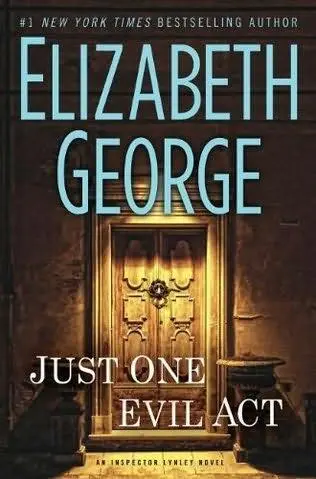
- Название:Just One Evil Act
- Автор:
- Издательство:Dutton
- Жанр:
- Год:2013
- ISBN:978-0-698-13828-5
- Рейтинг книги:5 / 5. Голосов: 1
-
Избранное:Добавить в избранное
- Отзывы:
-
Ваша оценка:
Just One Evil Act: краткое содержание, описание и аннотация
Предлагаем к чтению аннотацию, описание, краткое содержание или предисловие (зависит от того, что написал сам автор книги «Just One Evil Act»). Если вы не нашли необходимую информацию о книге — напишите в комментариях, мы постараемся отыскать её.
bestselling author Elizabeth George offers the latest in her Inspector Lynley series: a gripping child-in-danger story featuring fan favorite Barbara Havers. Detective Sergeant Barbara Havers is at a loss: The daughter of her friend Taymullah Azhar has been taken by her mother, and Barbara can't really help—Azhar had never married Angelina, and his name isn't on Hadiyyah's, their daughter's, birth certificate. He has no legal claim. Azhar and Barbara hire a private detective, but the trail goes cold.
Azhar is just beginning to accept his soul-crushing loss when Angelina reappears with shocking news: Hadiyyah is missing, kidnapped from an Italian marketplace. The Italian police are investigating, and the Yard won't get involved, until Barbara takes matters into her own hands. As she attempts to navigate the complicated waters of doing anything for the case against her superior's orders, her partner, Inspector Thomas Lynley, is dispatched to Italy as the liaison between the Italian police and Hadiyyah's distraught parents.
In time, both Barbara and Lynley discover that the case is far more complex than just a kidnapping, revealing secrets about Angelina; her new lover, Lorenzo; and even Azhar—secrets Barbara may not be willing to accept. With both her job and the life of a little girl on the line, Barbara must decide what matters most and how far she's willing to go to protect it.
Just One Evil Act — читать онлайн бесплатно полную книгу (весь текст) целиком
Ниже представлен текст книги, разбитый по страницам. Система сохранения места последней прочитанной страницы, позволяет с удобством читать онлайн бесплатно книгу «Just One Evil Act», без необходимости каждый раз заново искать на чём Вы остановились. Поставьте закладку, и сможете в любой момент перейти на страницу, на которой закончили чтение.
Интервал:
Закладка:
Lynley approached Lorenzo. Within the paddock, he saw, five donkeys stood, a male, two females, and two foals. They were grazing beneath an enormous mulberry tree, their tails swishing to ward off flies, feasting on the fresh, sweet growth of springtime grasses. They were handsome animals, all five of them. They looked well cared for.
Without preamble, Lorenzo told him that raising donkeys for sale was another way that he supported life at Fattoria di Santa Zita. The man who had just left the property had come to purchase one of the foals. A donkey, he said, was always useful to those who lived and made their money off the land.
Lynley didn’t think that the sale of one or two or twenty baby animals was going to go far in supporting everything about this particular fattoria that needed supporting, but instead of mentioning this, he asked about the old farmhouse and the work going on in, on, and around it.
This, Lorenzo told him, was being turned into rooms for letting to tourists who wished to experience life in the countryside by staying at one of Italy’s many agriturismi . Eventually, he added, they would have a swimming pool, terraces for sunbathing, and a tennis court.
“Big plans, then,” Lynley noted pleasantly. Big plans, of course, required big money.
Sì , there would always be plans for the fattoria , Lorenzo told him. And then he shifted gears entirely, saying to Lynley in English, “You must talk to her, Ispettore . Please, you must tell her to allow me to take her to the doctor in Lucca now.”
Lynley frowned. He switched to Italian, asking Mura, “Is Angelina ill?”
“ Venga ” was Lorenzo’s response, to which he added that Lynley could see for himself up at the villa. “All the day yesterday she has this sickness,” he said. “She keeps nothing inside. Not soup, not bread, not tea, not milk. She tells me not to worry because this is the pregnancy . She reminds me she has not been well from the first day of it. She says to me that this will pass. She says I worry because this is my first child but it is not her first child and I must be patient because she will be well soon enough. But how can I be patient when I see she is ill, when I believe she must visit a doctor, and when she believes she is not ill at all?”
They were walking up the sweeping loop of the villa’s formal drive as Lorenzo spoke. Lynley thought of his late wife’s pregnancy. She, too, had been ill for the first part of it. He, too, had been concerned. He told Lorenzo this, but the Italian man remained unconvinced.
Angelina was on the loggia. She was lying on a chaise longue with a blanket covering her. Next to her, a mosaic-topped metal table held a transparent jug of what appeared to be blood orange juice. A drinking glass stood next to this, but nothing had been poured into it. A plate sat near to this glass, its offering of a circle of biscuits, meat, fruit, and cheese all disregarded save for one very large strawberry out of which a single bite had been taken.
Lynley could understand why the Italian man was worried. Angelina looked weak. She smiled wanly as they crossed the loggia to her. “Inspector Lynley,” she murmured, as she struggled to sit upright. “You’ve caught me napping.” She searched his face. “Has there been word of something?”
Lorenzo strode to the table and inspected its rejected offerings. He said, “ Cara, devi mangiare e bere .” He poured orange juice into the glass and pressed it upon her.
“I did try, Renzo.” She indicated the single strawberry with its marking of a minuscule bite taken. “You’re worrying far too much. I’ll be fine with a little bit of rest.” And to Lynley, “Inspector, if there’s something—”
“She must to see a doctor,” Lorenzo said to Lynley. “She will not listen.”
Lynley said, “May I . . . ?” and indicated a wicker chair nearby.
“Of course,” she said. “Please.” And to Lorenzo, “Darling, stop being foolish. I’m not a buttercup. And I’m also not what matters just now. So do be quiet about doctors or leave us to talk because”—she took a breath to steady what she had to say, which she directed to Lynley—“you have word of something, I expect. Please tell me.”
Lynley glanced at Lorenzo, who’d flushed. He had not sat and now he walked to the rear of the loggia, where he stood behind the chaise longue with his arms crossed and his birthmark darkening noticeably.
Briefly, Lynley told Angelina of Carlo Casparia, of the “confession” extricated from the man by the public minister, and of Chief Inspector Lo Bianco’s doubts regarding this confession. He related the details of the search ongoing at the stables. He mentioned a possible sighting that had taken place in the Apuan Alps. He did not speak of a red convertible or of the exact nature of the sighting: a man leading a little girl into the woods. The first was something that needed to be held back from everyone. The second would only result in the woman’s terrified panic.
“The police are looking into this,” he told her in reference to the Alps. “In the meantime, the tabloids . . .” He showed her the front page of Prima Voce. He discovered they had not seen the paper that day as neither of them had been into town to purchase a newspaper and none were delivered to the fattoria . “It’s best, I daresay, to disregard all this. They have only limited information.”
Angelina was silent for a long moment during which the hammer blows from the old farmhouse sounded faintly. She finally said, “What does Hari think?” and behind her Lorenzo let out an exasperated breath. She said to him, “Renzo, please . . .”
“ Sì, sì ,” Mura said.
“He doesn’t know any of this yet,” Lynley told her, “unless he’s picked up the tabloid somewhere. He was already gone from the pensione when I came down to breakfast.”
“ Gone? ” This incredulously from Lorenzo.
“I expect he’s still putting up the missing-child handbills. It’s difficult for him—and for all of you, I know—just to be idle and have to wait for information.”
“ Inutile ,” Lorenzo said.
“Perhaps,” Lynley said. “But I’ve found that sometimes even an act that seems useless turns out to be the single action that breaks a case.”
“He won’t return to London till she’s found.” Angelina looked out at the lawn, although there was nothing on it to hold her attention. She quietly said, “I do so regret what I did. I just wanted to be free of him, but I knew . . . I’m sorry about everything.”
That desire to be free of other people, of life’s complexities, of the past that often clung to one like a ragtag group of mendicant children . . . This led people into the commission of acts that paved the way to remorse. But on the pathway to regret, the corpses of other people’s dreams often lay rotting. It was this that Lynley wished to talk about. But he wished to talk about it to Angelina alone, and not in the presence of her lover.
He said to Lorenzo, “I’d like a few minutes alone with Angelina, if you don’t mind, Signor Mura.”
Mura apparently did mind. He said, “We have no secrets from each other, Angelina and I. What you say to her can be said to me.”
“I understand that,” Lynley said. “But because of our previous conversation—yours and mine . . . ?” Let the man think that what he had to say to Angelina Upman involved her health and getting her to town to see a doctor, Lynley thought. Anything to have the Italian man remove himself for a few minutes of conversation that, he suspected, would only be entirely honest if Mura absented himself from it.
Читать дальшеИнтервал:
Закладка:
Похожие книги на «Just One Evil Act»
Представляем Вашему вниманию похожие книги на «Just One Evil Act» списком для выбора. Мы отобрали схожую по названию и смыслу литературу в надежде предоставить читателям больше вариантов отыскать новые, интересные, ещё непрочитанные произведения.









Обсуждение, отзывы о книге «Just One Evil Act» и просто собственные мнения читателей. Оставьте ваши комментарии, напишите, что Вы думаете о произведении, его смысле или главных героях. Укажите что конкретно понравилось, а что нет, и почему Вы так считаете.