Elizabeth George - Just One Evil Act
Здесь есть возможность читать онлайн «Elizabeth George - Just One Evil Act» весь текст электронной книги совершенно бесплатно (целиком полную версию без сокращений). В некоторых случаях можно слушать аудио, скачать через торрент в формате fb2 и присутствует краткое содержание. Год выпуска: 2013, ISBN: 2013, Издательство: Dutton, Жанр: Детектив, на английском языке. Описание произведения, (предисловие) а так же отзывы посетителей доступны на портале библиотеки ЛибКат.
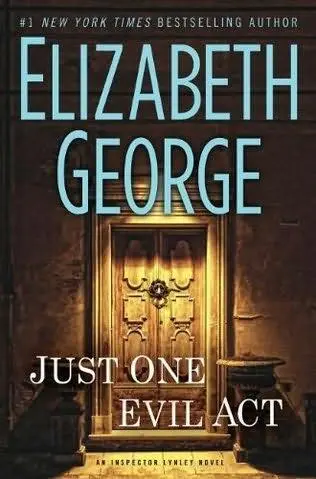
- Название:Just One Evil Act
- Автор:
- Издательство:Dutton
- Жанр:
- Год:2013
- ISBN:978-0-698-13828-5
- Рейтинг книги:5 / 5. Голосов: 1
-
Избранное:Добавить в избранное
- Отзывы:
-
Ваша оценка:
Just One Evil Act: краткое содержание, описание и аннотация
Предлагаем к чтению аннотацию, описание, краткое содержание или предисловие (зависит от того, что написал сам автор книги «Just One Evil Act»). Если вы не нашли необходимую информацию о книге — напишите в комментариях, мы постараемся отыскать её.
bestselling author Elizabeth George offers the latest in her Inspector Lynley series: a gripping child-in-danger story featuring fan favorite Barbara Havers. Detective Sergeant Barbara Havers is at a loss: The daughter of her friend Taymullah Azhar has been taken by her mother, and Barbara can't really help—Azhar had never married Angelina, and his name isn't on Hadiyyah's, their daughter's, birth certificate. He has no legal claim. Azhar and Barbara hire a private detective, but the trail goes cold.
Azhar is just beginning to accept his soul-crushing loss when Angelina reappears with shocking news: Hadiyyah is missing, kidnapped from an Italian marketplace. The Italian police are investigating, and the Yard won't get involved, until Barbara takes matters into her own hands. As she attempts to navigate the complicated waters of doing anything for the case against her superior's orders, her partner, Inspector Thomas Lynley, is dispatched to Italy as the liaison between the Italian police and Hadiyyah's distraught parents.
In time, both Barbara and Lynley discover that the case is far more complex than just a kidnapping, revealing secrets about Angelina; her new lover, Lorenzo; and even Azhar—secrets Barbara may not be willing to accept. With both her job and the life of a little girl on the line, Barbara must decide what matters most and how far she's willing to go to protect it.
Just One Evil Act — читать онлайн бесплатно полную книгу (весь текст) целиком
Ниже представлен текст книги, разбитый по страницам. Система сохранения места последней прочитанной страницы, позволяет с удобством читать онлайн бесплатно книгу «Just One Evil Act», без необходимости каждый раз заново искать на чём Вы остановились. Поставьте закладку, и сможете в любой момент перейти на страницу, на которой закончили чтение.
Интервал:
Закладка:
Safe from scrutiny they needed to be, he thought sardonically, considering what his employer looked like. For never had vanity led a man to such stupidity in the area of his personal appearance as it had led Michelangelo Di Massimo.
Di Massimo was already there, waiting. As promised, he was the only person in the room with the restored affreschi , and from a bench in the centre of the room he was studying one of them—or at least pretending to do so—with a guidebook opened on his knee and a pair of half-moon reading glasses perched on the end of his nose. The professorial air they lent him was completely at odds with the rest of him: the bleached yellow hair, the black leather jacket, the leather pantaloni , the stiff black boots. No one would mistake him for a professor of anything or even for a student of anything. But then, no one would mistake him for what he was, either.
There was no point to hiding his approach, so he did nothing to stifle the sharp tap of his footsteps on the marble floor. He lowered himself onto the bench next to Di Massimo, and he gazed upon the fresco to which the other man was giving his rapt attention. He saw that Di Massimo was fixed upon his namesake. Sword in hand, Michael the Archangel was either driving someone out of paradise—at least he reckoned it was paradise—or he was welcoming someone into paradise. Who really cared? For he simply couldn’t work out what all the shouting was about when it came to the rescued affreschi in this place. They were faded and worn and in spots whatever they depicted was barely visible.
He wanted a cigarette. Either that or a woman. But the thought of women took him directly back to his wallow in the dirt with his half-mad cousin and he preferred not to think about that.
He couldn’t fathom what got into him whenever he saw Domenica. She’d been pretty enough once, but that time was long past and still when she was in his presence, he wanted to possess her, to show her . . . something. And what did that say about him, that he still wanted the madwoman after all this time?
Next to him on the bench, Michelangelo Di Massimo stirred. He snapped his guidebook closed and deposited it into a rucksack at his feet. From this he took a folded newspaper. He said, “The British police are now involved. Prima Voce has the story. There’s been a television appeal. You saw it?”
Of course he had not. In the evening when the telegiornale was broadcast, he was at his regular job at Ristorante Maestoso, unavailable to the television news. During his days, he was preoccupied with seducing the commesse in the fancier shops and boutiques in town in order to talk them into ringing up a pair of socks for him while they bagged a fine linen shirt instead. Thus he had no time for television or tabloids. Whatever he knew about this matter of searching for the missing child, he knew only from Di Massimo.
Di Massimo passed the copy of Prima Voce over to him. He scanned the story. Scotland Yard, a detective inspector in Lucca to act as liaison with the parents of the girl, more information about those parents, dismissive remarks about British policing from that idiot Fanucci, and a carefully worded statement from Chief Inspector Lo Bianco indicating cooperation between the two police forces. There was an accompanying photo of the English detective in conversation with Lo Bianco. They were in front of the questura in Lucca, Lo Bianco’s arms crossed on his chest and his head lowered as he listened to something the Englishman was saying to him.
He passed the tabloid back to Di Massimo. He felt rather irritated with him. He hated having his time wasted, and if he’d had to come from the centre of town to Campo dei Miracoli merely to see something that he could have seen by stopping at the nearest giornalaio and purchasing a copy of the newspaper, he was going to be more irritated still. Thus he gestured rudely at the paper and said, “ Allora? ” in a way that indicated his impatience. To underscore this, he got up and paced the distance to the farthest wall. “This cannot be a surprise to you, Michelangelo. She’s missing. She’s a child. She’s gone without a trace. She’s British.” The implication was obvious: Of course the English coppers were going to stick their fingers into this pie he and Di Massimo were baking. Had Di Massimo expected something less?
“Not the point,” Di Massimo said. “Sit down. I don’t want to raise my voice.”
He waited till his order had been complied with before he went on. “This man and Lo Bianco . . . they came to my calcio practice the other day.”
He felt a sudden shift in his equilibrium. “And they talked to you?” he asked.
Di Massimo shook his head. “They thought—I expect—that I did not see them. But this”—he tapped the side of his nose—“has a talent for knowing when the cops are present. They came, and they watched. Less than five minutes. Then they were gone.”
He felt a momentary surge of relief and said, “So you do not know—”
“ Aspetti. ” Di Massimo went on to say that the two men had come to see him on the previous day, interrupting his appointment with his parrucchiere in the midst of having his blond locks maintained.
“ Merda! ” This was the worst possible news. “How in God’s name did they find you?” he demanded. “First at calcio and then this other? How the hell did they find you?”
“How does not matter,” Di Massimo said.
“Of course it matters! If not to you, then to me. If they’re on to you . . . If they’ve found you already . . .” He felt panic rising. “You swore to me enough time had passed. You said that no one would connect you to this matter of the girl.” He thought rapidly, trying to see what other connections were possible for the police to make. For if they’d found Michelangelo Di Massimo within a week of the girl’s disappearance, how much longer would it be till they found him as well? “This has to be taken care of,” he said. “Now. Today. As soon as possible.”
“Which is why you and I are meeting, my friend,” Michelangelo told him. He looked at him levelly. “I find that it’s time. We’re clear on that, yes?”
He nodded once. “I know what to do.”
“Be hasty about doing it, then.”
FATTORIA DI SANTA ZITA
TUSCANY
Lynley wasn’t entirely honest with Lo Bianco about speaking to Lorenzo Mura. He also wanted to talk to Angelina. So with the chief inspector’s blessing on the matter, he drove out to the fattoria . It appeared to be a busy day at the place, with all evidence saying that, one way or another, life had to go on.
Workmen were crawling about the ancient farmhouse that was part of the property, some of them unloading tiles clearly meant for the roof, others of them carrying heavy boards into the structure, still others banging about inside the building with their hammers ringing in the air. At the winery, a young man was within, offering tastes of Lorenzo’s Chianti to five individuals whose bicycles and discarded rucksacks indicated a spring cycling tour through the verdant district. Lorenzo stood at the fence of a paddock not far beyond the tall hedge that separated the old villa from the business end of the fattoria. He was speaking there to a bearded, middle-aged man, and as Lynley approached them, he saw this individual take a white envelope from the back pocket of his jeans and pass it over to Lorenzo Mura.
They exchanged a few more words before the man nodded and walked to a pickup truck that was parked in front of the wrought-iron gates giving access to the driveway up to the villa. He got in this truck and in a moment had made a quick turn around and was heading out of the place. Lynley observed him as he passed. He’d put on dark glasses and the kind of wide-brimmed straw hat that shades one’s face from the sun. It was, thus, impossible to see any particulars of what he looked like aside from his beard, which was dark and thick.
Читать дальшеИнтервал:
Закладка:
Похожие книги на «Just One Evil Act»
Представляем Вашему вниманию похожие книги на «Just One Evil Act» списком для выбора. Мы отобрали схожую по названию и смыслу литературу в надежде предоставить читателям больше вариантов отыскать новые, интересные, ещё непрочитанные произведения.










Обсуждение, отзывы о книге «Just One Evil Act» и просто собственные мнения читателей. Оставьте ваши комментарии, напишите, что Вы думаете о произведении, его смысле или главных героях. Укажите что конкретно понравилось, а что нет, и почему Вы так считаете.