Elizabeth George - Just One Evil Act
Здесь есть возможность читать онлайн «Elizabeth George - Just One Evil Act» весь текст электронной книги совершенно бесплатно (целиком полную версию без сокращений). В некоторых случаях можно слушать аудио, скачать через торрент в формате fb2 и присутствует краткое содержание. Год выпуска: 2013, ISBN: 2013, Издательство: Dutton, Жанр: Детектив, на английском языке. Описание произведения, (предисловие) а так же отзывы посетителей доступны на портале библиотеки ЛибКат.
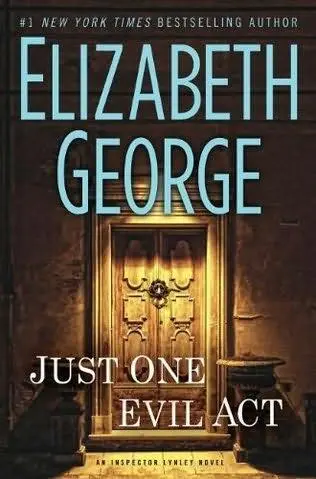
- Название:Just One Evil Act
- Автор:
- Издательство:Dutton
- Жанр:
- Год:2013
- ISBN:978-0-698-13828-5
- Рейтинг книги:5 / 5. Голосов: 1
-
Избранное:Добавить в избранное
- Отзывы:
-
Ваша оценка:
Just One Evil Act: краткое содержание, описание и аннотация
Предлагаем к чтению аннотацию, описание, краткое содержание или предисловие (зависит от того, что написал сам автор книги «Just One Evil Act»). Если вы не нашли необходимую информацию о книге — напишите в комментариях, мы постараемся отыскать её.
bestselling author Elizabeth George offers the latest in her Inspector Lynley series: a gripping child-in-danger story featuring fan favorite Barbara Havers. Detective Sergeant Barbara Havers is at a loss: The daughter of her friend Taymullah Azhar has been taken by her mother, and Barbara can't really help—Azhar had never married Angelina, and his name isn't on Hadiyyah's, their daughter's, birth certificate. He has no legal claim. Azhar and Barbara hire a private detective, but the trail goes cold.
Azhar is just beginning to accept his soul-crushing loss when Angelina reappears with shocking news: Hadiyyah is missing, kidnapped from an Italian marketplace. The Italian police are investigating, and the Yard won't get involved, until Barbara takes matters into her own hands. As she attempts to navigate the complicated waters of doing anything for the case against her superior's orders, her partner, Inspector Thomas Lynley, is dispatched to Italy as the liaison between the Italian police and Hadiyyah's distraught parents.
In time, both Barbara and Lynley discover that the case is far more complex than just a kidnapping, revealing secrets about Angelina; her new lover, Lorenzo; and even Azhar—secrets Barbara may not be willing to accept. With both her job and the life of a little girl on the line, Barbara must decide what matters most and how far she's willing to go to protect it.
Just One Evil Act — читать онлайн бесплатно полную книгу (весь текст) целиком
Ниже представлен текст книги, разбитый по страницам. Система сохранения места последней прочитанной страницы, позволяет с удобством читать онлайн бесплатно книгу «Just One Evil Act», без необходимости каждый раз заново искать на чём Вы остановились. Поставьте закладку, и сможете в любой момент перейти на страницу, на которой закончили чтение.
Интервал:
Закладка:
“That brings us back to the glass of wine. If you’ve time this evening, I’ll explain it to you. Have you the time?”
“Name the place and I’m there.”
She did so.
BELSIZE PARK
LONDON
The wine bar she suggested was in Regent’s Park Road, north of both Regent’s Park and Primrose Hill. It was situated rather unceremoniously between a newsagent’s and a kitchen shop, but its exterior position was deceptive. Inside, all was candlelight, velvet-draped windows, and linen-covered tables for two.
As the hour was still early and the place largely unoccupied, he saw Daidre at once. She was seated at a table tucked into a corner, where a painting on the wall either featured a modern look-alike to William Morris’s wife—God, what was her name? he wondered—or there was a Pre-Raphaelite extant that he wasn’t aware of. A light shone brightly upon the piece, giving Daidre sufficient illumination to inspect a set of papers she’d spread on the table. She was also speaking to someone on her mobile.
He paused before crossing the wine bar to join her, aware of experiencing a decided rush of pleasure at seeing Daidre again. He took a rare opportunity to study her without her knowledge, noting that she was wearing new spectacles—rimless and virtually unnoticeable—and that she was dressed for business in a tailored suit. The scarf she wore bore a mixture of colours that matched her sandy hair and, it was likely, her eyes as well, and it came to him that he and she could actually pass for brother and sister, so similar was their colouring.
As he approached, he saw other details. She was wearing a simple pendant necklace: its decoration a gold depiction of the wheelhouse of one of the Cornish mines from the area of her birth. She had gold studs in her ears as well, but they and the necklace comprised her only jewellery. Her hair was slightly longer now, reaching below her shoulders, and she was wearing it back from her face and fastened somehow on the back of her head. She was a handsome woman, but not a beautiful one. In a world of thin, young, airbrushed things on the covers of fashion magazines, she would not have garnered a second look.
She’d already ordered a glass of wine, but it seemed untouched. Instead, she was jotting notes on the margin of her paperwork, and as he reached the table, he heard her say into her mobile, “I’ll send it on to you then, shall I? . . . Hmm, yes. Well, I’ll wait for your word. And thank you, Mark. It’s very good of you.”
She glanced up then. She smiled at Lynley and held up a just-a-moment finger. She listened again to whatever was being said to her by whoever was on the other end of the mobile, and then, “Indeed. I depend on you,” and she rang off.
She stood to greet him, saying, “You’ve made it. It’s lovely to see you, Thomas. Thank you for coming.”
They engaged in air kisses: one cheek, then the other, with nothing touching anyone’s flesh. He asked himself idly where the maddening social nicety had come from.
He sat and tried not to notice what he noticed: that she quickly put all the paperwork into a large leather bag by the side of her chair, that a faint blush had risen to her cheeks, and that she was wearing something on her lips that made them look soft and glossy. Then it came to him suddenly that he was taking in aspects of Daidre Trahair that he hadn’t taken in, in the presence of a woman, since Helen’s death. Not even with Isabelle had he noted so much. It discomfited him, asking him to identify what it meant.
He wanted, of course, to ask who Mark was. But instead, he nodded at the large bag on the floor and said, “Work?” as he drew out a chair to sit.
She said, “Of a sort,” as she sat again herself. “You’re looking well, Thomas. Italy must suit you.”
“I daresay Italy suits most people,” he told her. “And Tuscany in particular suits everyone, I expect.”
“I’d like to see Tuscany someday,” she said. “I’ve not been.” And in less than a second and most typical of Daidre, “Sorry. That sounds as if I’m begging an invitation.”
“Perhaps coming from someone else,” he said. “Coming from you, no.”
“Why not from me?”
“Because I’ve got the impression that subterfuge isn’t part of your bag of tricks.”
“Well . . . yes. Admittedly, I have no bag of tricks.”
“Exactly,” he said.
“I ought, I suppose. But I’ve never quite had the time to develop tricks. Or to sew the bag for them. Or whatever. Are you having wine, Thomas? I’m drinking the house plonk. When it comes to wine, I’m hopeless. I doubt I could tell the difference between something from Burgundy and something made here in the cellar.” She twirled her wineglass by the stem and frowned. “I appear to be making the most disparaging remarks about myself. I must be nervous.”
“About?”
“As I was in complete order a moment ago, I must be feeling nervous with you here.”
“Ah,” he said. “Another glass of wine, perhaps?”
“Or two. Honestly, Thomas, I don’t know what’s wrong with me.”
A waitress came to them, a girl who had the look of a student and the accent of a recent arrival from the Eastern Bloc. He ordered wine for himself—the same plonk that Daidre was drinking—and when the girl took herself off to fetch it, he said, “Whether you’re nervous or not, I’m quite glad you rang me. Not only is it a fine thing to see you again, but frankly, I was in need of a drink.”
“Work?” she asked.
“Barbara Havers. I had an encounter with her that disturbed me rather more than I like to be disturbed by Barbara—and believe me she’s been disturbing me in one way or another for years—and getting thoroughly soused seems like a reasonable reaction to the entire mess she’s in. Either that or being diverted by your presence.”
Daidre took up her own wine but waited till he had been served his. They clinked glasses and drank to each other’s health, whereupon she said, “What sort of mess? It’s not my business, of course, but I’m available to listen should you have a mind to talk about it.”
“She’s gone her own maddening way in an investigation and not for the first time.”
“This is a problem?”
“She’s skirting far too close to ignoring her ethical responsibility as a police officer. It’s a complicated matter. Enough said on the subject. For the moment, I’d like to forget all about it. So tell me, then. What are you doing in London?”
“Interviewing for a job,” she said. “Regent’s Park. London Zoo.”
He found himself brightening, sitting up straighter all at once. Regent’s Park, the zoo . . . He had a thousand questions about what it all meant that Daidre Trahair was thinking of making a change from Bristol, but all he could manage was, stupidly, “As veterinarian?”
She smiled. “It is, more or less, what I do.”
He shook his head sharply. “Sorry. Stupid of me.”
She laughed. “Not at all. They might have wanted me to teach the gorillas to play chess or to train the parrots. One never knows.” She took more wine and gazed at him with something that looked to him like fondness. “I was contacted by a head hunter, someone employed by the zoo. I didn’t seek the position out, and I’m not altogether sure I’m interested in it.”
“Because . . . ?”
“I’m quite happy in Bristol. And, of course, Bristol is that much closer to Cornwall and I do love my cottage there.”
“Ah, yes, the cottage,” Lynley said. It was where they had first met, himself an intruder who’d broken a window to get to a phone, herself the owner of the place who’d arrived for a getaway only to find an unknown man tramping mud on her floors.
“And then, there’s my commitment to Boadicea’s Broads as well as my regular darts tournaments.”
Читать дальшеИнтервал:
Закладка:
Похожие книги на «Just One Evil Act»
Представляем Вашему вниманию похожие книги на «Just One Evil Act» списком для выбора. Мы отобрали схожую по названию и смыслу литературу в надежде предоставить читателям больше вариантов отыскать новые, интересные, ещё непрочитанные произведения.










Обсуждение, отзывы о книге «Just One Evil Act» и просто собственные мнения читателей. Оставьте ваши комментарии, напишите, что Вы думаете о произведении, его смысле или главных героях. Укажите что конкретно понравилось, а что нет, и почему Вы так считаете.