Elizabeth George - Just One Evil Act
Здесь есть возможность читать онлайн «Elizabeth George - Just One Evil Act» весь текст электронной книги совершенно бесплатно (целиком полную версию без сокращений). В некоторых случаях можно слушать аудио, скачать через торрент в формате fb2 и присутствует краткое содержание. Год выпуска: 2013, ISBN: 2013, Издательство: Dutton, Жанр: Детектив, на английском языке. Описание произведения, (предисловие) а так же отзывы посетителей доступны на портале библиотеки ЛибКат.
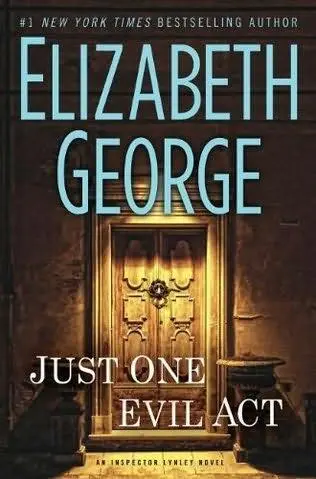
- Название:Just One Evil Act
- Автор:
- Издательство:Dutton
- Жанр:
- Год:2013
- ISBN:978-0-698-13828-5
- Рейтинг книги:5 / 5. Голосов: 1
-
Избранное:Добавить в избранное
- Отзывы:
-
Ваша оценка:
Just One Evil Act: краткое содержание, описание и аннотация
Предлагаем к чтению аннотацию, описание, краткое содержание или предисловие (зависит от того, что написал сам автор книги «Just One Evil Act»). Если вы не нашли необходимую информацию о книге — напишите в комментариях, мы постараемся отыскать её.
bestselling author Elizabeth George offers the latest in her Inspector Lynley series: a gripping child-in-danger story featuring fan favorite Barbara Havers. Detective Sergeant Barbara Havers is at a loss: The daughter of her friend Taymullah Azhar has been taken by her mother, and Barbara can't really help—Azhar had never married Angelina, and his name isn't on Hadiyyah's, their daughter's, birth certificate. He has no legal claim. Azhar and Barbara hire a private detective, but the trail goes cold.
Azhar is just beginning to accept his soul-crushing loss when Angelina reappears with shocking news: Hadiyyah is missing, kidnapped from an Italian marketplace. The Italian police are investigating, and the Yard won't get involved, until Barbara takes matters into her own hands. As she attempts to navigate the complicated waters of doing anything for the case against her superior's orders, her partner, Inspector Thomas Lynley, is dispatched to Italy as the liaison between the Italian police and Hadiyyah's distraught parents.
In time, both Barbara and Lynley discover that the case is far more complex than just a kidnapping, revealing secrets about Angelina; her new lover, Lorenzo; and even Azhar—secrets Barbara may not be willing to accept. With both her job and the life of a little girl on the line, Barbara must decide what matters most and how far she's willing to go to protect it.
Just One Evil Act — читать онлайн бесплатно полную книгу (весь текст) целиком
Ниже представлен текст книги, разбитый по страницам. Система сохранения места последней прочитанной страницы, позволяет с удобством читать онлайн бесплатно книгу «Just One Evil Act», без необходимости каждый раз заново искать на чём Вы остановились. Поставьте закладку, и сможете в любой момент перейти на страницу, на которой закончили чтение.
Интервал:
Закладка:
“Get me your final written report then, Barbara,” Isabelle said. “You as well, Thomas.” And she signalled an end to their meeting by gesturing towards the door.
Before Lynley could follow Barbara through it, though, Isabelle said his name once again. He turned and she lifted a finger that told him to stay where he was. A nod instructed him to shut the door.
He returned to the seat he’d taken. He watched the detective superintendent. He’d come to know how expert she was at hiding things—particularly the workings of her mind and her heart—so he waited to hear what she wished to say, knowing how unlikely was the possibility that he could guess it in advance.
She pulled open the bottom drawer of her desk. He took a sharp breath. Isabelle was a drinker, and she knew he knew this. She believed she had the problem under control. He did not. She was aware of his belief, but she was also aware of the tacit understanding between them: He would not betray her as long as she kept her drinking away from Victoria Street and away from the job should the job take her elsewhere. He could see the slight tremor in her hands, however, and he said her name.
She shot him a look. “I’m not entirely stupid, Tommy. I have things under control” was her expected remark. Instead of a bottle, she brought out of the drawer a folded tabloid, which she opened, smoothed, and began to flip through.
He could see it was The Source , the most scurrilous of the London rags. He felt wary when he considered the implications behind Isabelle’s having stowed it in her desk as well as her dismissal of Barbara Havers and her indication that she wished to speak to him alone. These were unfortunate signs. They transformed themselves into ill realities when she found what she was looking for and turned the paper towards him so that he could see for himself what was causing her concern.
He reached in his jacket for his reading glasses, although the truth was that he didn’t need them, at least for the headline of the story: Love Rat Dad’s Ties to the Met spread across the top of pages four and five. Accompanying this was a photograph of Taymullah Azhar inset onto another, larger photograph of some sort of brouhaha in a London street. This involved a shouting teenage boy in a school uniform, an enraged man who appeared to be in his late sixties, a frightened-looking woman in a shalwar kameez and headscarf, and Barbara Havers. Havers was in the act of attempting to get the old man to release his hold on the boy; the headscarf woman was in the act of attempting to get the boy away from the man. The man himself was in the act of trying to stuff the boy into a car, its back door open and waiting for him.
Lynley scanned the story, which was typical of The Source . It bore a by-line that he knew only too well: Mitchell Corsico . It contained the breathless sort of writing that was The Source ’s stock-in-trade. This was of the hot-breaking-news variety in which the named reporter had uncovered a close connection between a detective sergeant from the Met and the Love Rat Dad whose daughter had recently been kidnapped in Italy. This female officer from the Met would be, gentle readers, a presence in the life of the Love Rat Dad in addition to the deserted wife in Ilford and the lover who had borne the man’s child. They live cheek by jowl, as it happens, in a north London neighbourhood where they keep separate residences on the very same property under the watchful eye of neighbours only too happy to express their opinions on the topic of the mild-mannered university professor and what was turning out to be a veritable stable of women willing to partner him.
The article followed the same pattern as so many stories featured in the daily tabloids. Their meat and potatoes had for generations consisted of destroying reputations. They built someone up one week as a hero or a sympathetic victim or a luck-struck winner of a national lottery or a grand success in the arts or an admirable self-made man . . . only to tear him down the next week when every slighted friend or colleague he had in his life crawled out of their personal rubbish tip to report “new facts” about him. Just to bring him down a few pegs, of course.
Lynley looked up when he completed his reading of the article. He wasn’t quite sure where to go with any remark he might make because he wasn’t quite sure what Isabelle knew about Barbara and Taymullah Azhar. Nor, he had to admit, was he.
She said, “What am I to make of this, Tommy?”
He took off his glasses and returned them to his jacket pocket. “It looks to me like an officer of the police coming to the aid of an adolescent boy being struck about the head by an older man.”
“Oh, I can see that. I can even tell myself that all this photo depicts is a moment in which DS Barbara Havers happened upon a conflict in the street and stepped in to sort it like the Good Samaritan we know her to be. I could do all that happily, but what prevents me is the fact that this adolescent boy is the son of Taymullah Azhar. Not to mention the fact that the older man is the father of Taymullah Azhar. I’m not to make a coincidence of that, am I, Tommy?”
“The picture could have a thousand and one interpretations, Isabelle, as can the article. Anyone reading it and looking at the picture can see that much.”
“Naturally. And one of those interpretations is that Barbara Havers may very well have a vested interest—a deeply personal and not an objective professional interest—in matters that should not concern someone involved in an investigation.”
“You can’t possibly think that Barbara—”
“I don’t know what the hell to think about Barbara,” Isabelle cut in sharply. “But I do know what I see with my eyes and I do know what I hear with my ears, and—”
“‘Hear’? From whom? What? About Barbara?” Lynley studied her for a moment before he went on. She watched him do so and she met his gaze steadily. He finally looked away from her and at the paper still spread on her desk.
Lynley knew she wasn’t a tabloid reader. He didn’t flatter himself in thinking he knew everything about her from the months they’d spent naked in each other’s beds, but he did know that much. She didn’t read tabloids. So how had this one fallen into her hands? He said, “Where did you get this?” with a gesture at the paper.
“That’s hardly as important as the ‘news’ it contains.”
Lynley glanced over his shoulder at the closed door and what lay beyond it. And then, quite simply, he knew. “John Stewart,” he said. “And now he’s waiting to see what you intend to do about her. While all along what you should be intending to do is something about John.”
“I plan to deal with John in due time, Tommy. Just now we’re dealing with the issue of Barbara.”
“There is no issue of Barbara. She may know Azhar, but as to there being the slightest indication of a romantic involvement, a physical involvement, any involvement between them other than simple friendship . . . It’s just not on, Isabelle.”
She considered this for a very long moment. Outside her office, the sounds of a typical day’s activities were ongoing. Someone called out for “a copy of that article on peat preservation Philip was going on about,” and a trolley rattled by. Inside her office, they engaged in a stare-down which Isabelle finally broke by speaking.
“Tommy, we all have blind spots,” she said.
“Barbara doesn’t,” he returned as firmly as he could. “Not in this matter.”
She looked infinitely sad when she dismissed him with the reply, “I’m not talking about Barbara, Inspector.”
VICTORIA
LONDON
He wasn’t as certain about Barbara Havers as his words had been. He wasn’t, in fact, certain about anything. For this reason, he read the activity reports Barbara had turned in during the time she’d worked on John Stewart’s team, and from there he went to spend ten minutes with Harry Streener in SO12. The fact that now two CID officers were interested in SO12’s concerns about one Taymullah Azhar gave Streener pause, but Lynley soothed him with a claim that loose ends were being tied up upon the request of Detective Superintendent Ardery and he was the bloke given the job of tying.
Читать дальшеИнтервал:
Закладка:
Похожие книги на «Just One Evil Act»
Представляем Вашему вниманию похожие книги на «Just One Evil Act» списком для выбора. Мы отобрали схожую по названию и смыслу литературу в надежде предоставить читателям больше вариантов отыскать новые, интересные, ещё непрочитанные произведения.










Обсуждение, отзывы о книге «Just One Evil Act» и просто собственные мнения читателей. Оставьте ваши комментарии, напишите, что Вы думаете о произведении, его смысле или главных героях. Укажите что конкретно понравилось, а что нет, и почему Вы так считаете.