Elizabeth George - Just One Evil Act
Здесь есть возможность читать онлайн «Elizabeth George - Just One Evil Act» весь текст электронной книги совершенно бесплатно (целиком полную версию без сокращений). В некоторых случаях можно слушать аудио, скачать через торрент в формате fb2 и присутствует краткое содержание. Год выпуска: 2013, ISBN: 2013, Издательство: Dutton, Жанр: Детектив, на английском языке. Описание произведения, (предисловие) а так же отзывы посетителей доступны на портале библиотеки ЛибКат.
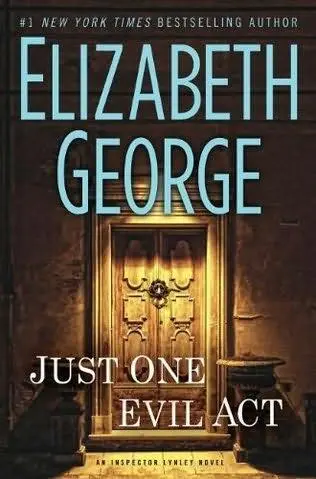
- Название:Just One Evil Act
- Автор:
- Издательство:Dutton
- Жанр:
- Год:2013
- ISBN:978-0-698-13828-5
- Рейтинг книги:5 / 5. Голосов: 1
-
Избранное:Добавить в избранное
- Отзывы:
-
Ваша оценка:
Just One Evil Act: краткое содержание, описание и аннотация
Предлагаем к чтению аннотацию, описание, краткое содержание или предисловие (зависит от того, что написал сам автор книги «Just One Evil Act»). Если вы не нашли необходимую информацию о книге — напишите в комментариях, мы постараемся отыскать её.
bestselling author Elizabeth George offers the latest in her Inspector Lynley series: a gripping child-in-danger story featuring fan favorite Barbara Havers. Detective Sergeant Barbara Havers is at a loss: The daughter of her friend Taymullah Azhar has been taken by her mother, and Barbara can't really help—Azhar had never married Angelina, and his name isn't on Hadiyyah's, their daughter's, birth certificate. He has no legal claim. Azhar and Barbara hire a private detective, but the trail goes cold.
Azhar is just beginning to accept his soul-crushing loss when Angelina reappears with shocking news: Hadiyyah is missing, kidnapped from an Italian marketplace. The Italian police are investigating, and the Yard won't get involved, until Barbara takes matters into her own hands. As she attempts to navigate the complicated waters of doing anything for the case against her superior's orders, her partner, Inspector Thomas Lynley, is dispatched to Italy as the liaison between the Italian police and Hadiyyah's distraught parents.
In time, both Barbara and Lynley discover that the case is far more complex than just a kidnapping, revealing secrets about Angelina; her new lover, Lorenzo; and even Azhar—secrets Barbara may not be willing to accept. With both her job and the life of a little girl on the line, Barbara must decide what matters most and how far she's willing to go to protect it.
Just One Evil Act — читать онлайн бесплатно полную книгу (весь текст) целиком
Ниже представлен текст книги, разбитый по страницам. Система сохранения места последней прочитанной страницы, позволяет с удобством читать онлайн бесплатно книгу «Just One Evil Act», без необходимости каждый раз заново искать на чём Вы остановились. Поставьте закладку, и сможете в любой момент перейти на страницу, на которой закончили чтение.
Интервал:
Закладка:
She looked round frantically for something to put on as a cover-up. She was wearing one of her sleeping tee-shirts, this one with a faded caricature of Keith Richards on it along with the words Forget His Money . . . I Want His Constitution written below it. She reached for her tattered chenille dressing gown but noticed as she tied its belt that she’d not laundered it since spilling tinned beef goulash down the front of it six weeks earlier. She threw it off and grabbed her mac from the wardrobe. It would have to do.
She drew the bedcovers over the disarray of sheets, pillows, and Tempest and Preston’s amorous difficulties. She hurried to the door.
She’d waited four days to talk to Azhar. Every evening, she’d arrived home from work and had immediately checked for his return from Italy. Every morning, she’d had to report to DI Lynley that he’d not yet come back to London. Every day, she’d had to repeat that she wanted to speak to Azhar face-to-face about everything that she’d uncovered concerning the kidnapping of his youngest child. And in response, Lynley’s reply had been unvarying: I want a report from you, Barbara, and I do not want to discover at some later date that Azhar’s been back since the evening of the first of May. She’d said passionately, I’m not lying to you. I wouldn’t lie to you. A raised aristocratic eyebrow told her exactly how seriously he took that claim.
When she swung the door open, it was to see Azhar standing hesitantly in the shadows. She flipped on the light above the front step, but it wasn’t helpful in the illumination department as it flashed brightly once like a bolt of lightning and then went dead. She said, “Oh, bloody hell,” and then, “Come in. How are you? How’s Hadiyyah? Are you only just back?”
She stepped away from the door, and he came into the light from the bungalow. He looked good, she thought. The relief he was feeling had to be enormous. She didn’t ask herself what the relief’s source was: having his daughter safe, having escaped Italy without anyone’s suspicions falling on him, or having a plan in place to spirit Hadiyyah to another country when the time was right. These things she shoved to the back of her mind. Not yet, she told herself.
He was carrying a plastic carrier bag, which he handed to her, saying, “I have brought you something from Italy. A very small way to say thank you for everything, Barbara. I am and have been so grateful to you.”
She took the bag from him and closed the door as he entered. He’d brought her olive oil and balsamic vinegar. She’d not the slightest clue what to do with the former—perhaps a Mediterranean fry-up? she thought—but she reckoned the latter would be smashing on chips. She said, “Ta, Azhar. Sit, sit,” and she went to the kitchen area and put on the kettle.
He was looking at her bed, at the light on next to it, at the cup of Ovaltine next to the light. He said, “You were in bed. Indeed, I thought you might be because of the hour, but I wanted to . . . Yet I probably should not have—”
“You should have,” she told him. “And I wasn’t asleep. I was reading.” She hoped he didn’t ask what she was reading because she’d have to lie and tell him Proust. Or perhaps The Gulag Archipelago . That would go down a real treat.
She brought out the PG Tips, a bowl of sugar—from which she removed the clotted evidence of a wet spoon having been dipped into it with rather too much regularity—and a jug of milk. She took mugs from a shelf and bustled round like the owner of a third-rate B & B accommodating a late-night arrival. Jaffa Cakes on a plate, two paper napkins, two spoons, then a “whoops” and a replacement for one of them when she saw it was dirty . . . Back and forth from the kitchen to the table she went until there was nothing left but to pour the water over the tea bags and sit and talk to this man whom she knew and did not know all at once.
He watched her solemnly. He knew something was up. He said nothing at first.
Then his initial statement: “Inspector Lynley will have told you the details.”
“Most of them, yeah,” Barbara said. “I would have rung you to get the rest of them, but I reckoned you had a lot to cope with. With Hadiyyah, with Angelina and Lorenzo. With the coppers as well, I expect.” She watched his face as she said this last, but he was busying himself with the tea, much dunking of the tea bag and then a questioning look as to where he was supposed to put it. She fetched an ashtray for the bag. She fetched her fags as well. She offered him one but he demurred and she found she didn’t feel much like a smoke either.
He said, “There was much to discuss. The nightmare has, I believe, finally ended.”
“Which means what exactly?”
He stirred his tea. He’d used sugar but no milk. Barbara saw to hers and waited for his answer. She found that nerves were making her suddenly ravenous. She grabbed up a Jaffa Cake and shoved it into her mouth.
“Not that Hadiyyah is restored to me,” he said, “but that she will come to me and I may go to her—to Lucca—as often as I like. I need only ring Angelina first. I believe it took this . . . this loss of Hadiyyah to allow Angelina to see that to either parent, the loss of a child cannot be contemplated, let alone endured. I think she did not realise this, Barbara.”
“Bollocks. She has to have known that.”
“I think not. She wanted Hadiyyah with her. She wanted Lorenzo and the life she now is making with him. She knew no other way to achieve this. She is not, at heart, an evil woman.”
“She’s capable of evil,” Barbara noted.
“Perhaps we all are,” Azhar said quietly.
It was as good an entrée as she was going to get. She said, “Where do things stand between you now, Azhar? Between you and Angelina?”
“We have an uneasy peace. I hope that trust might develop between us in time. There has been little enough of that in the past.”
“Trust,” she noted. “Always important in relationships, isn’t it?”
He didn’t reply. He was looking at his tea. She said his name questioningly. He looked up then, and when their gazes met, she tried to read his dark eyes for something—anything—that would tell her he hadn’t used her in the worst possible way, putting everything she was and everything she had in jeopardy. She saw nothing. His eyes looked peculiarly flat, and she tried to tell herself their lack of depth was owing to the overhead light.
She forged ahead. “Dwayne Doughty was someone you shouldn’t have trusted, Azhar. I’m partly responsible, I reckon, because I took you to him. I checked him out, and he seemed completely on the up-and-up. He probably is in a lot of ways, long as what he’s asked to do is perfectly in order and on the up-and-up as well. When it isn’t, though . . . ? When something tempts him . . . ? He protects himself. I expect you didn’t know that, did you?”
Still he said nothing. But he reached for her packet of Players and he lit one and she could see that his hand wasn’t steady. So could he. He glanced at her as he shook the match out. He waited. Good move on his part, she thought.
She said, “Doughty’s office is wired. Both for film and for sound. In his line of work, it’s not a bad idea when you think of it. And I should have thought of it. Or perhaps you should have.” She lit a cigarette herself. She saw that her own hands were none too steady. “So every meeting you and I had with him is documented, backed up, signed, sealed, and whatever. So is every meeting you had with him alone. ’Course, I don’t know how many there were—those you-and-him meetings—’cause he only showed me two. But then, two was all it took, Azhar.”
Читать дальшеИнтервал:
Закладка:
Похожие книги на «Just One Evil Act»
Представляем Вашему вниманию похожие книги на «Just One Evil Act» списком для выбора. Мы отобрали схожую по названию и смыслу литературу в надежде предоставить читателям больше вариантов отыскать новые, интересные, ещё непрочитанные произведения.










Обсуждение, отзывы о книге «Just One Evil Act» и просто собственные мнения читателей. Оставьте ваши комментарии, напишите, что Вы думаете о произведении, его смысле или главных героях. Укажите что конкретно понравилось, а что нет, и почему Вы так считаете.