William Trevor - After Rain
Здесь есть возможность читать онлайн «William Trevor - After Rain» весь текст электронной книги совершенно бесплатно (целиком полную версию без сокращений). В некоторых случаях можно слушать аудио, скачать через торрент в формате fb2 и присутствует краткое содержание. Год выпуска: 0101, Жанр: Старинная литература, на английском языке. Описание произведения, (предисловие) а так же отзывы посетителей доступны на портале библиотеки ЛибКат.
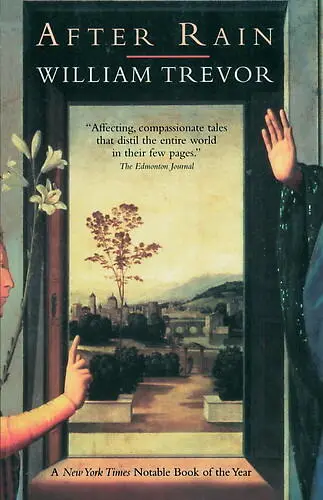
- Название:After Rain
- Автор:
- Жанр:
- Год:0101
- ISBN:нет данных
- Рейтинг книги:3 / 5. Голосов: 1
-
Избранное:Добавить в избранное
- Отзывы:
-
Ваша оценка:
After Rain: краткое содержание, описание и аннотация
Предлагаем к чтению аннотацию, описание, краткое содержание или предисловие (зависит от того, что написал сам автор книги «After Rain»). Если вы не нашли необходимую информацию о книге — напишите в комментариях, мы постараемся отыскать её.
After Rain — читать онлайн бесплатно полную книгу (весь текст) целиком
Ниже представлен текст книги, разбитый по страницам. Система сохранения места последней прочитанной страницы, позволяет с удобством читать онлайн бесплатно книгу «After Rain», без необходимости каждый раз заново искать на чём Вы остановились. Поставьте закладку, и сможете в любой момент перейти на страницу, на которой закончили чтение.
Интервал:
Закладка:
‘Have sense, for God’s sake,’ he crossly urged, his voice thick with the bluster that obscured his confusion.
‘You’ve done enough damage, Ellie,’ her mother said, all the colour gone from her thin face. ‘You’ve brought enough on us.’
When Mulreavy came into the kitchen an hour later he guessed at what had been said, but he did not add anything himself. He sat down to wait for his food to be placed in front of him. It was the first time since the arrangement had been agreed upon that any reference to it had been made in the household.
‘That’s the end of it,’ Ellie’s mother laid down, the statement made as much for Mulreavy’s benefit as for Ellie’s. ‘We’ll hear no more of this.’
Ellie did not reply. That evening she told her child.
People knew, and talked about it now. What had occurred ten years ago suddenly had an excitement about it that did not fail to please. Minds were cast back, memories ransacked in a search for the name and appearance of the summer priest who had been and gone. Father Mooney, who had succeeded old Father Hanlon, spoke privately to Ellie, deploring the exposure she had ‘so lightly’ been responsible for.
With God’s grace, he pointed out, a rough and ready solution had been found and disgrace averted ten years ago. There should have been gratitude for that, not what had happened now. Ellie explained that every time she looked at her child she felt a stab of guilt because a deception of such magnitude had been perpetrated. ‘Her life was no more than a lie,’ Ellie said, but Father Mooney snappishly replied that that was not for her to say.
‘You flew in the face of things once,’ he fulminated, ‘and now you’ve done it again.’ When he glared at her. it showed in his expression that he considered her an unfit person to be in his parish. He ordered Hail Marys to be repeated, and penitence practised, with humility and further prayer.
But Ellie felt that a weight had been lifted from her, and she explained to her child that even if nothing was easy now, a time would come when the difficulties of the moment would all be gone.
Mulreavy suffered. His small possession of pride was bruised; he hardly had to think to know what people said. He went about his work in the fields, planting and harvesting, spreading muck and fertilizer, folding away cheques until he had a stack ready for lodgement in Moyleglass. The sour atmosphere in the farmhouse affected him, and he wondered if people knew, on top of everything else, that he occupied a bedroom on his own and always had, that he had never so much as embraced his wayward young bride. Grown heavier over the years, he became even heavier after her divulgence, eating more in his despondency.
He liked the child; he always had. The knowledge that a summer priest had fathered her caused him to like her no less, for the affection was rooted in him. And the child did not change in her attitude to him, but still ran to him at once when she returned from school, with tales of how the nuns had been that day, which one bad-tempered, which one sweet. He listened as he always had, always pausing in his work to throw in a word or two. He continued to tell brief stories of his past experiences on the road: he had traded in potatoes since he was hardly more than a child himself, fifteen when he first assisted his father.
But in the farmhouse Mulreavy became silent. In his morose mood he blamed not just the wife he’d married but her elders too. They had deceived him. And knowing more than he did about these things, they should have foreseen more than they had. The child bore his name. ‘Mrs. Mulreavy’ they called his wife. He was a laughing-stock.
‘I don’t remember that man,’ he said when almost a year had passed, a September morning. He had crossed the furrows to where she was picking potatoes from the clay he’d turned, the plough drawn by the tractor. ‘I don’t know did I ever see him.’
Ellie looked up at the dark-jowelled features, above the rough, thick neck. She knew which man he meant. She knew, as well, that it had required an effort to step down from his tractor and cross to where she was, to stand unloved in front of her. She said at once:
‘He was here only a summer.’
‘That would be it so. I was always travelling then.’
She gave the curate’s name and he nodded slowly over it, then shook his head. He’d never heard that name, he said.
The sun was hot on her shoulders and her arms. She might have pointed across the ploughed clay to the field that was next to the one they were in. It was there, below the slope, that the conception had taken place. She wanted to say so, but she didn’t. She said:
‘I had to tell her.’
He turned to go away, then changed his mind, and again looked down at her.
‘Yes,’ he said.
She watched him slowly returning to where he’d left the tractor. His movements were always slow, his gait suggesting an economy of energy, his arms loose at his sides. She mended his clothes, she kept them clean. She assisted him in the fields, she made his bed. In all the time she’d known him she had never wondered about him.
The tractor started. He looked behind to see that the plough was as he wanted it. He lit another cigarette before he set off on his next brief journey.
Lost Ground
On the afternoon of September 14th 1989, a Thursday, Milton Leeson was addressed by a woman in his father’s upper orchard. He was surprised. If the woman had been stealing the apples she could easily have dodged out of sight around the slope of the hill when she heard his footfall. Instead, she came forward to greet him, a lean-faced woman with straight black hair that seemed too young for her wasted features. Milton had never seen her before.
Afterwards he remembered that her coat, which did not seem entirely clean, was a shade of dark blue, even black. At her throat there was a scarf of some kind. She wasn’t carrying anything. If she’d been stealing the apples she might have left whatever contained her takings behind the upper orchard’s single growth of brambles, only yards from where she stood.
The woman came close to Milton, smiling at him with her eyes and parted lips. He asked her what she wanted; he asked her what she was doing in the orchard, but she didn’t reply. In spite of her benign expression he thought for a moment she was mad and intended to attack him. Instead, the smile on her lips increased and she raised her arms as if inviting him to step into her embrace. When Milton did not do so the woman came closer still. Her hands were slender, her fingers as frail as twigs. She kissed him and then turned and walked away.
Afterwards Milton recalled very thin calves beneath the hem of her dark coat, and narrow shoulders, and the luxuriant black hair that seemed more than ever not to belong. When she’d kissed him her lips hadn’t been moist like his mother’s. ‘They’d been dry as a bone, the touch of them so light he had scarcely felt it.
‘Well ?’ Mr. Leeson enquired that evening in the farmhouse kitchen.
Milton shook his head. In the upper orchard the Cox’s were always the first to ripen. Nobody expected them to be ready as soon as this, but just occasionally, after a sunny summer, the first of the crop could catch you out. Due to his encounter with the stranger, he had forgotten to see if an apple came off easily when he twisted it on the branch. But he had noticed that not many had fallen, and guessed he was safe in intimating that the crop was better left for a while yet. Shyness prevented him from reporting that there’d been a woman in the orchard; if she hadn’t come close to him, if she hadn’t touched his lips with hers, it would have been different.
Milton was not yet sixteen. He was chunky, like his father and his brothers, one of them much older, the other still a child. The good looks of the family had gone into the two girls, which Mrs. Leeson privately gave thanks for, believing that otherwise neither would have married well.
Читать дальшеИнтервал:
Закладка:
Похожие книги на «After Rain»
Представляем Вашему вниманию похожие книги на «After Rain» списком для выбора. Мы отобрали схожую по названию и смыслу литературу в надежде предоставить читателям больше вариантов отыскать новые, интересные, ещё непрочитанные произведения.




Обсуждение, отзывы о книге «After Rain» и просто собственные мнения читателей. Оставьте ваши комментарии, напишите, что Вы думаете о произведении, его смысле или главных героях. Укажите что конкретно понравилось, а что нет, и почему Вы так считаете.