William Trevor - After Rain
Здесь есть возможность читать онлайн «William Trevor - After Rain» весь текст электронной книги совершенно бесплатно (целиком полную версию без сокращений). В некоторых случаях можно слушать аудио, скачать через торрент в формате fb2 и присутствует краткое содержание. Год выпуска: 0101, Жанр: Старинная литература, на английском языке. Описание произведения, (предисловие) а так же отзывы посетителей доступны на портале библиотеки ЛибКат.
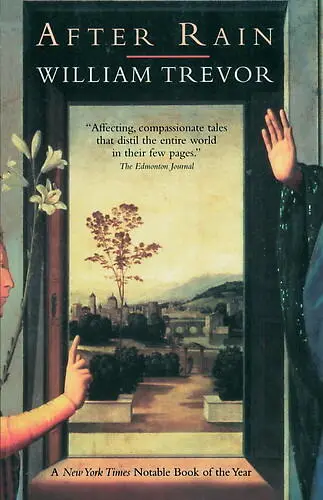
- Название:After Rain
- Автор:
- Жанр:
- Год:0101
- ISBN:нет данных
- Рейтинг книги:3 / 5. Голосов: 1
-
Избранное:Добавить в избранное
- Отзывы:
-
Ваша оценка:
After Rain: краткое содержание, описание и аннотация
Предлагаем к чтению аннотацию, описание, краткое содержание или предисловие (зависит от того, что написал сам автор книги «After Rain»). Если вы не нашли необходимую информацию о книге — напишите в комментариях, мы постараемся отыскать её.
After Rain — читать онлайн бесплатно полную книгу (весь текст) целиком
Ниже представлен текст книги, разбитый по страницам. Система сохранения места последней прочитанной страницы, позволяет с удобством читать онлайн бесплатно книгу «After Rain», без необходимости каждый раз заново искать на чём Вы остановились. Поставьте закладку, и сможете в любой момент перейти на страницу, на которой закончили чтение.
Интервал:
Закладка:
Ellie accepted with equanimity what there was. She lived a little in the past, in the summer of her love affair, expecting of the future only what she knew of the present. The summer curate who had loved her, and whom she loved still, would not miraculously return. He did not even know that she had given life to his child. ‘It can’t be,’ he’d said when they lay in the meadow that was now a potato field. ‘It can’t ever be, Ellie.’ She knew it couldn’t be: a priest was a priest. There would never, he promised, as if in compensation, be another love like this in all his life. ‘Nor for me,’ she swore as eagerly, although he did not ask for that, in fact said no, that she must live her normal life. ‘No, not for me,’ she repeated. ‘I feel it too.’ It was like a gift when she knew her child was to be born, a fulfilment, a forgiveness almost for their summer sin.
As months and then years went by, the child walked and spoke and suffered childhood ills, developed preferences, acquired characteristics that slipped away again or stubbornly remained. Ellie watched her mother and her uncle ageing, while they in turn were reminded by the child’s presence of their own uneasy companionship in the farmhouse when they were as young as the child was now. Mulreavy, who did not go in for nostalgia or observing changes in other people, increased his potato yield. Like Mr. Larrissey, he would have preferred the child who had been born to be a boy since a boy, later on, would be more useful, but he did not ever complain on this count. Mr. Larrissey himself worked less, in winter often spending days sitting in the kitchen, warm by the Esse stove. For Ellie’s mother, passing time did not alter her belief that the bought husband was her daughter’s reprimand on earth.
All that was how things were on the farm and in the farmhouse. A net of compromise and acceptance and making the best of things held the household together. Only the child was aware of nothing, neither that a man had been bought to be her father nor that her great-uncle had benefited by the circumstances, nor that her grandmother had come to terms with a punishment, nor that her mother still kept faith with an improper summer love. The child’s world when she was ten had more to do with reading whole pages more swiftly than she had a year ago, and knowing where Heligoland was, and reciting by heart The Wreck of the Hesperus.
But, without warning, the household was disturbed. Ellie was aware only of some inner restlessness, its source not identified, which she assumed would pass. But it did not pass, and instead acquired the intensity of unease: what had been satisfactory for the first ten years of her child’s life was strangely not so now. In search of illumination, she pondered all that had occurred. She had been right not to wish to walk the roads with her fatherless infant, she had been right to agree to the proposal put to her: looking back, she could not see that she should, in any way whatsoever, have done otherwise. A secret had been kept; there were no regrets. It was an emotion quite unlike regret that assailed her. Her child smiled back at her from a child’s innocence, and she remembered those same features, less sure and less defined, when they were newly in the farmhouse, and wondered how they would be when another ten years had passed. Not knowing now, her child would never know. She would never know that her birth had been accompanied by money changing hands. She would never know that, somewhere else, her father forgave the sins of other people, and offered Our Saviour’s blood and flesh in solemn expiation.
‘Can you manage them?’ Ellie’s husband asked when she was loading sacks on to the weighing scales, for she had paused in the work as if to rest.
‘I’m all right.’
‘Take care you don’t strain yourself.’
He was often kind in practical ways. She was strong, but the work was not a woman’s work and, although it was never said, he was aware of this. In the years of their marriage they had never quarrelled or even disagreed, not being close enough for that, and in this way their relationship reflected that of the brother and sister they shared the house with.
‘They’re a good size, the Kerrs,’ he said, referring to the produce they worked with. ‘We hit it right this year.’
‘They’re nice all right.’
She had loved her child’s father for every day of their child’s life and before it. She had falsified her confessions and a holy baptism. Black, ugly lies were there when their child smiled from her innocence, nails in another cross. It hadn’t mattered at first, when their child wouldn’t have understood.
‘I’ll stop now,’ Ellie said, recording in the scales book the number of sacks that were ready to be sealed. ‘I have the tea to get.’
Her mother was unwell, confined to her bedroom. It was usually her mother who attended to the meals.
‘Go on so, Ellie,’ he said. He still smoked forty cigarettes a day, his life’s indulgence, a way to spend a fraction of the money he accumulated. He had bought no clothes since his purchase of the christening suit except for a couple of shirts, and he questioned the necessity of the clothes Ellie acquired herself or for her child. Meanness was a quality he was known for; commercially, it had assisted him.
‘Oh, I got up,’ Ellie’s mother said in the kitchen, the table laid and the meal in the process of preparation. ‘I couldn’t lie there.’
‘You’re better?’
‘I’d say I was getting that way’
Mr. Larrissey was washing traces of fertilizer from his hands at the sink, roughly rubbing in soap. From the yard came the cries of the child, addressing the man she took to be her father as she returned from her evening task of ensuring that the bullocks still had grass to eat.
All the love there had been, all the love there still was - love that might have nourished Ellie’s child, that might have warmed her - was the deprivation the child suffered. Ellie remembered the gentle, pale hands of the lover who had given her the gift of her child, and heard again the whisper of his voice, and his lips lingered softly on hers. She saw him as she always now imagined him, in his cassock and his surplice, the embroidered cross that marked his calling repeated again in the gestures of his blessing. His eyes were still a shade of slate, his features retained their delicacy. Why should a child not have some vision of him too? Why should there be falsity?
‘You’ve spoken to them, have you?’ her husband asked when she said what she intended.
‘No, only you.’
‘I wouldn’t want the girl told.’
He turned away in the potato shed, to heft a sack on to the lorry. She felt uneasy in herself, she said, the way things were, and felt that more and more. That feeling wasn’t there without a reason. It was a feeling she was aware of most at Mass and when she prayed at night.
Mulreavy didn’t reply. He had never known the identity of the father. Some runaway fellow, he had been told at the time by Mr. Larrissey, who had always considered the shame greater because a priest was involved. ‘No need Mulreavy should know that,’ Ellie had been instructed by her mother, and had abided by this wish.
‘It was never agreed,’ Mulreavy maintained, not pausing in his loading. ‘It wasn’t agreed the girl would know.’
Ellie spoke of a priest then; her husband said nothing. He finished with the potato sacks and lit a cigarette. That was a shocking thing, he eventually remarked, and lumbered out of the barn.
‘Are you mad, girl?’ Her mother rounded on her in the kitchen, turning from the draining-board, where she was shredding cabbage. Mr. Larrissey, who was present also, told her not to be a fool. What good in the world would it do to tell a child the like of that?
Читать дальшеИнтервал:
Закладка:
Похожие книги на «After Rain»
Представляем Вашему вниманию похожие книги на «After Rain» списком для выбора. Мы отобрали схожую по названию и смыслу литературу в надежде предоставить читателям больше вариантов отыскать новые, интересные, ещё непрочитанные произведения.




Обсуждение, отзывы о книге «After Rain» и просто собственные мнения читателей. Оставьте ваши комментарии, напишите, что Вы думаете о произведении, его смысле или главных героях. Укажите что конкретно понравилось, а что нет, и почему Вы так считаете.