William Trevor - After Rain
Здесь есть возможность читать онлайн «William Trevor - After Rain» весь текст электронной книги совершенно бесплатно (целиком полную версию без сокращений). В некоторых случаях можно слушать аудио, скачать через торрент в формате fb2 и присутствует краткое содержание. Год выпуска: 0101, Жанр: Старинная литература, на английском языке. Описание произведения, (предисловие) а так же отзывы посетителей доступны на портале библиотеки ЛибКат.
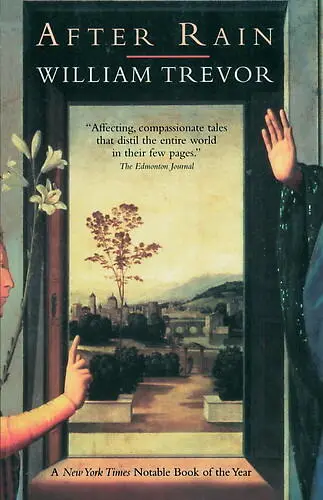
- Название:After Rain
- Автор:
- Жанр:
- Год:0101
- ISBN:нет данных
- Рейтинг книги:3 / 5. Голосов: 1
-
Избранное:Добавить в избранное
- Отзывы:
-
Ваша оценка:
After Rain: краткое содержание, описание и аннотация
Предлагаем к чтению аннотацию, описание, краткое содержание или предисловие (зависит от того, что написал сам автор книги «After Rain»). Если вы не нашли необходимую информацию о книге — напишите в комментариях, мы постараемся отыскать её.
After Rain — читать онлайн бесплатно полную книгу (весь текст) целиком
Ниже представлен текст книги, разбитый по страницам. Система сохранения места последней прочитанной страницы, позволяет с удобством читать онлайн бесплатно книгу «After Rain», без необходимости каждый раз заново искать на чём Вы остановились. Поставьте закладку, и сможете в любой момент перейти на страницу, на которой закончили чтение.
Интервал:
Закладка:
‘You didn’t go out again last night, did you, dear?’
‘Last night? It was tonight the poufta -’
‘No, I meant last night. You were back quite early, weren’t you?’
Headachy for no particular reason, she’d gone to bed after supper. But she’d heard him coming in, no later than a quarter-past nine, certainly no later than half-past. She’d fallen asleep about ten; she thought she remembered the sound of the television just before she dropped off.
‘The Big Sleep last night,’ he said. ‘But you can’t re-set a thing like that in England. It doesn’t make sense. A girl in the Kall Kwik was saying it was great, but I said I thought it was pathetic. I said it didn’t make any sense, interfering with an original like that. Silly of them to go interfering, I said.’
‘Yes.’
‘West Indian the girl was.’
Rosalie smiled and nodded.
‘Funny, saying it was great. Funny kind of view.’
‘Perhaps she didn’t know there’d been an original.’
‘I said. I explained about it. But she just kept saying it was great. They’re like that, the West Indian girls.’
Sometimes, when he went on talking, she felt like the shadow of a person who was not there. Ordinary-sounding statements he made exhausted her. Was it a deliberate act, that tonight he’d had a conversation with the police? Was it all part of being daring, of challenging the world that would take his rights from him? Often it seemed to her that his purposeless life was full of purpose.
‘I’ll make us tea,’ he said. ‘Really cold it is tonight.’
‘Not tea for me, dear.’
‘Chap in the Kall Kwik was saying the anti-freeze on his windscreen froze. If you can believe him, of course. Whopper Toms they call him. Says he likes the taste of paper. Eats paper bags, cardboard, anything like that. If you can believe him. Means no harm, though.’
‘No, I’m sure he doesn’t.’
‘Congenital. Pity, really. I mean, I’ve seen him chewing, always chewing he is. It’s just that it could be gum. Could be a toffee, come to that.’
Impassive she sat, staring at the grey empty screen of the television set when he went to make his tea. His father had found it impossible to love him, long before the marriage had collapsed. That had not been said either, but she knew it was true. For some reason he did not inspire love, even in a father. Yet it had broken her heart to say he should be retained in the centre where they’d studied him. It had broken her heart each time she’d begged that he should be put somewhere else, when they’d said the centre wasn’t suitable. Vigilance was his due, a vigilance she was herself unable, adequately, to supply. All she could do was listen to his rigmaroles, and care that he couldn’t bear wool next to his skin. The policemen he’d flagged down would have said he had a screw loose. In the Kall Kwik they would say the same.
‘You saw it to the end?’ she asked when he returned with a tray. ‘You saw that film to the end even though it was so silly?’
‘What film’s that?’
‘The Big Sleep.’
‘Really grotty it was.’
He turned the television on. Politicians discussed Romania. His features, coloured by the highlights from the screen, displayed no emotion, neither elation nor melancholy. He was meticulous about taking the drugs prescribed. ‘There is nothing to fear,’ she had been assured, ‘if the medication is taken. Nothing whatsoever.’
The time of the dance-hall fire she’d thought she’d never see him again. She’d thought he wouldn’t come back and that eventually there’d be questions, two and two put together. She had imagined waiting, and nothing happening, day after day; and then, in some unexpected place, his apprehension. Instead he returned.
‘Mr. Kipling’s Fancies,’ he said, offering her the iced cakes, still in their cardboard carton. When she shook her head he poured his tea.
‘Bet you it’s gum he chews,’ he said. ‘Bet you.’
If he’d gone out again last night she’d have heard the car starting. The car would have woken her. She’d have sat up, worrying. She’d have turned her bedside light on and waited to hear the car returning. Even if he’d left the house again almost as soon as he’d entered it he would have to have driven very fast to reach that part of London by five to ten, which was the time they gave; five to ten at the latest, since the girl had said goodnight to her friend at nine-fifty and only had seven hundred yards to walk. There was nothing unusual about his bringing back the Evening Standard. He’d mentioned the old homosexual who bothered him before: it just happened that tonight there was a police car prowling.
‘This is lousy stuff,’ he said, and changed the television channel. His hands were thin — delicate hands, not much larger than her own. He was not given to violence. ‘No! No!’ he used to cry, still sometimes did, when she swatted a fly. In all his acts of bravado there had never been violence — when he refused to open his schoolbooks, when he spent a night in a basement, when he acquired a motor-car without money. No one would deny his cleverness, cunningly concealed beneath his tedious chatter. No one would deny being baffled by him, but there was never violence.
‘Hey, look at that,’ he suddenly exclaimed, drawing her attention to overweight people at a holiday camp for the obese. He laughed, and she remembered his infant’s face when first they showed it to her. People didn’t want him. His father and a whole army of medical people, the social worker, people he tried to make friends with: all of them deserted him too soon. He was on sufferance in the architect’s office; wherever he went he was on sufferance.
‘Awful,’ he said, ‘as fat as that.’
Then the News was on again, on Channel 3, and he sat silent - that awful silence that closed him down. On the screen the face of Carol Dickson was just as it was in the newspaper. Her mother broke down, the police inspector gave out his facts: all of it was repetition.
She watched him staring at the screen intently, as if mesmerized. He listened carefully. When the News was over he crossed the room and picked up the Evening Standard. He read it, his tea and cakes forgotten. She turned the television off.
‘Goodnight, Gilbert,’ she said when he rose to go to bed. He did not answer.
The newspaper was on the floor beside his chair, the face of Carol Dickson spread out for her, the right way up. She remembered how he’d stood when he’d come back after his first disappearance, how he leaned against the kitchen door-frame, following her with his eyes, silent. When he’d come back with the Skoda she’d thought of going to the police. She’d thought of trying to explain to some kindly older man in a uniform, asking for help. But of course she hadn’t.
She might dial 999 now. Or she might go tomorrow to a police station, apologizing even before she began, hoping for reassurance. But even as these thoughts occurred she knew they were pretence. Before his birth she had possessed him. She had felt the tug of his lips on her breasts, a helpless creature then, growing into the one who controlled her now, who made her isolation total. Her fear made him a person, enriching him with power. He had sensed it when he had first idly examined the palms of his hands, and felt her mother’s instinct disturbed. He had sensed it when he had hidden the kitchen objects where they could not be found, when he had not come back from school, when he had talked to the social worker about photocopying. He knew about the jaded thoughts recurring, the worry coursing round and round at its slow, familiar pace. The Skoda had been stolen; parked outside the house, it was always a reminder.
Читать дальшеИнтервал:
Закладка:
Похожие книги на «After Rain»
Представляем Вашему вниманию похожие книги на «After Rain» списком для выбора. Мы отобрали схожую по названию и смыслу литературу в надежде предоставить читателям больше вариантов отыскать новые, интересные, ещё непрочитанные произведения.



Обсуждение, отзывы о книге «After Rain» и просто собственные мнения читателей. Оставьте ваши комментарии, напишите, что Вы думаете о произведении, его смысле или главных героях. Укажите что конкретно понравилось, а что нет, и почему Вы так считаете.