William Trevor - After Rain
Здесь есть возможность читать онлайн «William Trevor - After Rain» весь текст электронной книги совершенно бесплатно (целиком полную версию без сокращений). В некоторых случаях можно слушать аудио, скачать через торрент в формате fb2 и присутствует краткое содержание. Год выпуска: 0101, Жанр: Старинная литература, на английском языке. Описание произведения, (предисловие) а так же отзывы посетителей доступны на портале библиотеки ЛибКат.
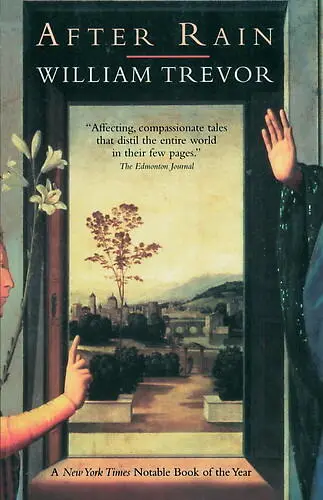
- Название:After Rain
- Автор:
- Жанр:
- Год:0101
- ISBN:нет данных
- Рейтинг книги:3 / 5. Голосов: 1
-
Избранное:Добавить в избранное
- Отзывы:
-
Ваша оценка:
After Rain: краткое содержание, описание и аннотация
Предлагаем к чтению аннотацию, описание, краткое содержание или предисловие (зависит от того, что написал сам автор книги «After Rain»). Если вы не нашли необходимую информацию о книге — напишите в комментариях, мы постараемся отыскать её.
After Rain — читать онлайн бесплатно полную книгу (весь текст) целиком
Ниже представлен текст книги, разбитый по страницам. Система сохранения места последней прочитанной страницы, позволяет с удобством читать онлайн бесплатно книгу «After Rain», без необходимости каждый раз заново искать на чём Вы остановились. Поставьте закладку, и сможете в любой момент перейти на страницу, на которой закончили чтение.
Интервал:
Закладка:
‘They’ll draw in,’ a man near the head of the march predicted as two cars advanced upon the marchers. Obediently the cars pressed into a gateway to make room, their engines turned off, honouring the music. Women and children in the cars waved and saluted; a baby was held up, its small paw waggled in greeting. ’Does your heart good, that,’ one of the men remarked.
The day was warm. White clouds were stationary, as if pasted on to the vast dome of blue. It was nearly always fine for the July celebration, a fact that did not pass unnoticed in the neighbourhood, taken to be a sign. Milton associated the day with sweat on his back and in his armpits and on his thighs, his shirt stuck to him in patches that later became damply cold. As he marched now the sun was hot on the back of his neck. ‘I wonder will we see the Kissane girl?’ Billie Carew speculated beside him.
The Kissane girl lived in one of the houses they passed. She and her two younger sisters usually came out to watch. Her father and her uncles and her brother George were on the march. She was the best-looking girl in the neighbourhood now that Milton’s sisters were getting on a bit. She had glasses, which she took off when she went dancing at the Cuchulainn Inn. She had her hair done regularly and took pains to get her eyeshadow right; she matched the shade of her lipstick to her dress. There wasn’t a better pair of legs in Ulster, Billie Carew claimed.
‘Oh, God!’ he muttered when the marchers rounded a bend and there she was with her two young sisters. She had taken her glasses off and was wearing a dress that was mainly pink, flowers like roses on it. When they drew nearer, her white sandals could be seen. ‘Oh, God!’ Billie Carew exclaimed again, and Milton guessed he was undressing the Kissane girl, the way they used to undress girls in church. One of the girl’s sisters had a Union Jack, which she waved.
Milton experienced no excitement. Last year he, too, had undressed the Kissane girl, which hadn’t been much different from undressing Esme Dunshea in church. The Kissane girl was older than Esme Dunshea, and older than himself and Billie Carew by five or six years. She worked in the chicken factory.
‘D’you know who she looks like?’ Billie Carew said. ‘Ingrid Bergman.’
‘Ingrid Bergman’s dead.’
Busy with his thoughts, Billie Carew didn’t reply. He had a thing about Ingrid Bergman. Whenever Casablanca was shown on the television nothing would get him out of the house. For the purpose he put her to it didn’t matter that she was dead.
‘God, man!’ Billie Carew muttered, and Milton could tell from the urgency of his intonation that the last of the Kissane girl’s garments had been removed.
At ten to one the marchers reached the green corrugated-iron sheds of McCourt’s Hardware and Agricultural Supplies. They passed a roadside water pump and the first four cottages of the village. They were in Catholic country now: no one was about, no face appeared at a window. The village was a single wide street, at one end Vogan’s stores and public house, at the other Tiernan’s grocery and filling station, where newspapers could be obtained. Next door was O’Hanlon’s public house and then the road widened, so that cars could turn in front of the Church of the Holy Rosary and the school. The houses of the village were colour-washed different colours, green and pink and blue. They were modest houses, none of more than two storeys.
As the marchers melodiously advanced upon the blank stare of so many windows, the stride of the men acquired an extra fervour. Arms were swung with fresh intent, jaws were more firmly set. The men passed the Church of the Holy Rosary, then halted abruptly. There was a moment of natural disarray as ranks were broken so that the march might be reversed. The Reverend Herbert Cutcheon’s voice briefly intoned, a few glances were directed at, and over, the nearby church. Then the march returned the way it had come, the music different, as though a variation were the hidden villagers’ due. At the corrugated sheds of McCourt’s Hardware and Agricultural Supplies the men swung off to the left, marching back to Mr. Leeson’s field by another route.
The picnic was the reward for duty done, faith kept. Bottles appeared. There were sandwiches, chicken legs, sliced beef and ham, potato crisps and tomatoes. The men urinated in twos, against a hedge that never suffered from its annual acidic dousing - this, too, was said to be a sign. Jackets were thrown off, bowler hats thrown down, sashes temporarily laid aside. News was exchanged; the details of a funeral or a wedding passed on; prices for livestock deplored. The Reverend Herbert Cutcheon passed among the men who sat easily on the grass, greeting those from outside his parish whom he hadn’t managed to greet already, enquiring after womenfolk. By five o’clock necks and faces were redder than they had earlier been, hair less tidy, beads of perspiration catching the slanting sunlight. There was euphoria in the field, some drunkenness, and an occasional awareness of the presence of God.
‘Are you sick?’ Billie Carew asked Milton. ‘What’s up with you?’
Milton didn’t answer. He was maybe sick, he thought. He was sick or going round the bend. Since he had woken up this morning she had been there, but not as before, not as a tranquil presence. Since he’d woken she had been agitating and nagging at him.
‘I’m OK,’ he said.
He couldn’t tell Billie Carew any more than he could tell his mother, or anyone in the family, yet all the time on the march he had felt himself being pressed to tell, all the time in the deadened village while the music played, when they turned and marched back again and the tune was different. Now, at the picnic, he felt himself being pressed more than ever.
‘You’re bloody not OK,’ Billie Carew said.
Milton looked at him and found himself thinking that Billie Carew would be eating food in this field when he was as old as Old Knipe. Billie Carew with his acne and his teeth would be satisfied for life when he got the Kissane girl’s knickers off. ‘Here,’ Billie Carew said, offering him his half-bottle of Bushmills.
‘I want to tell you something,’ Milton said, finding the Reverend Herbert Cutcheon at the hedge where the urinating took place.
‘Tell away, Milton.’ The clergyman’s edgy face was warm with the pleasure the day had brought. He adjusted his trousers. Another day to remember, he said.
‘I was out in the orchards a while back,’ Milton said. ‘September it was. I was seeing how the apples were doing when a woman came in the top gate.’
‘A woman?’
‘The next day she was there again. She said she was St Rosa.’
‘What d’you mean, St Rosa, Milton?’
The Reverend Cutcheon had halted in his stroll back to the assembled men. He stood still, frowning at the grass by his feet. Then he lifted his head and Milton saw bewilderment, and astonishment, in his opaque brown eyes.
‘What d’you mean, St Rosa?’ he repeated.
Milton told him, and then confessed that the woman had kissed him twice on the lips, a holy kiss, as she’d called it.
‘No kiss is holy, boy. Now, listen to me, Milton. Listen to this carefully, boy.’
A young fellow would have certain thoughts, the Reverend Cutcheon explained. It was the way of things that a young fellow could become confused, owing to the age he was and the changes that had taken place in his body. He reminded Milton that he’d left school, that he was on the way to manhood. The journey to manhood could have a stumble or two in it, he explained, and it wasn’t without temptation. One day Milton would inherit the farm and the orchards, since Garfield had surrendered all claim to them. That was something he needed to prepare himself for. Milton’s mother was goodness itself, his father would do anything for you. If a neighbour had a broken fence while he was laid up in bed, his father would be the first to see to it. His mother had brought up four fine children, and it was God’s way that the fifth was afflicted. God’s grace could turn affliction into a gift: poor Stewart, you might say, but you only had to look at him to realize you were glad Stewart had been given life.
Читать дальшеИнтервал:
Закладка:
Похожие книги на «After Rain»
Представляем Вашему вниманию похожие книги на «After Rain» списком для выбора. Мы отобрали схожую по названию и смыслу литературу в надежде предоставить читателям больше вариантов отыскать новые, интересные, ещё непрочитанные произведения.





Обсуждение, отзывы о книге «After Rain» и просто собственные мнения читателей. Оставьте ваши комментарии, напишите, что Вы думаете о произведении, его смысле или главных героях. Укажите что конкретно понравилось, а что нет, и почему Вы так считаете.