Erin Bow - Plain Kate
Здесь есть возможность читать онлайн «Erin Bow - Plain Kate» весь текст электронной книги совершенно бесплатно (целиком полную версию без сокращений). В некоторых случаях можно слушать аудио, скачать через торрент в формате fb2 и присутствует краткое содержание. Год выпуска: 2010, ISBN: 2010, Издательство: Scholastic Inc., Жанр: Старинная литература, на английском языке. Описание произведения, (предисловие) а так же отзывы посетителей доступны на портале библиотеки ЛибКат.
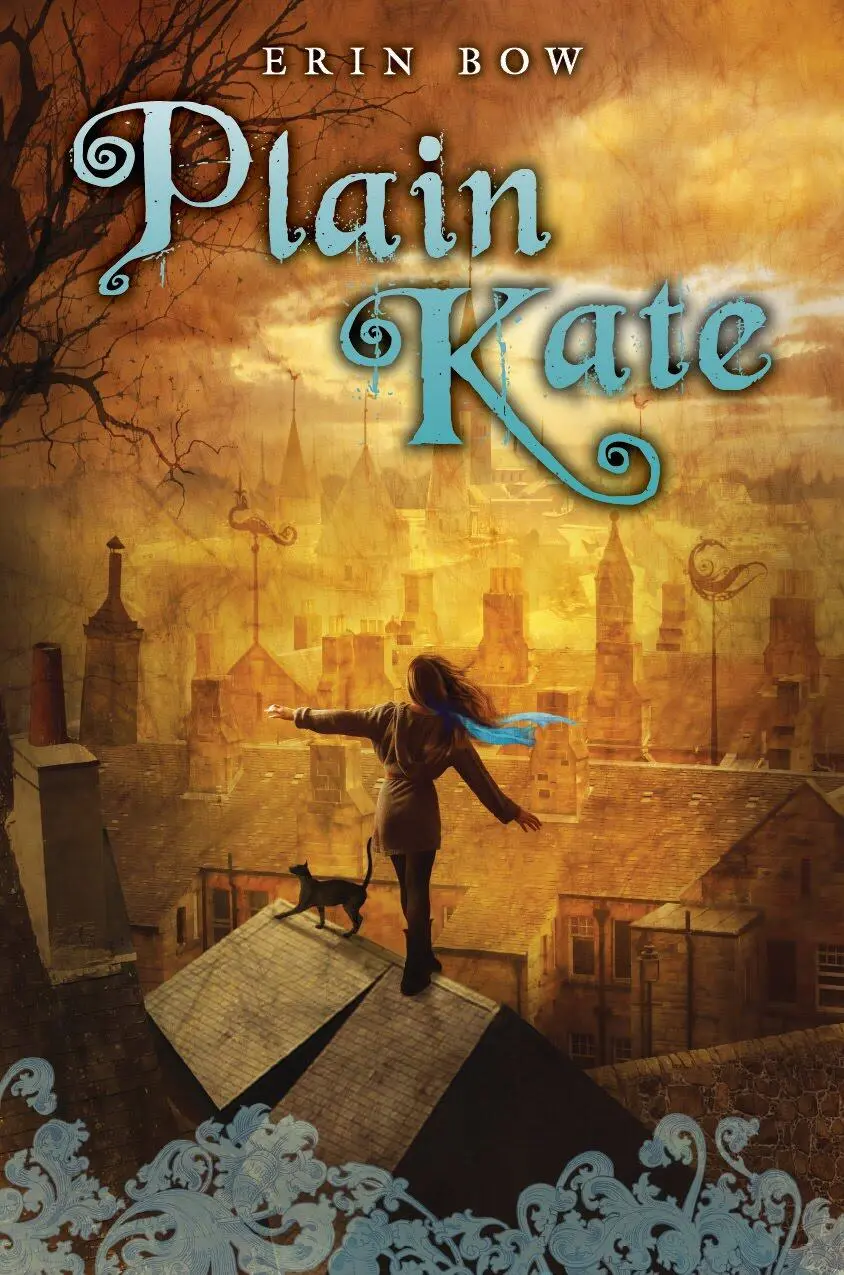
- Название:Plain Kate
- Автор:
- Издательство:Scholastic Inc.
- Жанр:
- Год:2010
- ISBN:9780545166645
- Рейтинг книги:3 / 5. Голосов: 1
-
Избранное:Добавить в избранное
- Отзывы:
-
Ваша оценка:
Plain Kate: краткое содержание, описание и аннотация
Предлагаем к чтению аннотацию, описание, краткое содержание или предисловие (зависит от того, что написал сам автор книги «Plain Kate»). Если вы не нашли необходимую информацию о книге — напишите в комментариях, мы постараемся отыскать её.
Plain Kate — читать онлайн бесплатно полную книгу (весь текст) целиком
Ниже представлен текст книги, разбитый по страницам. Система сохранения места последней прочитанной страницы, позволяет с удобством читать онлайн бесплатно книгу «Plain Kate», без необходимости каждый раз заново искать на чём Вы остановились. Поставьте закладку, и сможете в любой момент перейти на страницу, на которой закончили чтение.
Интервал:
Закладка:
Plain Kate felt her mouth widen toward a smile, and to hide it she looked down at the horrible faces of the objarka arrayed before her. “It will be all right,” she said softly, almost to herself.
“I told you!” Drina grinned and flipped over into a backward handspring. Taggle jumped up and rebounded off her boots. The cat flew, twisting through the air like a ribbon of silver, and landed neatly on his feet. Someone cheered. And they did it again.
Drina paused to spread out a begging scarf and kilt up her skirts, and then she and Taggle danced and flipped, bright as a pair of dragonflies. Drina was far from the only tumbler in the market, but Plain Kate would lay money that Taggle was the only and the best tumbling cat in the world. A crowd gathered. Among them, some stopped to look at the objarka. Plain Kate fell into the easy push-pull of haggling, which was like a two-man saw, and for a little while she was as happy as she had ever been.
When Drina stopped dancing, she was flushed and panting. Taggle preened in her arms. Kopeks lay on the scarf at her feet. “Look!” she said. “And you?”
“Three,” Kate told her, and shyly opened her hand, letting Drina see the silver coins her three sales had garnered her.
“I knew it!” Drina beamed. “Luck will be with us here, Plain Kate. You will make your silver and I will find”—she dropped her voice and glanced around—“our answer.” Still gleaming with sweat and breathing hard, she untucked her skirts and tied the scarf across her shoulder.
Kate had spent time among the Roamers now, and knew that Drina was too young to wear her scarf across her body. It was a woman’s costume, the scarf and the turban. As Drina piled up her hair, she took on a power Kate could only glimpse, and didn’t understand. Drina held the scarf edge out to make a pouch. “Give me the little ones; I’ll stroll the crowd.”
As Plain Kate gathered up some of the smaller objarka, Drina opened her belt pouch and pulled out the charms she had made: bundles of birch twigs and yarrow and herb and feathers, knotted with red thread and white horse hair. Kate looked at them. “Are you sure?”
But Drina was almost laughing with joy. “Luck is with us,” she said again. So Plain Kate put the little objarka burji into Drina’s sash like peas into an apron, and watched her walk away, up the broad, crowded steps.

Kate watched Drina for a while, dark and vivid among the pale damp people of Toila in their browns and beiges. In her red turban she stood out like a poppy in a wheat field. She was moving with a catlike sway Kate hadn’t seen her use before, and she sang as she walked, weaving a spell of wordless notes. Taggle, elegant as a greyhound, shadowed her heels.
Drina was busy. She let young men reach into her apron, and spun them tales about the horrible little burji they drew out. And with older women she exchanged whispers and coins and pointing fingers. She was using the bundles as a passport, looking for the real witch—someone who could teach them how to call into the dark and be sure of what would answer.
But the market was crowded and noisy, and soon Kate lost sight of Drina. Without the tumbling to snare them, the eddy of people around her blanket had dissolved, but still, she had better than her share of interest. Some people merely threw glances at her or her carvings, but some slowed, and some paused, and some stopped a moment, and some stopped.
“I have not seen you here before.” The man who loomed over Plain Kate was bald, but he had long whiskers like a catfish. His dark zupan was covered with little figures cast in pewter: acorns and angels, knots and night creatures. There were hundreds of them. The man jangled faintly in the wet gusts of wind. “Not seen you, eh?” he said.
She shrugged. “I’ve not been here before.”
“Not been,” he squawked. “Not been to the famous market? The great market? The great market of Toila?”
“No.”
“Not been,” he said again, and Kate began to wonder if he was simple or mad. “No, not been. I would have seen you. I would have seen”—he smiled, and suddenly looked horribly sane—“such fine work.”
Plain Kate said nothing.
“Bit of a witch-blade, are you, girl?”
“A carver,” she said. “I’m a carver.”
“Objarka, though.” He raised his arms grandly, and the pewter things chittered all over his coat. “I sell objarka.”
“Not as good as mine,” said Kate. “But don’t worry. I won’t be back.”
“Don’t be,” he said. And he turned away.
“Hmph,” Kate snorted to herself. Taggle was a bad influence.
“He can’t keep you from here,” said the woman at the next blanket. She was selling round-weave baskets, and had a wickerworker’s hands, calloused and tough as roots. “The great market is free to all. And we need better charms than what Stanislaus sells.” She cast some sort of fingered curse at the departing back of the catfish man. “Objarka, ha! They’re meant to draw luck, but that man couldn’t draw bees with honey.”
Plain Kate, looking down at the terrible faces of her big objarka, felt herself smile.
“There you are,” said the woman. “You can see it yourself, surely. There’s no magic in his work.” She fingered her ear; the top was notched strangely, just where Drina had cut Kate. Was this a witch? “Pewter,” the woman sneered. “You can’t draw luck with tin. It needs blade.”
“I’m just a carver,” said Kate again.
The woman looked at her appraisingly, her fingers still pinching at her ear. “As you say.”
A bit later another man stopped. His zupan’s front was bright and stiff with embroidery. He looked a while, then stooped and picked up the pig-snouted face. “Luck! I’m not sure I would enter my own home, if it meant passing this fellow. What do you want for him?” And he gave her eight silver without even bargaining.
“That was the master of the threadneedle guild,” whispered the basket maker, when he was gone. “Now you’ll sell, wait and see.”
And indeed the stream of customers thickened around her, and people of all classes came to see her work, hefting the faces and running fingers over the smoothness of the carving. She sold four of her big objarka and made good silver. But then, suddenly, the crowd scattered, taking flight like a field full of starlings at no cue Kate could see. She found herself looking at a single pair of good boots and the hilt of a sword. She looked up at a man in the dress of the city watch. “We’ll have no witchcraft in the market,” he said.
“I don’t do any.”
“And your little friend?” said the watchman. For a moment she thought he meant Taggle, and her stomach lurched. She looked at the basket woman, whose eyes were wide with fear. “The lass with the pretty ways and little bundles,” he said. “The Roamer girl.”
Plain Kate swallowed and looked straight ahead. This gave her a good view of the watchman’s sword, bumping at his hip. “Well?”
But she could think of nothing to say.
“Have a word with her,” he said more kindly. “They burned a woman here last week.”
When he’d gone, Plain Kate tried to catch the basket woman’s eyes. But the woman, pale, turned her head away.
Plain Kate sat trembling on her bedroll with her three masks in front of her, and didn’t know what to do. She stood up and didn’t see Drina anywhere. She looked and looked. Her eyes lit on every flash of red, but none of them was the red turban Drina had been wearing. She tried to shout Drina’s name, and her voice caught in her throat.
People were still thick around her blanket, but now the glances were for her and not for her work, and some were hot, and some were cold. Plain Kate looked down at the objarka that had the face of a woman burning. She shifted her weight from foot to foot.
Читать дальшеИнтервал:
Закладка:
Похожие книги на «Plain Kate»
Представляем Вашему вниманию похожие книги на «Plain Kate» списком для выбора. Мы отобрали схожую по названию и смыслу литературу в надежде предоставить читателям больше вариантов отыскать новые, интересные, ещё непрочитанные произведения.








Обсуждение, отзывы о книге «Plain Kate» и просто собственные мнения читателей. Оставьте ваши комментарии, напишите, что Вы думаете о произведении, его смысле или главных героях. Укажите что конкретно понравилось, а что нет, и почему Вы так считаете.