Erin Bow - Plain Kate
Здесь есть возможность читать онлайн «Erin Bow - Plain Kate» весь текст электронной книги совершенно бесплатно (целиком полную версию без сокращений). В некоторых случаях можно слушать аудио, скачать через торрент в формате fb2 и присутствует краткое содержание. Год выпуска: 2010, ISBN: 2010, Издательство: Scholastic Inc., Жанр: Старинная литература, на английском языке. Описание произведения, (предисловие) а так же отзывы посетителей доступны на портале библиотеки ЛибКат.
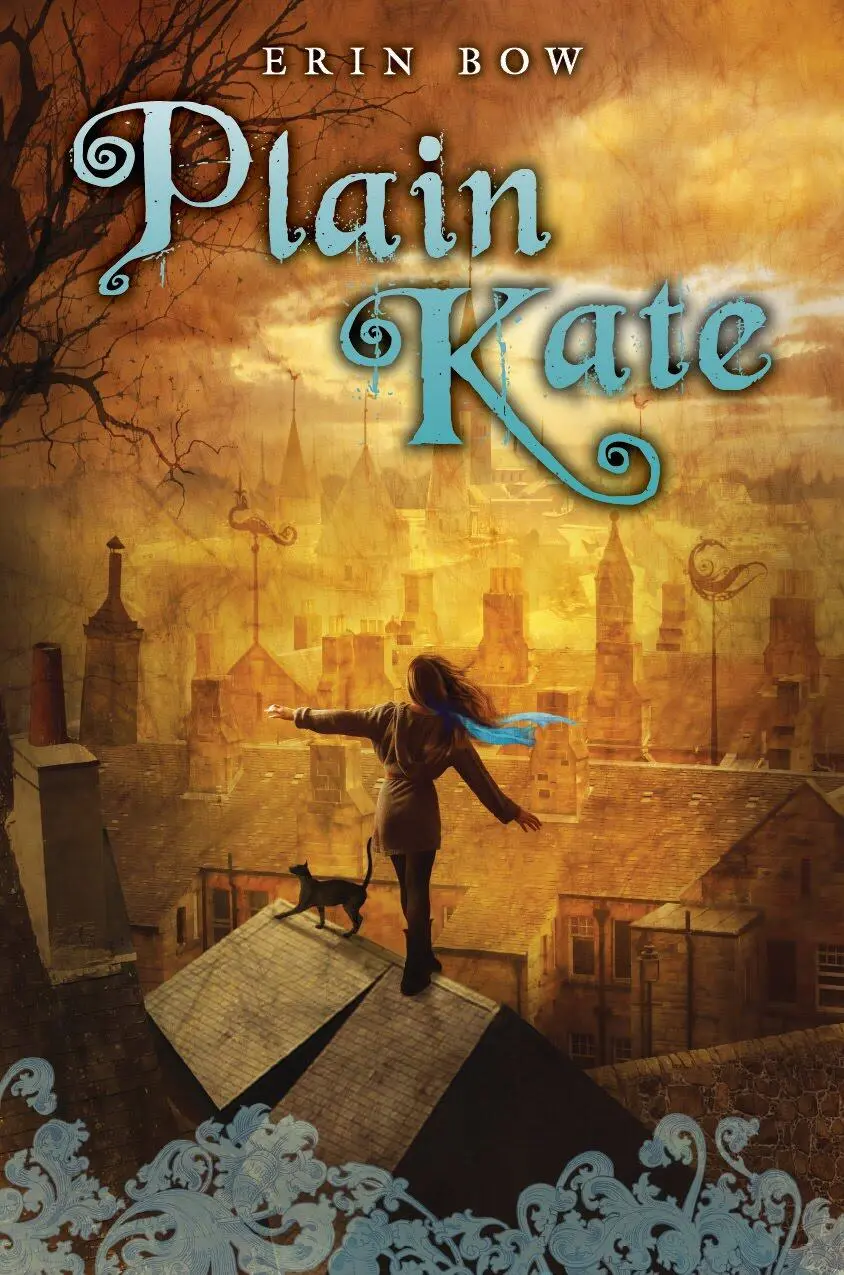
- Название:Plain Kate
- Автор:
- Издательство:Scholastic Inc.
- Жанр:
- Год:2010
- ISBN:9780545166645
- Рейтинг книги:3 / 5. Голосов: 1
-
Избранное:Добавить в избранное
- Отзывы:
-
Ваша оценка:
Plain Kate: краткое содержание, описание и аннотация
Предлагаем к чтению аннотацию, описание, краткое содержание или предисловие (зависит от того, что написал сам автор книги «Plain Kate»). Если вы не нашли необходимую информацию о книге — напишите в комментариях, мы постараемся отыскать её.
Plain Kate — читать онлайн бесплатно полную книгу (весь текст) целиком
Ниже представлен текст книги, разбитый по страницам. Система сохранения места последней прочитанной страницы, позволяет с удобством читать онлайн бесплатно книгу «Plain Kate», без необходимости каждый раз заново искать на чём Вы остановились. Поставьте закладку, и сможете в любой момент перейти на страницу, на которой закончили чтение.
Интервал:
Закладка:
So she hugged the cat to her chest. “My hero,” she said. “My soft damp little warrior. What are we going to do?”

Behjet was gone for a long time. The woods they had disturbed into silence filled again with birdsong and glimpsed movement, rabbits and deer. Gradually it occurred to Plain Kate that the Roamers could abandon her here, dump her off like a sack of kittens.
But finally Behjet did come back. Together they walked Xeri deeper into the woods, to where the stream widened into a clearing by the river. Behjet fished, and Kate tried to do the chores that she and Drina did together. It took longer, and was harder, drearier work alone. She was still piling firewood when the first vardo came nosing through the willow saplings, the horse straining to pull it through the mud.
The clearing was a miserable camp: more bog than meadow. Every step pressed tea-colored water from the grass. The wheels of the vardo sank halfway to the hubs. Flies swarmed and bit. The horses twitched and pulled at the sour-smelling grass. The people swatted and grumbled.
Daj and Drina did not come out of the red vardo . Stivo sat on its steps and sharpened his axe.
So Kate, by herself, took the buckets from their pegs on the green vardo and placed them—one, two, three, four—a few paces apart along the stream. She took the big bucket from the blue vardo and set off toward the river. One of the women, pulling piled chicken baskets out of the bear cage, called after her: “Not alone! It’s not the Roamer way—”
But Stivo interrupted her: “But she’s not Roamer, is she? And she looks after herself well enough.”
So Kate went alone. Full, the big bucket was iron-heavy. She and Drina usually carried it between them, their hands twined side by side on the handle, both of them leaning outward against the weight. Without Drina, Kate staggered. The bucket had to be held out far enough that it didn’t bang into her knee. It made the weight more; it was like carrying her secret. She shook with it.
It was too much. Drina hurt and hating her—her silver gone—her place vanishing—her shadow twisted away. Coming into camp, she caught her foot in a rabbit hole and fell. The water spilled. The bucket tumbled under the feet of the horses; Xeri shied and struck at it, and two of the staves cracked, and when Kate picked it up she was crying.
But worse was coming. It took her all of the evening to water the chickens, fill the kettles, and tend the fires, and through it all no one spoke to her, though there was whispering.
Where the men’s fire should be, the Roamers had put up a big tent, which she had only ever seen bundled and strapped beneath the biggest vardo . “Council tent,” said Behjet, who caught her looking. “This business in Toila was bad, Plain Kate. We must decide what to do.”
What to do with her, he did not say. She knew it, anyway. I knew this, she tried to remind herself. The test. After Toila, they were going to decide.
All the men went inside, and the women spoke only in their own language. Drina, she heard, gadje, Toila, market, knife, blood, witch. Blame.
Kate settled onto the back step of the red vardo and tried to mend the bucket in the fading light. Inside she could hear Daj muttering and puttering, and Stivo—gruff, angry Stivo—singing a lullaby that her own father had once sung to her. She knew the tune, though he sang in the Roamer language: “Cheya, Drina, mira cheya.” Daughter, dearest daughter.
The fire burning inside the council tent cast the men’s shadows on yellow canvas—shadows so crisp and solid they looked like people made of shadow. Smoke billowed, dragonish, from the vent in the roof. In the women’s circle, the cooking fire smoldered and sputtered, smoking in the damp. The woods pressed close and the river muttered.
Plain Kate worked and listened to Stivo sing. Drina’s voice didn’t come. The night closed in.
One of the women came around with a splint and lit the lanterns that hung from the back doors of the five vardo , which Kate had always thought made the wagons look sweet as fireflies. But tonight—the lantern washed down over her as she struggled with planing a stave for the broken bucket. And after a moment she saw the way the shadow of the step made a fluttering line on the damp grass. Nothing broke that line. Of her own shadow there was no trace.
Kate stopped. Her hands went numb, her stomach seized, her breathing snatched. Gone. It was finally gone. Into the gathering dark, she hissed: “Taggle? Taggle?”
From the shifting dark shapes of the horses a smaller gray shape sauntered. The cat leapt onto the steps beside her. His shadow fell—alone—across the grass. “I found the horse,” he announced. “The one that gave us such a horrible ride. I scratched his ankle.”
“Ah,” she said automatically. She couldn’t even gather the courage to tell him, to speak the horrible thing aloud. My shadow. “Taggle—”
He had heard something, anyway. “Katerina?” He pricked his ears at her. His tail twitched and he sniffed at her, as if looking for the wound. “Are you hurt?”
“Taggle, my shadow—” But suddenly, inside the vardo , someone was shifting. The steps wobbled; the frame creaked. Daj pushed the curtain aside, and her shadow fell across Kate. My shadow, she thought again. But neither of them spoke. Taggle leaned his comforting warmth into Kate’s side.
Feeling Daj’s eyes on her, Plain Kate bent her head and tried to work. The curved length of the wood was clamped between her knees. She drew the plane over the wood toward her. Pale shavings curled up like carrot peelings. “Deadly work for such little hands,” said Daj at last.
“It’s not hard.” Though it was hard. Mending a bucket was a cooper’s work, and Kate had never done it. She had to guess how the wood might swell or shrink, bend or straighten, and the stave had to be perfect. If the bucket leaked, she thought, the Roamers would surely cast her out. Still, she said again: “It’s not hard.”
“Well, it looks hard,” said Daj. “Leave off now, kit, you’ve lost the light.” She plucked down the lantern and peered into the vardo . “Not much room in here, I’m feared. Full as the king’s pocket. Why don’t you pitch the bender tent, have a night on your own.”
Alone. At Daj’s words, Plain Kate did something she had never done. She let the plane slip.
The blade skipped off some knot in the wood and sliced into her forearm. She watched it cut a strip of skin like bark. Taggle howled.
Daj almost dropped the lantern. “Mira!” She rushed and stumbled down the steps, yanking off scarves. “Aye! I’ve jinxed you!” Plain Kate’s arm was seeping blood the way the bog seeped water. Daj tied the scarf around it, tight. The pink flowers were at once soaked through.
“Blood,” hissed Taggle, and over him, Kate said, “Oh.”
“Ah,” Daj sobbed. “I’ll never forgive myself.” She yanked Kate up—“Come on , kit”—and pulled her by the wrist, staggering, toward the big tent, with the cat tangling around their feet. They burst into the yellow light and sudden silence. Faces turned to them.
There was no men’s fire ceremony, no “May I pass between you?” Daj barked: “Tea!” Her husband, Wen, rose, creaking, his hands on his knees, and shuffled over with the black kettle. Daj seized it and pushed Kate onto one of the trestles. Taggle leapt up. Daj swatted him away. She ripped off the bandage-scarf. Before Plain Kate knew what was happening, hot tea was pouring over the open wound.
“Just brewed that,” said Wen.
Daj thrust the kettle lid at him. “Can’t you see the child’s hurt?” She slapped a handful of steaming tea leaves on Plain Kate’s arm.
Читать дальшеИнтервал:
Закладка:
Похожие книги на «Plain Kate»
Представляем Вашему вниманию похожие книги на «Plain Kate» списком для выбора. Мы отобрали схожую по названию и смыслу литературу в надежде предоставить читателям больше вариантов отыскать новые, интересные, ещё непрочитанные произведения.









Обсуждение, отзывы о книге «Plain Kate» и просто собственные мнения читателей. Оставьте ваши комментарии, напишите, что Вы думаете о произведении, его смысле или главных героях. Укажите что конкретно понравилось, а что нет, и почему Вы так считаете.