Richard Patterson - Conviction
Здесь есть возможность читать онлайн «Richard Patterson - Conviction» весь текст электронной книги совершенно бесплатно (целиком полную версию без сокращений). В некоторых случаях можно слушать аудио, скачать через торрент в формате fb2 и присутствует краткое содержание. Жанр: Старинная литература, на английском языке. Описание произведения, (предисловие) а так же отзывы посетителей доступны на портале библиотеки ЛибКат.
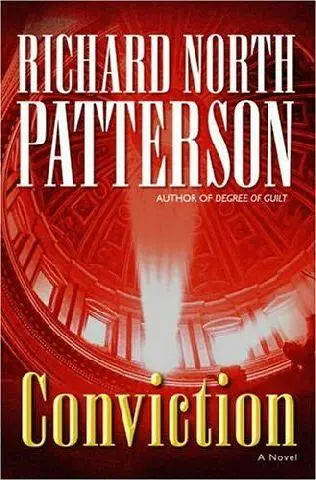
- Название:Conviction
- Автор:
- Жанр:
- Год:неизвестен
- ISBN:нет данных
- Рейтинг книги:3 / 5. Голосов: 1
-
Избранное:Добавить в избранное
- Отзывы:
-
Ваша оценка:
Conviction: краткое содержание, описание и аннотация
Предлагаем к чтению аннотацию, описание, краткое содержание или предисловие (зависит от того, что написал сам автор книги «Conviction»). Если вы не нашли необходимую информацию о книге — напишите в комментариях, мы постараемся отыскать её.
Conviction — читать онлайн бесплатно полную книгу (весь текст) целиком
Ниже представлен текст книги, разбитый по страницам. Система сохранения места последней прочитанной страницы, позволяет с удобством читать онлайн бесплатно книгу «Conviction», без необходимости каждый раз заново искать на чём Вы остановились. Поставьте закладку, и сможете в любой момент перейти на страницу, на которой закончили чтение.
Интервал:
Закладка:
"She guessed there was nothing waiting for him at home—which would have been a mercy, were it true. Anyhow, he just stayed there near her desk. Eventually they developed a routine, Brooks doing her work with Rennell close by." Tammy shook her head. "If no one came for him, sometimes she'd drop him by the house. But usually Payton showed up to fetch him."
"What does she say about their relationship?" Lane asked.
"That Payton would be short with him, like Rennell was more a burden than a companion." Mattox glanced at the notepad. "She remembers Payton being cool and wary and sort of hostile. But with Rennell he had what she calls 'this little man's sense of responsibility.' "
Terri wondered how that might have played itself out in the lives of these two young boys, and then in the death of Thuy Sen—the black hole in Terri's knowledge—followed by Payton's desperate solicitation of Jamal Harrison to kill Eddie Fleet and, at the last, of Tasha Bramwell's alibi. "Did Brooks ever meet the parents?" she asked.
"No. The adults in Rennell's life were phantoms, she said. But she gave me this." Reaching into an accordion folder, Mattox withdrew a piece of art paper with a child's primitive drawing: a head with a crooked mouth and shoe-button eyes, its ears sprouting sticks representing arms and legs. "It was a present—Rennell's picture of her. She kept it in a scrapbook."
Examining Rennell's gift, tendered in exchange for a teacher's desultory kindness, Terri felt immensely sad. Turning to Carlo, she asked, "Remember the drawings Kit used to send to you in law school?"
Carlo studied the picture. "Sure. Compared to this, they were Renoirs. And Kit was five or six."
"It was like that across the board." Mattox ran a finger down her notes. "In the fourth grade, the school gave Rennell a battery of tests. The results were abysmal: excessive anxiety, poor ego strength, lousy coordination, rotten academics, minimal attention span, poor reality contact, substandard intellectual development, and poor impulse control." Pausing, she frowned. "Needless to say, they found him eligible for special ed. Somehow he never got any."
"Poor impulse control," Lane repeated. "But no school-ground fights."
"No sign of them. Brooks described him as 'fundamentally passive.' The one thing kids seemed to notice about him was that he couldn't keep up."
Lane rubbed his temples. "Here's what I'd guess began happening," he ventured. "Around third grade the other kids figure out he's different. And because he can't be a member of the group anymore, they start to pull away. In reaction, he slowly begins the process of withdrawal.
"He can't play like other kids can, 'cause he can't grasp the rules." Lane looked at Carlo. "Remember learning board games with other kids? Rennell can't do that—he'll lose track of the rules, like a child too young to grasp chess. So kids just cut him out." His gaze taking in the others, Lane finished, "And so, perhaps fatefully, he becomes even more dependent on the only person who still deals with him—Payton."
"According to Rennell," Carlo noted, "Payton never did anything wrong."
Lane shrugged. "If Payton did, Carlo, what would the world be for Rennell?"
"That's pretty much what Sharon Brooks said," Tammy observed. "If Payton did something, so did Rennell. Except Payton was a blacktop shark—quick to take offense and ready to fight in a nanosecond. Rennell wasn't. Brooks says he did all he could to stay out of fights."
"And out of trouble?" Lane asked.
"Seems like. Though trouble followed him. He was nine when Mama killed Daddy with a knife—though how that affected Rennell, and what he saw, no one quite seems to know. But Mom went to the mental hospital, and the boys went to live with Grandma—the only other consistent figure in his life."
"What did her influence seem to be?"
Mattox placed the pen to her lips. "She seems to have had some—she was a churchgoing woman of firm moral beliefs, which she tried to instill in the boys. She clearly loved them. But she wasn't one of those iron-willed black matriarchs people like to imagine, bent on scaring those two boys straight. Payton was eleven by the time she got him—he already lived in the streets. Rennell just followed in his wake."
"How so?" Carlo asked.
"As best he could," Tammy answered wryly. "His crack career was paltry, a stretch in juvenile hall for street dealing. That's a singular achievement—in the Bayview it's not easy to get caught. After that, Payton seems to have thought better of using his chucklehead brother as a dealer." She smiled briefly. "Must have been Payton's deep family feeling. He didn't seem to give a shit about his other human sacrifices."
Terri poured herself more coffee. "What do we know about his time in juvenile hall?"
"Not much—no behavior problems." Again, Mattox reached into the bulging folder and placed a paper in front of Terri. "All I could find of interest is this letter."
The letters were printed—as primitive, it seemed to Terri, as they were heartfelt:
DEAR Judge,
This Letter CONCERN ME and My PROBLEM I have BEEN HEAR OVER TIME. I DON'T PLAN TO BE HERE much longEST. PLEASE write a letter HEAR saying r*ennell price gRandmother need ma home.
rennell price
Reflecting on Rennell's tools, so painfully limited, Terri wondered about the circumstances which would cause him to employ them in such a plan. "Problem is," Tammy remarked, "he could actually write this. I can hear the A.G. saying that a man of such superior gifts couldn't possibly be retarded."
Terri looked up from the letter. "You think there was abuse," she prodded. "Was that in his parents' home?"
"That'll take some piecing together." Mattox fished inside the folder and produced a faded photograph. "I started here."
In the photo were two black kids: a slender, sharp-eyed boy she guessed was Payton, and a much younger but bulkier one—Rennell at something like Kit's age, six or seven. A large bandage covered a portion of his scalp.
"What happened?" Terri asked.
"Grandma didn't remember. So I checked out the admissions records at S.F. General." Mattox gave Terri a two-page Xerox. "On December twenty-third, 1976, Mama brought him to the hospital on a bus. He was seven years old, and it was twelve-thirty-five at night. Mama told the doctor he 'fell off a curb.' "
Terri gazed at the picture. "Some curb," she said softly.
"Some fall," Mattox answered. "But the doctor didn't see fit to question what a kid was doing falling off a curb at midnight. He just noted that Mom had liquor on her breath and then wrote her bullshit down like it was gospel.
"His notes also describe Rennell as crying off and on, apologizing to the nurse for being trouble. And that he was lethargic and slow to communicate . . ."
"A concussion would do that."
"So would retardation," Mattox answered with a smile so tight it was murderous. "But here's the best part. The doctor looked for bruises on his body like you'd find if he'd fallen on cement. There were none. All Dr. Kildare could come up with were burn marks on his buttocks."
Briefly, Terri closed her eyes. "What did the doctor say about that?"
"That the burns weren't recent, and therefore required no treatment." Mattox's voice flattened out. "Mom told the doctor Rennell was so damned slow he'd sat on a space heater without thinking."
Terri sat back, drawing a breath. Through the floor-to-ceiling windows, the sunlight of late morning had reached the edge of the conference table: for the last three hours, she realized, Rennell Price's childhood had absorbed her too much to notice her surroundings.
"What do you think?" she asked Mattox.
"Something a little different." Tammy's voice held suppressed anger. "Yesterday, I reviewed the prison doctor's records from when Rennell came onto death row. Turns out the burn marks were still there. They were permanent—and symmetrical."
Читать дальшеИнтервал:
Закладка:
Похожие книги на «Conviction»
Представляем Вашему вниманию похожие книги на «Conviction» списком для выбора. Мы отобрали схожую по названию и смыслу литературу в надежде предоставить читателям больше вариантов отыскать новые, интересные, ещё непрочитанные произведения.











Обсуждение, отзывы о книге «Conviction» и просто собственные мнения читателей. Оставьте ваши комментарии, напишите, что Вы думаете о произведении, его смысле или главных героях. Укажите что конкретно понравилось, а что нет, и почему Вы так считаете.