Connie Willis - All Clear
Здесь есть возможность читать онлайн «Connie Willis - All Clear» весь текст электронной книги совершенно бесплатно (целиком полную версию без сокращений). В некоторых случаях можно слушать аудио, скачать через торрент в формате fb2 и присутствует краткое содержание. Жанр: Старинная литература, на английском языке. Описание произведения, (предисловие) а так же отзывы посетителей доступны на портале библиотеки ЛибКат.
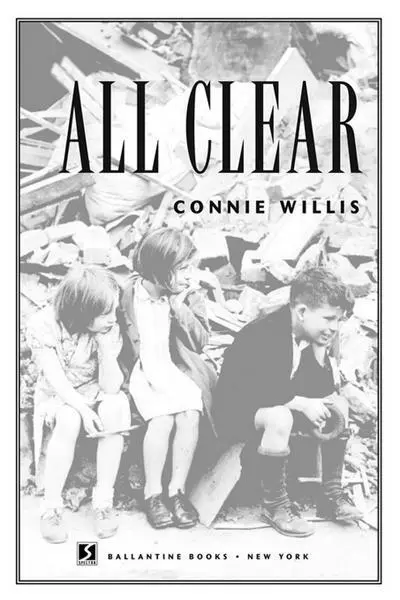
- Название:All Clear
- Автор:
- Жанр:
- Год:неизвестен
- ISBN:нет данных
- Рейтинг книги:5 / 5. Голосов: 1
-
Избранное:Добавить в избранное
- Отзывы:
-
Ваша оценка:
All Clear: краткое содержание, описание и аннотация
Предлагаем к чтению аннотацию, описание, краткое содержание или предисловие (зависит от того, что написал сам автор книги «All Clear»). Если вы не нашли необходимую информацию о книге — напишите в комментариях, мы постараемся отыскать её.
All Clear — читать онлайн бесплатно полную книгу (весь текст) целиком
Ниже представлен текст книги, разбитый по страницам. Система сохранения места последней прочитанной страницы, позволяет с удобством читать онлайн бесплатно книгу «All Clear», без необходимости каждый раз заново искать на чём Вы остановились. Поставьте закладку, и сможете в любой момент перейти на страницу, на которой закончили чтение.
Интервал:
Закладка:
“It’s no one’s fault,” she said.
They couldn’t have found him no matter what they did because it had all happened already, and when he got back to Oxford, he hadn’t been bearing a message from them. It had been a hopeless enterprise from the beginning. It had all been hopeless—the attempts to contact Mike’s retrieval team and the search for Gerald.
The door behind them opened, and Mr. Humphreys came out bearing a tray with a teapot and cups on it. “Your friend Mr. Davis said you were still out here,” he said to Polly, handing her and the others cups and saucers. “And I thought you might like some tea. It’s such a cold morning.”
He poured out their tea, then went down the steps and over to the man who’d asked Mike what he should do and then over to Alf and Binnie, who were playing in the still-smoldering wreckage.
He gave them biscuits and then came back. “I’m so sorry you missed your friend, Miss Sebastian,” he said. “I’ll ask Dean Matthews if he had an address where Mr.
Bartholomew might be reached. Do you need assistance in getting home?”
Yes, she thought, but you can’t help us.
She shook her head.
“If you need bus fare or—”
“No,” Polly said. “We have transport.”
“Good. Drink your tea,” he ordered. “It will make you feel better.”
Nothing will make me feel better, she thought, but she drank it down. It was hot and sweet. Mr. Humphreys must have put his entire month’s sugar ration into it.
She drained the cup, feeling suddenly ashamed of herself. She wasn’t the only one who’d had a bad night. Or the only one facing a frightening future. And the outlook wasn’t totally bleak. The fact that they hadn’t found Mr. Bartholomew meant that Mr. Dunworthy hadn’t betrayed them, that Colin hadn’t lied to her.
And her actions, and Mike’s and Eileen’s, didn’t seem to have affected events. Last night had gone just as it was supposed to. St. Paul’s was still standing, and the rest of the City wasn’t. History was still on track.
For the past two months Polly’d been terrified of finding proof they’d altered the course of the war, but now she almost wished historians were able to alter events, to alter this—the Guildhall and the Chapter House and all those beautiful Christopher Wren churches destroyed. And all the horrors that were still to come—Dresden and Auschwitz and Hiroshima. And Jerusalem and the Pandemic and the pinpoint bomb which would obliterate St. Paul’s. To repair the whole bloody mess.
But what could do that? The three of them had attempted all last night to find a single man and deliver a single message, to no avail. What made her think they could repair history, even if they knew how to go about it? And there was no way to know. The continuum was far too complex, too chaotic, to ensure that an attempt to avert a disaster wouldn’t lead to a worse one. And, as horrific as World War II had been, at least the Allies had won. They’d stopped Hitler, which had been an unarguably good thing.
But at such a terrible, terrible price—millions dead, cities in ruins, lives destroyed. Including mine, she thought. And Eileen’s and Mike’s.
She glanced over at them, sitting hunched on the steps, Eileen looking half frozen and about to cry, Mike with his arm bandaged and his foot half shot off. They looked done in, and Polly felt a wave of love for both of them. They had done all this, quite literally risked life and limb, for her because of her deadline. And they would both have sacrificed their lives if it had meant getting her safely home. Which meant the least she could do was to pull herself together.
Mr. Humphreys had managed to, and so had London. The day after they’d watched half their city burn down around their ears, Londoners hadn’t sat there feeling sorry for themselves. Instead, they’d set about putting out the fires that were still burning and digging people out of the rubble. They’d repaired water mains and railway tracks and telephone lines, shown up at their jobs, even if where they worked was no longer there, swept up glass. Gone on.
If they could do it, she could, too. “Once more into the breach,” she thought, and stood up and brushed the soot off her coat.
“We need to be going,” she said. She gathered up their cups and saucers, took them inside, set them on the desk next to the half-burned print of The Light of the World, and started out, then went back to look at it again—at the lantern raised to light the nothingness which lay before it, the darkness on all sides, at Christ’s robe smeared with soot from the charred, flaking edge.
She’d expected his face to look as done in, as defeated, as Eileen’s and Mike’s, but it didn’t. It was filled with kindness and concern, like Mr. Humphreys’s.
She fished sixpence out of her bag, laid it on the desk, folded the picture into quarters, put it in her pocket, and went outside.
“We need to go,” she said to Mike and Eileen. “We’ll be late for work. And we must take the ambulance back to St. Bart’s.”
“And get my coat,” Mike said. “And Eileen’s.”
“And get my coat,” Mike said. “And Eileen’s.”
“I need to take the children home first,” Eileen said. “Alf! Binnie!” she called to them.
They were still messing about in the ruins, poking at a smoldering timber with sticks and then jumping back as it crumbled into glowing embers.
“Come along. I’ll take you home.”
“ ’Ome?” Binnie said. The children looked at each other and then up at her. “We don’t need nobody to take us,” Alf said. “We can get there on our own.”
“No, the trains to Whitechapel may not be running, and your mother will be worried to death,” Eileen said. “I want to tell her where you’ve been all night and how much help you were.” She started down the steps toward them.
Alf and Binnie exchanged glances again, then dropped their sticks and tore off down the street, running as fast as they could.
“Alf! Binnie! Wait!” Eileen called, and took off after them, Polly and Mike in pursuit, but they’d already vanished into the tangle of smoking ruins beyond Paternoster Row.
“We’ll never catch them in that maze,” Mike said, and Eileen nodded reluctantly.
“Will they be all right, do you think?” Polly asked.
“Yes, they’re expert at taking care of themselves,” Eileen said, looking after them and frowning. “But I wonder why—”
“They were probably afraid if you took them home they’d have to go to school,” Mike said, and when they reached the ambulance, he peered at the petrol gauge and said, “We couldn’t have taken them home anyway. We don’t have enough gas to get to Whitechapel and back. We’ll be lucky if we’ve got enough to get us to St.
Bart’s.”
“If we can find St. Bart’s,” Eileen said. She started the car. “Alf was my navigator, remember?”
Polly nodded, thinking of all the blocked streets and barricades.
“I think I can get us there,” Mike said.
And he did.
Eileen’s coat was still hanging over the railing where she’d left it, but Mike’s was nowhere to be found, and he refused to ask the staff. “I left without being discharged,” he told them, “and they’re liable to try to put me back in the hospital.”
“I thought you said you’d scarcely burned your arm at all,” Polly said.
“I did. It’s nothing. But that doesn’t mean they’ll let me out, and I can’t afford to be stuck in here doing nothing, like I was all those weeks in Orpington. I don’t need a coat.”
“But it’s winter,” Eileen said. “You’ll catch your death—”
“I’ll go find it,” Polly said, taking charge. “Eileen, go turn the ambulance in. Mike, wait for us out front.”
Читать дальшеИнтервал:
Закладка:
Похожие книги на «All Clear»
Представляем Вашему вниманию похожие книги на «All Clear» списком для выбора. Мы отобрали схожую по названию и смыслу литературу в надежде предоставить читателям больше вариантов отыскать новые, интересные, ещё непрочитанные произведения.









Обсуждение, отзывы о книге «All Clear» и просто собственные мнения читателей. Оставьте ваши комментарии, напишите, что Вы думаете о произведении, его смысле или главных героях. Укажите что конкретно понравилось, а что нет, и почему Вы так считаете.