Connie Willis - All Clear
Здесь есть возможность читать онлайн «Connie Willis - All Clear» весь текст электронной книги совершенно бесплатно (целиком полную версию без сокращений). В некоторых случаях можно слушать аудио, скачать через торрент в формате fb2 и присутствует краткое содержание. Жанр: Старинная литература, на английском языке. Описание произведения, (предисловие) а так же отзывы посетителей доступны на портале библиотеки ЛибКат.
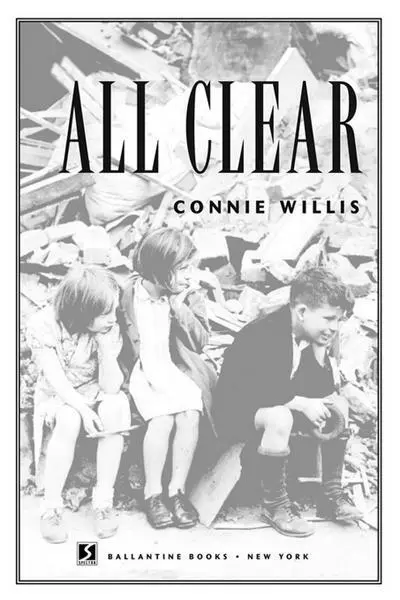
- Название:All Clear
- Автор:
- Жанр:
- Год:неизвестен
- ISBN:нет данных
- Рейтинг книги:5 / 5. Голосов: 1
-
Избранное:Добавить в избранное
- Отзывы:
-
Ваша оценка:
All Clear: краткое содержание, описание и аннотация
Предлагаем к чтению аннотацию, описание, краткое содержание или предисловие (зависит от того, что написал сам автор книги «All Clear»). Если вы не нашли необходимую информацию о книге — напишите в комментариях, мы постараемся отыскать её.
All Clear — читать онлайн бесплатно полную книгу (весь текст) целиком
Ниже представлен текст книги, разбитый по страницам. Система сохранения места последней прочитанной страницы, позволяет с удобством читать онлайн бесплатно книгу «All Clear», без необходимости каждый раз заново искать на чём Вы остановились. Поставьте закладку, и сможете в любой момент перейти на страницу, на которой закончили чтение.
Интервал:
Закладка:
“… north aisle?” one of them said, and Dunworthy looked back toward the transept, wondering if he should retreat there.
“No … check the gallery first.” There was a brief flash of light, and Dunworthy heard a clank of metal and footsteps ascending.
They’re going up Wren’s Geometrical Staircase, he thought, and took advantage of the covering sound of their footsteps to walk quickly along the aisle, his hand on the wall for guidance. Pillar, pillar, iron grille. That was St. Dunstan’s Chapel. The vestibule and the door should be just beyond.
“… find anything?” he heard from somewhere above him. He ducked for cover moments before the pocket torch’s light flared down.
“Here it is!” one of them shouted; it must have been the first one because he said triumphantly, “I told you I heard something. It’s an incendiary. Fetch a stirrup pump.”
Dunworthy heard the second one racket along the gallery overhead. He felt his way quickly to the door, opened it, and slipped out to the porch and the steps.
And into pouring rain. Which explains why it’s so dark, he thought, ducking back under the porch’s roof. It was nearly as dark out here as inside. If he hadn’t known there was a pillared porch and then steps, he couldn’t have found his way down to the courtyard.
He squinted across it. He could only just make out the dark outlines of the buildings opposite. The rain also explained the absence of searchlights and of bombers droning overhead—the Luftwaffe would have had to call off the raids when this started. And it explained there not being any fires. The rain would have put all of them—except for the incendiary that had come through the gallery’s roof—out.
Dunworthy glanced up at the bell tower to see if they were up there and then splashed down the steps. To reach the tube station, he needed to find Paternoster Row and then Newgate.
And watch where he was going, though that was almost impossible to do in this downpour. It beat against him icily, more like sleet than rain. He hunched forward, ducking his head against its onslaught.
At any rate, no one else will be mad enough to be out in this, he thought, pulling the collar of his tweed jacket up tightly round his neck, but he was wrong. There were two figures walking straight toward him. Members of the fire watch? Or civilians on the way home from the tube station? Or an ARP warden who would demand to know what he was doing out on the streets and hustle him off to a surface shelter?
He splashed quickly across the road and down the narrow lane to his left. It was scarcely six feet across, and what little light he’d had to see by was utterly shut out by the buildings on either side. It was as dark as it had been inside the cathedral. He had to return to feeling his way, and it took him forever to reach Paternoster Row.
If it was Paternoster Row. It didn’t look like it. It was no wider than the lane and was lined with ramshackle houses instead of publishers’ offices and book warehouses. It also seemed to have a deeper descent than it should, though that might be a trick of the darkness.
Its abrupt end in a courtyard wasn’t. He must have missed Paternoster Row in the dark. He retraced his way back to the lane and up the way he’d come.
But it wasn’t the same lane. This one ended in a wooden stable. You’re lost, he thought furiously. You should have known better than to wander about in the dark in the City.
There was no worse place in London—or history—to be lost. The area surrounding St. Paul’s had been a rabbit warren of confusing lanes and mazelike passages, most of them leading nowhere. He could wander in here forever and never find his way out. And the rain was coming down harder than ever.
“I am positively too old for this,” he muttered, craning his neck to catch a glimpse of St. Paul’s, but the buildings were too tall, and there was nothing to orient himself by. He no longer even knew which direction the cathedral lay in.
Yes, you do, he thought. You know exactly where it is. On top of Ludgate Hill. All you need to do is climb up the hill. But that was easier said than done. There were no streets going up. They all led inexorably downhill, away from St. Paul’s and from the tube station. But if he continued downhill, he’d eventually come to Blackfriars, or, if he was too far east, Cannon Street. Either tube station would have trains which could take him to the station where Polly was. He turned down a lane and then another.
After two more turns and another cul-de-sac, he came to a broader street. Old Bailey? If so, Blackfriars lay at the foot of it. It was finally growing light, at least enough to see that the street was lined with shops, and the shops had awnings. He splashed across the street, eager to get even partially out of the rain.
Nearly all the shop windows were boarded up. Only the second from the corner still had glass in it, and as he drew nearer, he saw it was boarded up as well. What he’d thought was glass was actually a reflection from a garland of silver-paper letters nailed to the wood. They spelled out Happy Christmas.
It can’t be Christmas, he thought. If it was, there’d have been a Christmas tree in the nave and another outside in the porch. John Bartholomew had talked about its having been repeatedly knocked over by blast.
But the trees could very well have been there. He wouldn’t have seen them in the darkness.
But if it’s Christmas, he thought, that means there’s been nearly four months’ slippage, and that’s impossible. The increase was only two days. But he knew it was true. That was why it was so cold. And so dark. The net had sent him through at four A.M., but in December four A.M. would be pitch-black.
“Ascertain your temporal location immediately upon arrival.” Wasn’t that what he was always enjoining his students to do? He should have realized it couldn’t be September tenth when there weren’t any fires. They hadn’t got the ones on the docks out for nearly a week.
But he’d ignored the clues, and now he’d have to climb all the way back up that hill in the rain. Because Polly wasn’t here. Her assignment had ended the twenty-second of October. She’d been safely back in Oxford for at least a month and a half, and this had been an exercise in futility.
Except that now he had the proof he’d been looking for that the slippage was beginning to spike. He had to return to St. Paul’s immediately, go back through to Oxford, and tell Badri to pull all the historians out. He started back up the hill, looking for a taxi, but the streets were completely deserted.
No, wait, there was one, in the darkness at the end of a side lane. He stepped into the lane and hailed it.
It had seen him. It pulled out and began to move toward him, and thank God Colin had insisted on his bringing money. Dunworthy pulled out his papers and It had seen him. It pulled out and began to move toward him, and thank God Colin had insisted on his bringing money. Dunworthy pulled out his papers and shuffled through them, looking for the five-pound notes, and then looked up again.
The taxi was moving away. It hadn’t seen him after all. “Hullo!” Dunworthy shouted, his voice echoing in the narrow street, and rushed toward it, waving.
There, it had seen him now. The taxi began to move toward him again. It must be farther away than he’d thought because he couldn’t hear the engine at all. He hurried toward it, but before he’d gone half the distance, he saw it wasn’t a taxi. What he’d thought was the vehicle’s bonnet was the rounded edge of a huge black metal canister, swinging gently back and forth from a lamppost. A dark shroud was draped over the lamppost. A parachute.
It’s a parachute mine, he thought, watching as the canister swung gently back and forth, missing the lamppost by inches. And if the wind shifted slightly, or the parachute ripped …
Читать дальшеИнтервал:
Закладка:
Похожие книги на «All Clear»
Представляем Вашему вниманию похожие книги на «All Clear» списком для выбора. Мы отобрали схожую по названию и смыслу литературу в надежде предоставить читателям больше вариантов отыскать новые, интересные, ещё непрочитанные произведения.




Обсуждение, отзывы о книге «All Clear» и просто собственные мнения читателей. Оставьте ваши комментарии, напишите, что Вы думаете о произведении, его смысле или главных героях. Укажите что конкретно понравилось, а что нет, и почему Вы так считаете.