Connie Willis - All Clear
Здесь есть возможность читать онлайн «Connie Willis - All Clear» весь текст электронной книги совершенно бесплатно (целиком полную версию без сокращений). В некоторых случаях можно слушать аудио, скачать через торрент в формате fb2 и присутствует краткое содержание. Жанр: Старинная литература, на английском языке. Описание произведения, (предисловие) а так же отзывы посетителей доступны на портале библиотеки ЛибКат.
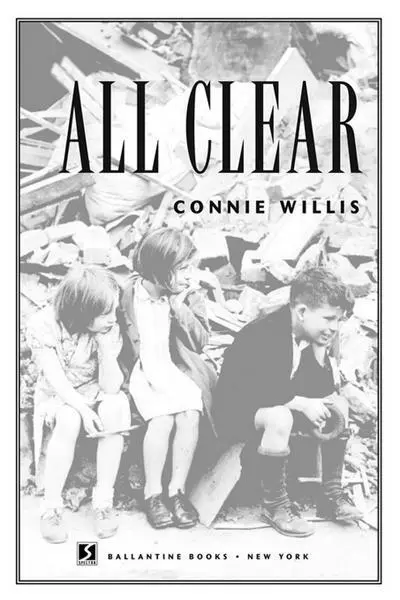
- Название:All Clear
- Автор:
- Жанр:
- Год:неизвестен
- ISBN:нет данных
- Рейтинг книги:5 / 5. Голосов: 1
-
Избранное:Добавить в избранное
- Отзывы:
-
Ваша оценка:
All Clear: краткое содержание, описание и аннотация
Предлагаем к чтению аннотацию, описание, краткое содержание или предисловие (зависит от того, что написал сам автор книги «All Clear»). Если вы не нашли необходимую информацию о книге — напишите в комментариях, мы постараемся отыскать её.
All Clear — читать онлайн бесплатно полную книгу (весь текст) целиком
Ниже представлен текст книги, разбитый по страницам. Система сохранения места последней прочитанной страницы, позволяет с удобством читать онлайн бесплатно книгу «All Clear», без необходимости каждый раз заново искать на чём Вы остановились. Поставьте закладку, и сможете в любой момент перейти на страницу, на которой закончили чтение.
Интервал:
Закладка:
“That’s exactly what I’m going to say.”
“But it wouldn’t have to be. You thought the shutting of our drops was a defense mechanism. Perhaps it is, only not to shut off interference from the future, but to enlist it when the continuum’s threatened. If Hitler’d won the war, he’d have had time to develop the atomic bomb, and he wouldn’t have hesitated to use it against the United States and all the other non-Aryan peoples. He already had a plan in place for wiping out Africa’s ‘mud people,’ and he wouldn’t have stopped there. He could have ended by wiping out—”
“Everything,” Mr. Dunworthy said. “Gotterdämmerung, the twilight of the gods. But if that’s the case, and the continuum wanted to protect itself, why didn’t it simply let us come through and shoot Hitler?”
“I don’t know. Perhaps the system only allows minor changes. Or unintentional ones. Or perhaps something else is going on in those divergence points which makes it impossible to alter them. Or perhaps we came into the picture too late. Like the Good Fairy in Sleeping Beauty—”
“The Good Fairy?”
“Yes,” she said earnestly. “She couldn’t undo the spell, she could only make it less terrible. Time travel wasn’t invented till long after the start of the continuum.
Perhaps we’re too late to completely repair it, but we can still—”
“But even if that’s true, and even if you saved Sir Godfrey’s life and Mike saved Hardy’s and I saved the Wren’s, we still altered events, and history’s a chaotic system where a good action, done with the best intentions, can have the opposite effect. How can you be certain that even if the continuum intended us to make repairs, we did? That we didn’t make things worse instead?”
“Because they were already worse.”
“Worse? What do you mean?”
“I mean, what if we’ve been looking at the war the wrong way round? What if the disaster had already occurred, and the outcome we were altering was a bad outcome?”
“A bad outcome?” Mr. Dunworthy said, bewildered.
“Yes. What if the Allies lost the war? You said there were dozens of times when the outcome balanced on a knife’s edge, like in that old saying, ‘For want of a nail, the shoe was lost, for want of a shoe—’ ”
“—the horse was lost.”
“Yes, and because of that, the rider and the battle and the war were lost. There were scores of times in World War Two like that, when if things had gone even slightly differently, we’d have lost. Well, what if we did lose?” she asked. “What if your Wren was killed in Ave Maria Lane and Sir Godfrey was killed in Bristol and Eileen’s bombing victim died in the back of the ambulance because they couldn’t find a driver and Hardy ended up in a German POW camp and they lost the war?”
“But then time travel would never have been invented. Ira Feldman—”
“No, because the continuum’s a chaotic system, which means time travel was already a part of it, and they hadn’t lost it. Because you’d come and run into a Wren and set a cascade of events in motion. And Mike was part of that cascade, and our being stranded here.”
“We’re the horseshoe, in other words.”
“Yes—”
“And you’re saying we waltzed in, tightened a few nuts and bolts, and won the war?” Mr. Dunworthy said. “Historians as Little Miss Fix-Its? My dear, history’s a chaotic system. It’s far more complicated than—”
“I know it’s complicated. I’m not saying we won it. And I’m not saying your Wren or Hardy or Sir Godfrey or Alf and Binnie or whoever it is they and Eileen treated on the twenty-ninth was who won it either. Or even that saving them was what tipped the balance. It may have been something else altogether—Marjorie’s deciding to become a nurse, or one of the FANYs I worked with borrowing my dance frock, or Mike’s nearly colliding with Alan Turing. Or something we don’t even know we did—our stepping ahead of someone onto an escalator or hailing a taxi or asking for directions. Mike might have done something in hospital, or Eileen might have affected one of her evacuees. Or I might have taken too long to wrap a customer’s parcel and delayed her five minutes, so that she missed her bus, or got caught in the tube when the sirens went.”
“But you think whatever that action was, one of us did it,” Mr. Dunworthy said. “And it was one of us who won the war.”
“No,” she said, frustrated. “I’m not saying that either. No one person or thing won the war. People argue over whether it was Ultra or the evacuation from Dunkirk or Churchill’s leadership or fooling Hitler into thinking we were invading at Calais that won the war, but it wasn’t any one of them. It was all of them and a thousand, a million, other things and people. And not just soldiers and pilots and Wrens, but air-raid wardens and planespotters and debutantes and mathematicians and weekend sailors and vicars.”
“Doing their bit,” Mr. Dunworthy murmured.
“Yes. Canteen workers and ambulance drivers and ENSA chorus girls. And historians. You said no one can be in a chaotic system and not affect events. What if your—our—coming to the past added another weapon to the war, a secret weapon like the French Resistance or Fortitude South?”
“Or Ultra.”
“Yes,” Polly said. “Like Ultra. Something which operated behind the scenes, and which, combined with everything else, was enough to avert disaster, to tip the balance.”
“And win the war,” Mr. Dunworthy said softly.
There was a long silence, and then he said, almost longingly, “But there’s no proof …”
No, she thought, except that so many lives saved and so many sacrificed— so much courage, kindness, endurance, love—must count for something even in a chaotic system.
“No,” she said. “I haven’t any proof.”
There was a knock, and Eileen leaned in the door, her red hair windblown and her cheeks rosy. “What are you two doing sitting here in the dark?” she said, and switched on the light. “You look as if you could both do with some tea. I’ll put the kettle on.”
“No, wait,” Polly said. “Did you find out who the man you saved was?”
“Yes.” She took off her hat. “The admitting nurse wouldn’t tell me anything, and neither would the matron, so then I hit on the idea of going to the men’s ward and telling the nurse that Mrs. Mallowan had sent me to find out.”
“Mrs. Mallowan?” Mr. Dunworthy said.
“That’s Agatha Christie’s married name.” She unbuttoned her green coat. “The nurse and I chatted a bit about Murder in the Calais Coach, and I told her about Agatha Christie’s new book, which hasn’t come out yet. It’s all right, Polly, I told her I had an editor friend who’d let me look at it. And as a result, she let me look at the ambulance log.”
“And the man you saved was—?”
“There were three people, actually, or at any rate the nurse said she doubted they’d have survived if they hadn’t been brought immediately to hospital. I wrote them down,” Eileen said, taking a sheet of paper out of her handbag and reading from it. “Sergeant Thomas Brantley, Mrs. Jean Cuttle—that was the ambulance driver—
and Captain David Westbrook.”
Mr. Dunworthy made an involuntary sound.
“Do you know who Captain Westbrook is?” Polly asked him.
Mr. Dunworthy nodded. “He was killed on D-Day, after single-handedly holding a critical crossroads till reinforcements arrived.”
For there is nothing lost that may not be found, if sought.
—EDMUND SPENSER, THE FAERIE QUEENE
London—Spring 1941
“SO YOU’RE TELLING ME ALF AND BINNIE ARE WAR HEROES?” Eileen said after Polly and Mr. Dunworthy had explained Polly’s theory to her.
Читать дальшеИнтервал:
Закладка:
Похожие книги на «All Clear»
Представляем Вашему вниманию похожие книги на «All Clear» списком для выбора. Мы отобрали схожую по названию и смыслу литературу в надежде предоставить читателям больше вариантов отыскать новые, интересные, ещё непрочитанные произведения.
Обсуждение, отзывы о книге «All Clear» и просто собственные мнения читателей. Оставьте ваши комментарии, напишите, что Вы думаете о произведении, его смысле или главных героях. Укажите что конкретно понравилось, а что нет, и почему Вы так считаете.