Gary Jennings - Aztec
Здесь есть возможность читать онлайн «Gary Jennings - Aztec» весь текст электронной книги совершенно бесплатно (целиком полную версию без сокращений). В некоторых случаях можно слушать аудио, скачать через торрент в формате fb2 и присутствует краткое содержание. Жанр: Старинная литература, на английском языке. Описание произведения, (предисловие) а так же отзывы посетителей доступны на портале библиотеки ЛибКат.
- Название:Aztec
- Автор:
- Жанр:
- Год:неизвестен
- ISBN:нет данных
- Рейтинг книги:4 / 5. Голосов: 1
-
Избранное:Добавить в избранное
- Отзывы:
-
Ваша оценка:
Aztec: краткое содержание, описание и аннотация
Предлагаем к чтению аннотацию, описание, краткое содержание или предисловие (зависит от того, что написал сам автор книги «Aztec»). Если вы не нашли необходимую информацию о книге — напишите в комментариях, мы постараемся отыскать её.
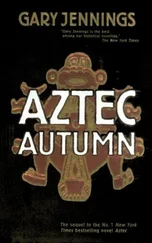
"Anyone who reads, anyone who still lusts for adventure or that book you can't put down, will glory in Aztec."--Los Angeles Times
Aztec
Aztec
Aztec — читать онлайн бесплатно полную книгу (весь текст) целиком
Ниже представлен текст книги, разбитый по страницам. Система сохранения места последней прочитанной страницы, позволяет с удобством читать онлайн бесплатно книгу «Aztec», без необходимости каждый раз заново искать на чём Вы остановились. Поставьте закладку, и сможете в любой момент перейти на страницу, на которой закончили чтение.
Интервал:
Закладка:
"As you probably know, Meat, we Mexíca are accustomed to speak of all desert inhabitants as the Chichimeca. But no doubt you have another name for yourselves."
He indicated the scattering of campfires and said, "We here are the Tecuexe tribe. There are many others in the desert—Fame, Janambre, Hualahuise, many others—but yes, we are all Chichimeca, since we are all red-skinned people." I privately thought that he and his tribesmen were more the gray color of grime. Meat swallowed a mouthful of stew and added, "You too are a Chichimecatl. No different from us."
I had resented the Rarámuri's calling me that. It was even more outrageous that a desert savage himself should claim kinship with a civilized Mexícatl. But he said it so casually that I realized he meant no presumption. It was true that, underneath their dirt, Meat and the other Tecuexe were of a coppery complexion similar to my own and that of every other person I knew. Tribes and individuals of our race might vary, from palest red-gold to the ruddy brown of cacao, but, generally speaking, red-skinned was the most inclusive description. And so I understood: those scruffy, half-naked, ignorant nomads obviously believed that the name Chichimeca derived not from the chichine, dog, but from the word chichiltic, meaning red. To anyone who chose to believe that, Chichimeca was no contemptuous name; it described every human being in every desert, every jungle, every civilized city of The One World.
I went on feeding my grateful belly—the stew was gritty with sand, but tasty nonetheless—and I meditated on the ties between diverse peoples. Clearly the Chichimeca must once have had some improving contact with civilization. Meat had mentioned his wife's imprudent sickbed confession to Tlazolteotl, so I already knew of the Chicimeca's acquaintance with that goddess. I later learned that they worshiped most of our other gods as well. But, in their isolation and ignorance, they had invented a new one just for themselves. They held the laughable belief that the stars are butterflies made of obsidian, and that the stars' twinkling light is only a reflection of moonlight from those fluttering wings of shiny stone. So they had conceived a goddess—Itzpapalotl, Obsidian Butterfly—whom they regarded as the highest of all gods. Well, in the desert night, the stars are spectacularly bright, and they do seem to hover, like butterflies, just beyond one's reach.
But even if the Chichimeca have some things in common with more civilized peoples, and even if they interpret the very name Chichimeca to imply that all red-skinned peoples are somehow distantly related, they have no compunction about living at the expense of those relatives, distant or near. On that first night I dined with the Tecuexe tribe, the mealtime stew contained bits of tender white meat flaking off delicate bones which I could not recognize as being the bones of lizards or rabbits or any other creatures I had seen in the desert. So I inquired:
"Meat, what is this meat we are eating?"
He grunted, "Baby."
"Baby what?"
He said again, "Baby," and shrugged. "Food for the hard times." He saw that I still did not comprehend, so he explained, "We sometimes leave the desert to pillage an Otomí village and we take, among other things, their infant children. Or we might fight with another Chichimeca tribe in the open desert. When the defeated tribe withdraws, it must leave those of its children too small to run. Since such tiny captives would be of no other use to their captors, they are gutted and cured in the sun, or smoked over a mizquitl fire, so they last a long time without spoiling. They weigh little, so each of our women can easily carry three or four of them dangling from a cord around her waist. They are carried to be cooked and eaten when—as happened today—Obsidian Butterfly neglects to send game for our arrows."
I can see from your faces, reverend scribes, that you deem that practice reprehensible. But I must confess that I learned to eat almost anything edible, with as much satisfaction and as little repugnance as any Chichimecatl, for during that desert journey I knew no laws more peremptory than those of hunger and thirst. Nevertheless, I did not totally discard the manners and discriminations of civilization. There were other dietary eccentricities of the Chichimeca in which not even the direst deprivations could make me participate.
I accompanied Meat and his fellows as long as their wanderings tended more or less northward, in the way I was going. Then, when the Tecuexe decided to veer off to the east, Meat kindly escorted me to the camp of another tribe, the Tzacateca, and introduced me to a friend there with whom he had often done battle, a man named Greenery. So I went along with the Tzacateca as long as they drifted northward, and, when our paths diverged, Greenery in turn introduced me to another friend, by the name of Banquet, of the Hua tribe. Thus I was handed on from one band of Chichimeca to another—to the Toboso, the Iritila, the Mapimi—and thus it was that I lived in the desert through all the seasons of an entire year, and thus it was that I observed some really disgusting customs of the Chichimeca.
In the late summer and early autumn of the year, the various desert cactuses put out their fruit. I have mentioned the towering quinametl cactus, which resembles an immense green man with many uplifted arms. It bears the fruit called the pitaaya, which is admittedly tasty and nourishing, but I think it is most prized because it is so difficult of acquisition. Since no man can climb a spine-clothed quinametl, the fruit can be coaxed loose only with the aid of long poles or thrown rocks. Anyway, the pitaaya is a favorite delicacy of the desert dwellers—such a luxury that they eat each fruit twice.
A Chichimecatl man or woman will gobble one of the purplish globes entire, pulp and juice and black seeds together, and then wait for what those people call the ynic ome pixquitl, or "second harvest." That means only that the eaters digest the fruit and excrete the residue, among which are the undigested pitaaya seeds. As soon as a person has voided his bowels, he examines his excrement, he fingers through it and picks out those nutlike seeds and then eats them again, voluptuously crunching and chewing them to extract their full flavor and measure of nourishment. If a man or woman finds a trace of other excrement anywhere in the desert in that season—whether it be the droppings of an animal or vulture or another human—he or she will leap to examine it and paw through it, in hope of finding overlooked pitaaya seeds to appropriate and eat.
There is another practice of those people which I found even more repellent, but to describe it I must explain something. When I had been traveling in the desert for almost a year, and the springtime came—I was at that time in the company of the Iritila tribe—I saw that Tlaloc does condescend to spill some of his rain upon the desert. For about a month of twenty days, he rains. On some of those days he storms so liberally that the desert's long-dry gullies become raging, frothing torrents. But Tlaloc's dispensation continues for no longer than that one month, and the water soon is sucked into the sands. So it is only during those twenty or so days of rain that the desert becomes briefly colorful, with flowers on the cactuses and the otherwise sere scrub bushes. At that time, too, in places where the ground stays soggy long enough, the desert sprouts a growth I had not seen before: a mushroom called the chichinanacatl. It consists of a skinny stem topped by a blood-red cap which is disfigured by white warts.
The Iritila women eagerly gathered those mushrooms, but they never served any of them in the meals they prepared, and I thought that odd. During that same short, moist springtime, the chief of the Iritila ceased to urinate on the ground like other men. During that time, one of his wives carried always and everywhere a special clay bowl. Whenever the chief felt the urge to relieve himself, she held the bowl and he urinated into it. And there was one other odd circumstance during that season: each day, various of the Iritila males would be too drunk to go out hunting or foraging, and I could not imagine how they could have found or concocted a drunk-making drink. It was a while before I discerned the connection among those various odd things and events.
Читать дальшеИнтервал:
Закладка:
Похожие книги на «Aztec»
Представляем Вашему вниманию похожие книги на «Aztec» списком для выбора. Мы отобрали схожую по названию и смыслу литературу в надежде предоставить читателям больше вариантов отыскать новые, интересные, ещё непрочитанные произведения.










Обсуждение, отзывы о книге «Aztec» и просто собственные мнения читателей. Оставьте ваши комментарии, напишите, что Вы думаете о произведении, его смысле или главных героях. Укажите что конкретно понравилось, а что нет, и почему Вы так считаете.