Gary Jennings - Aztec
Здесь есть возможность читать онлайн «Gary Jennings - Aztec» весь текст электронной книги совершенно бесплатно (целиком полную версию без сокращений). В некоторых случаях можно слушать аудио, скачать через торрент в формате fb2 и присутствует краткое содержание. Жанр: Старинная литература, на английском языке. Описание произведения, (предисловие) а так же отзывы посетителей доступны на портале библиотеки ЛибКат.
- Название:Aztec
- Автор:
- Жанр:
- Год:неизвестен
- ISBN:нет данных
- Рейтинг книги:4 / 5. Голосов: 1
-
Избранное:Добавить в избранное
- Отзывы:
-
Ваша оценка:
Aztec: краткое содержание, описание и аннотация
Предлагаем к чтению аннотацию, описание, краткое содержание или предисловие (зависит от того, что написал сам автор книги «Aztec»). Если вы не нашли необходимую информацию о книге — напишите в комментариях, мы постараемся отыскать её.
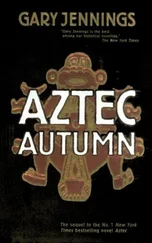
"Anyone who reads, anyone who still lusts for adventure or that book you can't put down, will glory in Aztec."--Los Angeles Times
Aztec
Aztec
Aztec — читать онлайн бесплатно полную книгу (весь текст) целиком
Ниже представлен текст книги, разбитый по страницам. Система сохранения места последней прочитанной страницы, позволяет с удобством читать онлайн бесплатно книгу «Aztec», без необходимости каждый раз заново искать на чём Вы остановились. Поставьте закладку, и сможете в любой момент перейти на страницу, на которой закончили чтение.
Интервал:
Закладка:
For example, I never lacked for water, thanks to his teachings. The most convenient source is the comitl cactus, which is why it is called the comitl, or jar. I would select a sizable one and lay a ring of twigs around it, and set them afire, and wait until the heat drove the comitl's moisture toward its interior. I then had only to slice off the top of the cactus, mash its inner pulp and squeeze the water from that into my leather bag. Also, each night, I cut down one of the tall, straight-trunked cactuses and laid it with its ends propped on rocks so that it sagged in the middle. By the morning, all its moisture would have collected in that middle, where I had only to cut out a plug and let the water trickle into my bag.
I seldom had any meat to cook over my evening campfire, except an occasional lizard, sufficient for about two mouthfuls—and once a rabbit which had still been kicking when I drove off the vulture tearing at it. But meat is not indispensable to the sustenance of life. Throughout the year, the mizquitl tree is festooned with seed pods, new green ones as well as the withered brown ones left from the year before. The green pods can be cooked to tenderness in hot water and then mashed into an edible pulp. The dry seeds inside the old pods can be crushed between two rocks to the consistency of meal. That coarse powder can be carried like pinoli and, when no fresher food is available, mixed with water and boiled.
Well, I survived, and I traveled in that dreadful desert for a whole year. But I need describe it no more, since every one-long-run was indistinguishable from every other. I will only add—in case you reverend friars cannot yet envision its vastness and emptiness—that I had been trudging through it for at least a month before I encountered another human being.
From a distance, because it was dust-colored like the desert, I took it to be just a strangely shaped hummock of sand, but as I got closer I saw it was a seated human figure. Rather joyfully, since I had been so long alone, I gave a hail, but I heard no reply. As I continued to approach I called again, and still I got no answer, though by then I was close enough to see that the stranger's mouth was open wide enough to be screaming.
Then I stood over the figure, a naked woman sitting on the sand and wearing a light powdering of it. If she had once been screaming, she was no more, for she was dead, with eyes and mouth wide. She sat with her legs out before her and parted, with her hands pressed flat on the ground as if she had died while trying strenuously to push herself erect. I touched her dusty shoulder; the flesh was yielding and not yet chill; she had not been dead for long. She stank of being unwashed, as no doubt I did too, and her long hair was so full of sand fleas that it might have writhed had it not been so matted. Nevertheless, given a good bath, she would have been handsome of face and figure, and she was younger than I was, with no marks of disease or injury, so I was puzzled as to the cause of her death.
During the past month, I had got into the habit of talking to myself, for lack of anyone else, so then I said to myself, forlornly, "This desert is surely abandoned by the gods—or I am. I have the good fortune to meet what is perhaps the only other person in all this wasteland, and by good fortune it is a woman, who would have been ideal for a traveling companion, but by ill fortune she is a corpse. Had I come a day earlier, she might have been pleased to share my journey and my blanket and my attentions. Since she is dead, the only attention I can pay is to bury her before the vultures come flocking."
I shed my pack and my water bag and began to scrape with my maquahuitl in the sand nearby. But I seemed to feel her eyes reproachfully on me, so I decided she might as well lie down restfully while I dug the grave. I dropped my blade and took the woman by her shoulders to ease her onto her back—and I got a surprise. She resisted my hands' pressure, she insisted on remaining in a sitting position, as if she had been a stuffed doll sewn to stay bent in the middle. I could not understand the body's reluctance; its muscles had not yet been stiffened, as I proved by lifting one of her arms and finding it quite limber. I tried again to move her, and her head lolled onto her shoulder, but her torso would not be budged. A mad thought came into my mind. Did desert people, when they died, perhaps grow roots that fixed them in place? Did they perhaps gradually turn into those giant but often very human-shaped quinametin cactuses?
I stepped back to consider the incomprehensibly stubborn cadaver—and was surprised again when I felt a sharp stab between my shoulderblades. I whirled around to find myself in a half circle of arrows, all pointed at me. Each was poised on the taut string of a bow, and every bow was held by an angrily frowning man, and every man was clad in nothing but a greasy loincloth of ragged leather, a crust of body dirt, and some feathers in his lank hair. There were nine of the men. Admittedly, I had been preoccupied with my peculiar find, and they had taken pains to come noiselessly, but I should have smelled them long before they were upon me, for their stink was that of the dead woman multiplied by nine.
"The Chichimeca!" I said to myself, or perhaps I said it aloud. I did say to them, "I just now happened upon this unfortunate woman. I was trying to be of help."
Since I blurted that out in a hurry, hoping it would hold back their arrows, I spoke in my native tongue of Náhuatl. But I accompanied the words with gestures intended to be understandable even by savages, and even in that tense moment I was thinking that, if I lived long enough to say anything else, I should have the task of learning yet another foreign language. But, to my surprise, one of the men—the one who had jabbed me with his arrow point, a man about my own age and nearly of my height—said in easily understandable Náhuatl:
"The woman is my wife."
I cleared my throat and said condolingly, as one does when imparting bad news, "I regret to say she was your wife. She appears to have died a short while ago." The Chichimecatl's arrow—all nine arrows—stayed aimed at my middle. I hastened to add, "I did not cause her death. I found her thus. And I had no thought of molesting her, even if I had found her alive."
The man laughed harshly, without humor.
"In fact," I went on, "I was about to do her the favor of burying her, before the scavengers should get at her." I indicated the place where my maquahuitl lay.
The man looked at the furrow I had begun, then up at a vulture already hovering overhead, then at me again, and his stern face softened somewhat. He said, "That was kindly of you, stranger," and he lowered his arrow and relaxed the bowstring.
The other eight Chicimeca did likewise, and tucked their arrows into their tangled hair. One of the men went to pick up my maquahuitl and examine it appraisingly; another began to poke through the contents of my pack. Maybe I was about to be robbed of what little I carried, but at least it seemed that I would not immediately be killed as a trespasser. To maintain the mood of amiability, I said to the just-widowed husband:
"I sympathize in your bereavement. Your wife was young and comely. Of what did she die?"
"Of being a bad wife," he said glumly. Then he said, "She was bitten by a rattle-tailed snake."
I could make no connection between his two statements. I could only say, "Strange. She does not at all appear to have been ill."
"No, she recovered from the venom," he growled, "but not before she had made her confession to Filth Eater, and with me at her side. The only bad deed she confessed to Tlazolteotl was her having lain with a man of another tribe. Then she had the misfortune not to die of the snakebite."
He shook his head somberly. So did I. He continued:
Читать дальшеИнтервал:
Закладка:
Похожие книги на «Aztec»
Представляем Вашему вниманию похожие книги на «Aztec» списком для выбора. Мы отобрали схожую по названию и смыслу литературу в надежде предоставить читателям больше вариантов отыскать новые, интересные, ещё непрочитанные произведения.










Обсуждение, отзывы о книге «Aztec» и просто собственные мнения читателей. Оставьте ваши комментарии, напишите, что Вы думаете о произведении, его смысле или главных героях. Укажите что конкретно понравилось, а что нет, и почему Вы так считаете.