Gary Jennings - Aztec
Здесь есть возможность читать онлайн «Gary Jennings - Aztec» весь текст электронной книги совершенно бесплатно (целиком полную версию без сокращений). В некоторых случаях можно слушать аудио, скачать через торрент в формате fb2 и присутствует краткое содержание. Жанр: Старинная литература, на английском языке. Описание произведения, (предисловие) а так же отзывы посетителей доступны на портале библиотеки ЛибКат.
- Название:Aztec
- Автор:
- Жанр:
- Год:неизвестен
- ISBN:нет данных
- Рейтинг книги:4 / 5. Голосов: 1
-
Избранное:Добавить в избранное
- Отзывы:
-
Ваша оценка:
Aztec: краткое содержание, описание и аннотация
Предлагаем к чтению аннотацию, описание, краткое содержание или предисловие (зависит от того, что написал сам автор книги «Aztec»). Если вы не нашли необходимую информацию о книге — напишите в комментариях, мы постараемся отыскать её.
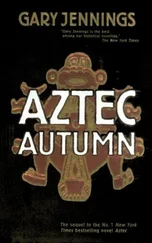
"Anyone who reads, anyone who still lusts for adventure or that book you can't put down, will glory in Aztec."--Los Angeles Times
Aztec
Aztec
Aztec — читать онлайн бесплатно полную книгу (весь текст) целиком
Ниже представлен текст книги, разбитый по страницам. Система сохранения места последней прочитанной страницы, позволяет с удобством читать онлайн бесплатно книгу «Aztec», без необходимости каждый раз заново искать на чём Вы остановились. Поставьте закладку, и сможете в любой момент перейти на страницу, на которой закончили чтение.
Интервал:
Закладка:
But I cut a long, stout pole, and sharpened the end of it, and with it I prodded deep into every feature of the local terrain that might conceivably not have been there since the world was first created: suspiciously isolated hills of earth, oddly uncleared thickets of scrub growth, the fallen-in remains of ancient buildings. I do not know whether my behavior moved the villagers to amusement or to pity of the alien madman or to simple curiosity, but at last they invited me to sit down and explain myself to their two most venerable elders.
Those old men answered my questions in as few and simple words as possible. No, they said, they had never heard of any such place as Atlitalacan, but if the name meant the same as D'ntado Dene, then D'ntado Dene was doubtless the same place. Because yes, according to their fathers' fathers' fathers, a long time ago a rough, ragged, and verminous tribe of outlanders had settled at the spring—for some years of residence—before moving on again and disappearing to the southward. When I delicately inquired about possible diggings and deposits therein, the two aged men shook their heads. They said n'yehina, which means no, and they said a sentence that they had to repeat several times before I laboriously made sense of it:
"The Aztéca were here, but they brought nothing with them, and they left nothing when they went."
Within not many days, I had left the regions where the last vestiges of even mongrel Náhuatl or Poré were spoken, and was well into the territory inhabited solely by Otomí speaking only Otomite. I did not travel an unswervingly fixed course, for that would have required me to climb trackless hills and scale formidable cliffs and fight my way through many cactus thickets, which I was sure the migrant Aztéca had not done. Instead, as they surely had done, I followed the roads, where there were any, and the more numerous well-trodden footpaths. That made my journey a meandering one, but always I bore generally northward.
I was still on the high plateau between the mighty mountain ranges invisibly far to the east and west, but as I progressed the plateau perceptibly sloped downward before me. Each day I descended a little farther from the highlands of crisp, cool air, and those days of late springtime got warmer, sometimes uncomfortably warm, but the nights were gentle and balmy. That was a good thing, for there were no wayside inns in the Otomí country, and the villages or farmsteads where I could request lodging were often far between. So most nights I slept on the open ground, and even without my seeing crystal I could make out the fixed star Tlacpac hung high above the northern horizon toward which I would plod again at dawn.
The lack of inns and other eating places did not work much hardship on me. The paucity of people in that region made the wild creatures less timid than they were in more populous places; rabbits and ground squirrels would sit up boldly from the grass to watch me pass; an occasional swift-runner bird would companionably pace at my very side; and at night an armadillo or opossum might even come to investigate my camp-fire. Although I carried no weapon but my maquahuitl, scarcely designed for hunting small game, I usually had to do no more than make a swipe with it to secure for myself a meal of fresh meat or fowl. For variety or for side dishes, there was a plenty of growing things.
The name of that northern nation, Otomí, is a shortened rendition of a much longer and less pronounceable term meaning something like "the men whose arrows bring down birds on the wing," though I think it must have been a very long time since hunting was their chief occupation. There are numerous tribes of the Otomí, but they all live by pastoral pursuits: farming tidy fields of maize, xitomatin, and other vegetables; or gathering fruit from trees and cactus; or collecting the sweet-water sap of the maguey plants. Their fields and orchards were so productive that they had a great surplus of fresh foods to send to Tlalteltolco and other foreign markets, and we Mexíca called their country Atoctli, The Fertile Land. However, as an indication of how lowly we regarded those people themselves: we ranked our octli liquor according to three grades of quality, respectively called fine, ordinary, and Otomí.
The Otomí villages all have nearly unpronounceable names—like the largest of them all, N't Tahi, the one your explorers of the northern regions now refer to as Zelalla. And in none of those mumble-named communities did I find a hidden supply store or any other trace of the Aztéca's ever having passed. In only an infrequent village could the aged local storyteller strain his memory backward to recall a tradition that yes, untold sheaves of years ago, a vagrant train of footsore nomads had slouched through the neighborhood, or stopped to rest for a time. And every such elder told me, "They brought nothing with them, and they left nothing when they went." It was discouraging. But then, I was a direct descendant of those vagabonds and I likewise brought nothing. Just once during my journey through those Otomí lands, I may have left a little something—
The Otomí men are short, squat, dumpy, and, like most farm folk, sullen and surly of disposition. The Otomí women are also small, but slim of body, and far more vivacious than their glum men. I will even say the women are pretty—from the knees upward—which I realize is a curious kind of compliment. What I mean is that they have fetching faces, nicely molded shoulders and arms and breasts and waists and hips and buttocks and thighs, but, below the knees, their calves are disappointingly straight and skinny. They dwindle tapering down to their tiny feet, giving the women somewhat the look of tadpoles balancing on their tails.
Another peculiarity of the Otomí is that they enhance their appearance—or so they believe—by the art they call n'detade, which means coloring themselves with permanent colors. They dye their teeth black or red, or alternately black and red. They adorn their bodies with designs of a blue color, pricked into the skin with thorns so the designs remain forever. Some make only a small decoration on the forehead or on a cheek, but others continue doing the n'detade, as frequently as they can stand the pain of it, over the skin of their entire body. They appear always to be standing behind the web of some extraordinary spider that spins blue.
The Otomí men, as far as I am concerned, are neither improved nor impaired by their adornment. For a while, I did think it a shame that so many otherwise handsome women should obscure their beauty behind those webs and whorls and patterns they could never remove. However, as I became more accustomed to seeing the n'detade, I must confess that I began to regard it as a subtle beguilement. The very veiling made the females seem in a measure unapproachable, and therefore challenging, and therefore tantalizing—
At the farthest northern extent of the Otomí lands was a riverside village called M'boshte, and one of the villagers was a young woman named R'zoono H'don we, which means Flower of the Moon. And flowery she was: every visible part of her blossoming with blue-drawn petals and leaves and fronds. Behind that artificial garden, she was fair of face and figure, excepting of course those disappointing calves. At first sight of her, I felt an urge to part her clothes and see how much of her was flower-petaled, then to make my way through the petals to the woman underneath.
Flower of the Moon was attracted to me, too, and I suspect in much the same way: an urge to enjoy an oddity, since my height and breadth, oversized even among the Mexíca, made me rather a giant among the Otomí. She conveyed to me that she was at the time unattached to any other male; she had been recently widowed, when her husband died in the R'donte Sh'mboi, the River Slate, which trickled past the village. Since that water was only about a hand span deep and almost narrow enough for me to jump across, I suggested that her husband must have been a very small man to have drowned in it. She laughed at that, and made me understand that he had fallen and cracked his skull on the river's slate bed.
Читать дальшеИнтервал:
Закладка:
Похожие книги на «Aztec»
Представляем Вашему вниманию похожие книги на «Aztec» списком для выбора. Мы отобрали схожую по названию и смыслу литературу в надежде предоставить читателям больше вариантов отыскать новые, интересные, ещё непрочитанные произведения.










Обсуждение, отзывы о книге «Aztec» и просто собственные мнения читателей. Оставьте ваши комментарии, напишите, что Вы думаете о произведении, его смысле или главных героях. Укажите что конкретно понравилось, а что нет, и почему Вы так считаете.