Gary Jennings - Aztec
Здесь есть возможность читать онлайн «Gary Jennings - Aztec» весь текст электронной книги совершенно бесплатно (целиком полную версию без сокращений). В некоторых случаях можно слушать аудио, скачать через торрент в формате fb2 и присутствует краткое содержание. Жанр: Старинная литература, на английском языке. Описание произведения, (предисловие) а так же отзывы посетителей доступны на портале библиотеки ЛибКат.
- Название:Aztec
- Автор:
- Жанр:
- Год:неизвестен
- ISBN:нет данных
- Рейтинг книги:4 / 5. Голосов: 1
-
Избранное:Добавить в избранное
- Отзывы:
-
Ваша оценка:
Aztec: краткое содержание, описание и аннотация
Предлагаем к чтению аннотацию, описание, краткое содержание или предисловие (зависит от того, что написал сам автор книги «Aztec»). Если вы не нашли необходимую информацию о книге — напишите в комментариях, мы постараемся отыскать её.
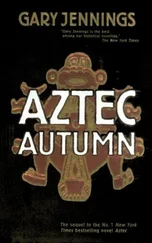
"Anyone who reads, anyone who still lusts for adventure or that book you can't put down, will glory in Aztec."--Los Angeles Times
Aztec
Aztec
Aztec — читать онлайн бесплатно полную книгу (весь текст) целиком
Ниже представлен текст книги, разбитый по страницам. Система сохранения места последней прочитанной страницы, позволяет с удобством читать онлайн бесплатно книгу «Aztec», без необходимости каждый раз заново искать на чём Вы остановились. Поставьте закладку, и сможете в любой момент перейти на страницу, на которой закончили чтение.
Интервал:
Закладка:
"I should be grateful for a sharing of your knowledge, venerable chief."
"Know then," said old Juice. "The legends tell that seven different tribes—among them your Aztéca—departed long ago from that Aztlan, The Place of Snowy Egrets, in search of a more pleasant place to live. The tribes were all related, they spoke the same language and recognized the same gods and observed the same customs, and for a long while that mixed company traveled amicably. But, as you might expect, among so many persons on such a long journey, there arose frictions and dissensions. Along the way, various of them dropped out of the march—families, whole calpuli clans, even entire tribes. Some quarreled and left, some stopped from sheer fatigue, some took a liking to a place in which they found themselves and decided to go no farmer. It is impossible now to say which of them went where. Over the sheaves of years since then, those truant tribes themselves have often fragmented and moved apart. It is known that your Aztéca continued all the way to wherever your Tenochtítlan now stands, and perhaps others also traveled that far. But we were not among them, we who are now the Chichimeca. That is why I say this. When your Aztéca crossed the desert lands, they left no stores for future use, they left no trace, they left nothing behind them but us."
His account sounded all too believable, and it was as disconcerting as the assertion of my earlier companion Meat: that the term Chichimeca embraced all peoples of our skin color. The implication was that, instead of finding anything of possible value, like the allegedly hidden hoards of stores, I had found only a horrid rabble eager to claim kinship as my cousins. Quickly putting that ghastly possibility out of my mind, I said with a sigh:
"I still would like to discover the whereabouts of Aztlan."
Chief Juice nodded, but said, "It is far from here. As I told you, the seven tribes came a long way from their homeland before they began to separate."
I looked northward, into what I had been told was an even more awful and limitless desert, and I groaned. "Ayya, then I must keep on through this blighted and accursed wasteland—"
The old man glanced in that direction. He looked mildly puzzled and he asked, "Why?"
Probably I also looked puzzled, at such a foolish question from a man I had thought fairly intelligent. I said, "The Aztéca came from the north. Where else should I be going?"
"North is not a place," he explained, as if I were the dullard. "It is a direction, and an imprecise direction at that. You have already come too far north."
I cried, "Aztlan is behind me?"
He chuckled at my dismay. "Behind, beside, and beyond."
I said impatiently, "And you speak of imprecise directions!"
Still laughing, he went on, "By keeping to the desert all the way, you moved always in a direction west and north, but not enough to the west. Had you not been misled by the notion of north, you might have found Aztlan long ago, without ever braving the desert, without ever leaving the living lands."
I made some sort of strangled noise. The chief continued:
"According to my fathers' fathers, our Aztlan was somewhere southwest of this desert, on the seashore, on the coast of the great sea, and surely there was never more than one Aztlan. But from there, our ancestors—and yours—did much circuitous wandering in those sheaves of years. Quite possibly the Aztéca's last march, as remembered in your Mexíca leg-ends, did bring them directly from the north into what is now Tenochtítlan. Nevertheless, Aztlan should lie almost directly northwest of there."
"So I must go back again... southwest from here..." I muttered, regretting all the dreary months and tedious one-long-runs and dirt and misery I had needlessly endured.
Old Juice shrugged. "I do not say you must. But if you will go on, I advise against your going farther north. Aztlan is not there. Northward is only more desert, more terrible desert, merciless desert in which even we hardy Mapimi cannot live. Only the Yaki can make even brief forays into that desert, and they only because they are more cruel than the desert itself."
I said, with sadness at the recollection, "I know what the Yaki are like. I will turn back, Chief Juice, as you advise."
"Go yonder." He gestured to the southward of where Tonatíu was dropping unowned into an unquilted bed behind the indistinct gray-white mountains which had kept pace with me—but kept their distance—all the way I had come through the desert. "If you would find Aztlan, you must go to those mountains, over those mountains, through those mountains. Beyond those mountains you must go."
* * *
And that is what I did: I went southwest, to and over and through and beyond the mountains. I had been seeing that remote, pale range for more than a year, and I fully expected to have to scale walls of sheer granite. But as I neared them, I saw that it had been only their distance that had made them appear so. The foothills rising from the desert were sparsely covered with typical dusty desert scrub, but the growth got denser and greener as I progressed. The genuine high mountains, when I reached them, I found to be as verdantly forested and hospitable as those of the Rarámuri country. Indeed, as I made my way through those mountains, I found cave villages where the inhabitants resembled the Rarámuri—even in the matter of bodily hair—and spoke very similar languages, and told me that they were in fact relatives of the Rarámuri, whose country, they said, was considerably farther north in that same mountain range.
So, when I came down from those heights at last, on the other side of the ranges, I came down to a beach somewhere south of the beach where I had landed after my involuntary sea voyage, more than ten years before. That coast is called the Sinalobola, I learned from the fisher tribes whose villages I found dotted along it. Those people, the Kaita, were not hostile to my traveling along their beaches, but neither were they inviting, they were simply indifferent; and their women smelled of fish. So I did not linger long in any of their villages as I went south along the Sinalobola, trusting in old Chief Juice's assertion that Aztlan was somewhere on that "coast of the great sea."
For most of my way, I kept to the level sands of the shore, with the ocean on my right hand. Sometimes I had to turn far inland to skirt a sizable lagoon or a coastal swamp or an impenetrable tangle of the stringy mangrove trees, and sometimes I had to wait on the bank of a river full of alligators until a Kaita boatman came by who would grudgingly ferry me to the other side. But my progress was more often rapid, unhindered, and uneventful. A cool breeze from off the ocean tempered the heat of the daytime sun, and after sundown the beach sands retained that same heat, so they were most comfortable to sleep on.
Long after I had left the Kaita lands and found no more villages where I could buy a meal of fish, I was able to dine well on those same odd drumming crabs that had frightened me when I first encountered them, years before. Also, the ocean's tidal movement led me to discover another seafood which I commend as a superbly tasty dish. I noticed that, whenever the waters receded, the flats of mud or sand were not entirely quiescent. Here and there, little spouts and plumes of water squirted upward from the exposed sea bed. Impelled by curiosity, I sloshed out across the flats, waited for one of the little wisps to squirt nearby, and dug down with my hands to find what had caused it. I came up with an ovoid, smooth blue shell, a clam as big as my palm. I suppose the spurt of water was its way of coughing sand out of its throat, or whatever a clam uses for a throat. Anyway, I splashed about the flats and collected an armload of the shellfish and took them ashore, intending to eat them raw.
Читать дальшеИнтервал:
Закладка:
Похожие книги на «Aztec»
Представляем Вашему вниманию похожие книги на «Aztec» списком для выбора. Мы отобрали схожую по названию и смыслу литературу в надежде предоставить читателям больше вариантов отыскать новые, интересные, ещё непрочитанные произведения.











Обсуждение, отзывы о книге «Aztec» и просто собственные мнения читателей. Оставьте ваши комментарии, напишите, что Вы думаете о произведении, его смысле или главных героях. Укажите что конкретно понравилось, а что нет, и почему Вы так считаете.