Jack Whyte - The Lance Thrower
Здесь есть возможность читать онлайн «Jack Whyte - The Lance Thrower» весь текст электронной книги совершенно бесплатно (целиком полную версию без сокращений). В некоторых случаях можно слушать аудио, скачать через торрент в формате fb2 и присутствует краткое содержание. Жанр: Старинная литература, на английском языке. Описание произведения, (предисловие) а так же отзывы посетителей доступны на портале библиотеки ЛибКат.
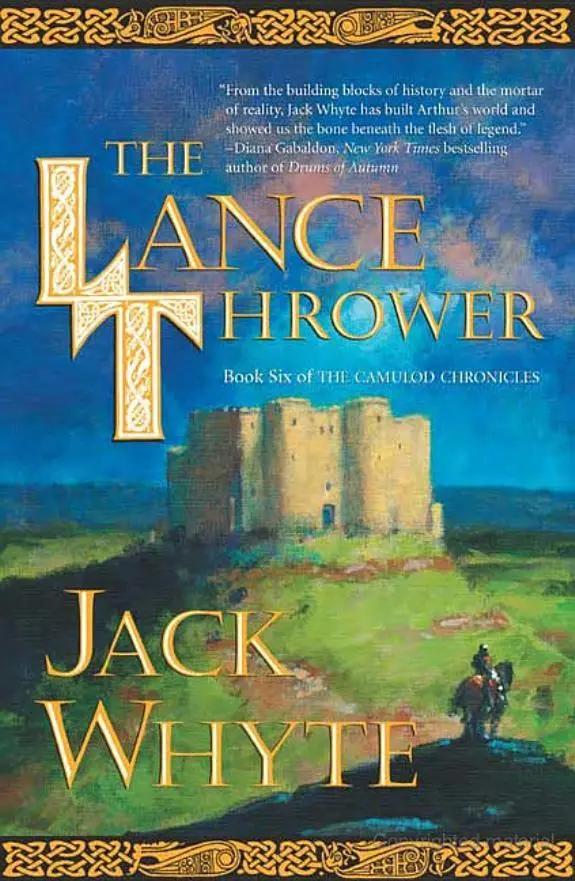
- Название:The Lance Thrower
- Автор:
- Жанр:
- Год:неизвестен
- ISBN:нет данных
- Рейтинг книги:5 / 5. Голосов: 1
-
Избранное:Добавить в избранное
- Отзывы:
-
Ваша оценка:
The Lance Thrower: краткое содержание, описание и аннотация
Предлагаем к чтению аннотацию, описание, краткое содержание или предисловие (зависит от того, что написал сам автор книги «The Lance Thrower»). Если вы не нашли необходимую информацию о книге — напишите в комментариях, мы постараемся отыскать её.
Clothar is a young man of promise. He has been sent from the wreckage of Gaul to one of the few schools remaining, where logic and rhetoric are taught along with battle techniques that will allow him to survive in the cruel new world where the veneer of civilization is held together by barbarism. He is sent by his mentor on a journey to aid another young man: Arthur Pendragon. He is a man who wants to replace barbarism with law, and keep those who work only for destruction at bay. He is seen, as the last great hope for all that is good.
Clothar is drawn to this man, and together they build a dream too perfect to last--and, with a special woman, they share a love that will nearly destroy them all...
The name of Clothar may be unknown to modern readers, for tales change in the telling through centuries. But any reader will surely know this heroic young man as well as they know the man who became his king. Hundreds of years later, chronicles call Clothar, the Lance Thrower, by a much more common name.
That of Lancelot.
The Lance Thrower — читать онлайн бесплатно полную книгу (весь текст) целиком
Ниже представлен текст книги, разбитый по страницам. Система сохранения места последней прочитанной страницы, позволяет с удобством читать онлайн бесплатно книгу «The Lance Thrower», без необходимости каждый раз заново искать на чём Вы остановились. Поставьте закладку, и сможете в любой момент перейти на страницу, на которой закончили чтение.
Интервал:
Закладка:
He shook his head gently. “No, they have not. They must be close by. Would you like us to hunt them?”
Now it was my turn to quirk my brow, alerted by his tone. “You don’t want to. Why not?”
“Because if we hunt them we will find them and then we will have to hang them and they will die in utter misery and great pain, and what will we have achieved, for all that pain and misery?”
“Justice, for these people!”
Cyrus glanced toward the hanged farmer and shook his head. “I think not, Master Clothar. Vengeance, perhaps. Revenge. But justice? By whose criteria? Justice in your eyes, perhaps. But who are you, in the absence of any and all laws, to judge what might have happened to reduce the people who did this to such a condition? Or do you believe they might have been born as monstrous as they were today when they did this? Something, probably a number of contributing factors must have combined to make these people behave like this, and many of those factors might be things the like of which you could never imagine: starvation; suffering; deprivation; cruelty at the hands of other, stronger folk. But even if that is not the case, and they are simply monsters, I would still say no to hunting them. There are too many thousands like them between us and Verulamium, and our task is to find Bishop Enos, not to right the wrongs of a godless world.”
I nodded, a single, abrupt dip of my head. “You are right, Tribune. Inarguably. And I am an ignorant Outlander with too many questions and no appropriate answers. Ride with me, if you will, and educate me further.”
I pulled myself up into my saddle and wheeled away without another glance at the charnel house in the small clearing to ride with Cyrus at the head of our column as we trotted back toward the high roadway that cut across the horizon in a perfectly level slash of blackness.
We talked together at great length thereafter, Cyrus and I, and I learned much from him about the rule of law in Camulod, as devised and laid down by Merlyn Britannicus and his forebears: his father, Picus Britannicus, his grandsire Caius Britannicus, and his great-uncle Publius Varrus.
Cyrus, it transpired, was a student of law, not merely the laws of Camulod but those of Rome itself. His grandsire’s father had been a lawyer in the days before Camulod was founded and had later worked with Caius Britannicus to establish the colony, which at that time had no name, and to draft the first of what would become Camulod’s own laws in later years. Since then, Cyrus told me with pride, his family had been involved in governing the colony, as members of the Council of Camulod and custodians of the justiciary of the colony. It was their right and privilege to guard and maintain the written annals and records of the Camulodian law and its tribunals, and they had steadfastly upheld that responsibility since it was entrusted to them by Caius Britannicus himself, the founder of Camulod.
Cyrus himself was now fully prepared to assume the burden of his family responsibility whenever it should be passed on to him. For the time being, however, he served the colony, as all its men did, in a military capacity.
At one point while he and I were talking I noticed a trio of horsemen watching us from high above, on the side of a hill, and when I mentioned it to Cyrus he merely glanced up at them, then returned his gaze to the road ahead.
“They’re bandits. They won’t bother us because we’re too strong for them. And we won’t bother them, because they’re too far away and we would have to work too hard to come in reach of them, with no guarantee that we ever would. The fellow in the red cloak is notorious in these parts. They call him the Ghost, because he seems to have the ability to be in more than one place at the same time. He’s instantly recognizable by the red cloak, of course, but it doesn’t seem to have occurred yet to the people in these parts that he might own more than one cloak, and that he might perhaps issue them to certain friends of his for specific purposes. It’s always the cloak that’s seen; seldom the man’s face.”
“How many men does he have?”
“Altogether about a hundred, perhaps a score or so more, plus all their women and camp followers. That’s a lot of mouths to feed, for a bandit chief, so he has to keep traveling and raiding.”
I was looking up to where the so-called Ghost sat on his horse, watching us. He seemed utterly unperturbed by our presence.
“If he has a hundred and more men, why do you say we’re too strong for. him?”
Cyrus chuckled. “Because we’re cavalry. He might have twenty horsemen, at most, and none of them are trained in anything except staying on a horse’s back. The rest of his men are all leg-mounted. We would crush them like a rotten nut, in one charge.”
“He doesn’t seem worried about being caught.”
“Nor need he be. He knows he is not at risk, not today. One of these days, though, we’ll catch him and his marauding will be ended.”
“What will you do to him then? Hang him?”
Again the young tribune almost smiled, his face sobering just before his amusement could break out. “We might, although we have yet to hang anyone merely for being in disagreement with us. If he were to do something truly heinous, something completely outrageous that cried out for punishment, we might hang him and put an end to it. One of the men with whom we were at war in Cambria was such a creature—Carthac. He was a real devil, utterly incapable of mercy or compassion, and he received none from us when his time came. Merlyn killed him without compunction because there was no other option. There is simply no way to deal with, or to control, someone like that.”
He sniffed and glanced back to where the Ghost yet stood on the hillside. “Simple banditry, though, as carried out by the Ghost up there, really boils down to feeding and providing for his people, and although admittedly he does it wantonly and at the dire expense of others, we have heard no reports of gross atrocities being laid at his feet. For that, and all his other crimes, we would probably simply disarm him and turn him loose afoot and weaponless, with a warning of what he can look forward to should we ever encounter him again at the same game.”
Cyrus turned in his saddle then and gave the arm signal for our column to increase speed to a trot, and for a while after that there was no opportunity to talk further.
The network of magnificent roads that stretched all over Britain was, in my opinion, the single greatest marvel in the entire land, particularly so since it had existed for hundreds pf years and was now barely used. That lack of use allowed an observer such as me to appreciate the complexity of all the work and planning that had gone into the construction of the network in the first place, but it was disconcerting to see such roads so deserted, because the traffic on the main roads of Gaul was so often dense and frantic. I had discussed the matter of road use at length with Donuil and Shelagh the night before we left for Verulamium, and what they had told me was fresh in my mind.
Donuil had said that the roads had fallen into disuse simply because they provided a focus for all the disruptive forces that existed to prey upon travelers. Bandits and thieves knew well that if they positioned themselves properly along a road they would, sooner or later, be easily able to intercept and rob any travelers who came along and were unequipped to fight strongly in their own defense. We, being who we were, were safe from any such threat, but few other people could afford to travel in the company of guardians strong enough to discourage attack, and so the roads had lain largely unused since the departure of the legions who had built, used, and maintained them.
Читать дальшеИнтервал:
Закладка:
Похожие книги на «The Lance Thrower»
Представляем Вашему вниманию похожие книги на «The Lance Thrower» списком для выбора. Мы отобрали схожую по названию и смыслу литературу в надежде предоставить читателям больше вариантов отыскать новые, интересные, ещё непрочитанные произведения.







Обсуждение, отзывы о книге «The Lance Thrower» и просто собственные мнения читателей. Оставьте ваши комментарии, напишите, что Вы думаете о произведении, его смысле или главных героях. Укажите что конкретно понравилось, а что нет, и почему Вы так считаете.