Jack Whyte - The Lance Thrower
Здесь есть возможность читать онлайн «Jack Whyte - The Lance Thrower» весь текст электронной книги совершенно бесплатно (целиком полную версию без сокращений). В некоторых случаях можно слушать аудио, скачать через торрент в формате fb2 и присутствует краткое содержание. Жанр: Старинная литература, на английском языке. Описание произведения, (предисловие) а так же отзывы посетителей доступны на портале библиотеки ЛибКат.
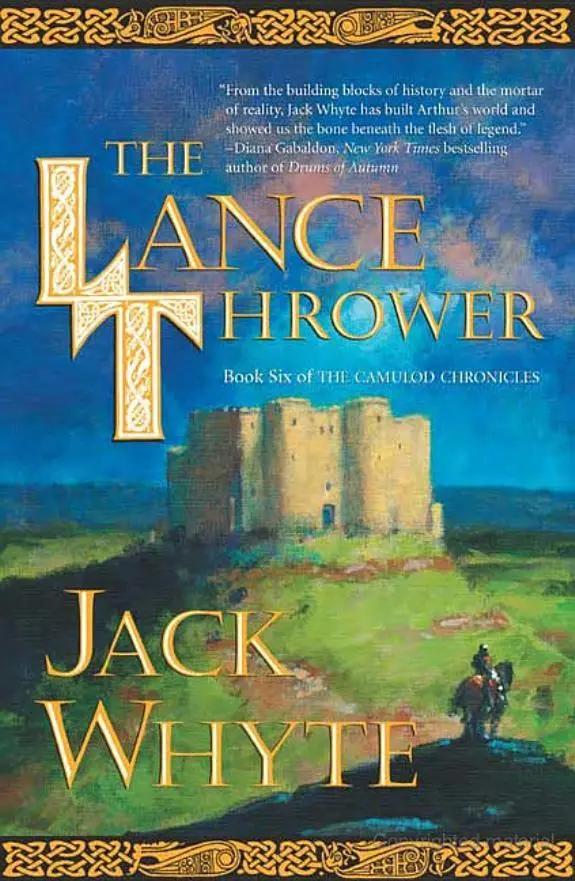
- Название:The Lance Thrower
- Автор:
- Жанр:
- Год:неизвестен
- ISBN:нет данных
- Рейтинг книги:5 / 5. Голосов: 1
-
Избранное:Добавить в избранное
- Отзывы:
-
Ваша оценка:
The Lance Thrower: краткое содержание, описание и аннотация
Предлагаем к чтению аннотацию, описание, краткое содержание или предисловие (зависит от того, что написал сам автор книги «The Lance Thrower»). Если вы не нашли необходимую информацию о книге — напишите в комментариях, мы постараемся отыскать её.
Clothar is a young man of promise. He has been sent from the wreckage of Gaul to one of the few schools remaining, where logic and rhetoric are taught along with battle techniques that will allow him to survive in the cruel new world where the veneer of civilization is held together by barbarism. He is sent by his mentor on a journey to aid another young man: Arthur Pendragon. He is a man who wants to replace barbarism with law, and keep those who work only for destruction at bay. He is seen, as the last great hope for all that is good.
Clothar is drawn to this man, and together they build a dream too perfect to last--and, with a special woman, they share a love that will nearly destroy them all...
The name of Clothar may be unknown to modern readers, for tales change in the telling through centuries. But any reader will surely know this heroic young man as well as they know the man who became his king. Hundreds of years later, chronicles call Clothar, the Lance Thrower, by a much more common name.
That of Lancelot.
The Lance Thrower — читать онлайн бесплатно полную книгу (весь текст) целиком
Ниже представлен текст книги, разбитый по страницам. Система сохранения места последней прочитанной страницы, позволяет с удобством читать онлайн бесплатно книгу «The Lance Thrower», без необходимости каждый раз заново искать на чём Вы остановились. Поставьте закладку, и сможете в любой момент перейти на страницу, на которой закончили чтение.
Интервал:
Закладка:
The roads represented the pragmatism of Rome’s military genius. Knowing the shortest distance between two points to be a straight line, the ancient Romans had made it their first priority, from the earliest days of their military expansion, to construct roads for the convenience and the provisioning of their ubiquitous armies. The Roman legions, moving at the forced march pace along these magnificently straight causeways, could cover greater distances in less time than any other armies in history.
But mobility and ease of transportation were merely the most obvious aspects of the genius underlying Rome’s road-building program. Another aspect, equally important, solved the ages-old problem of how to keep soldiers disciplined and usefully occupied during those times when they were not involved in war or preparing for war. In the ancient days of Republican Rome, the answer to that problem had been twofold: at the end of each day, after marching all day and eating on the move, the soldiers of each individual unit had been required to build an entire camp, fortified and defended on all four sides by a ditch and a defensive wall, to a specific plan that remained unchanged for hundreds of years. Only after the camp had been built and occupied were they permitted to relax and enjoy their only hot meal of the day. Then, the following morning before they resumed their march, they had to break down the camp they had built so painstakingly the night before. Thus the moving units of the armies were kept occupied, and effectively tired, with little time for dreaming up mischief and mayhem.
Their stationary counterparts, soldiers on garrison duty or those not currently marching over long distances, had their time filled for them by their superiors, too, all day, every day. They were kept hard at work building new roads or expanding and maintaining existing roads and buildings.
Over time, of course, what was temporary became permanent, and many of the overnight marching camps became permanent outposts, positioned at strategic road junctions or along particular stretches of road that had been identified as being in need of close supervision. And over the course of years and decades of the same efforts to keep soldiers busy and hard at work, the palisaded earthen ramparts of the original camps gave way to permanent walls of quarried, hand-dressed stone.
Meanwhile, outside the walls of these selfsame camps, the stalls and lean-to shelters of the tradesmen and merchants whose livelihood depended upon supplying the garrisons with all their needs were gradually replaced by solid, substantial buildings containing shops and manufactories for all kinds of commodities. And as these premises grew larger and required more and more support, they attracted workers and gave rise to towns.
Looking at those wondrous, unused roads in Britain, so different from the great, bustling highways of Gaul, I remembered clearly my own wonder and awestruck fascination when I first heard, at the Bishop’s School, about the saga of the Roman roads and how they had transformed Rome’s world. Because once the Empire had been pacified and the Pax Romana established, what remained was an open network of beautiful, publicly maintained roads connecting thriving towns everywhere, and that reality, combined with the ease and swiftness of transportation and communication, gave rise to commerce, so that eventually the hurrying bodies of troops for whom the roads had been originally built were supplanted by the caravans and wagon trains of trading merchants who bought and sold goods and commodities from all parts of the Empire and beyond its boundaries. And as the merchants prospered, so, too, did their society. But then had come the beginnings of the dissolution of the Empire and the weakening of the Pax Romana, and what had since happened here in Britain was a microcosm of what was happening to a greater or lesser degree in the rest of the Roman world. The roads were no longer safe because they could not be protected, and so almost overnight they had been transformed from avenues of opportunity and growth into long, inimical, tree-shrouded lanes filled with the threats of imminent violence and the constant fear of invasion and enslavement. Cyrus’s words about Camulod’s army not being big enough gained more and more relevance as I thought about what he had meant, and although the notion seemed strange to me at first, I soon began to accept that much of the rule of law might be restored here by the simple expedient of having bands of armed and dedicated men patrolling the roads to safeguard travelers and discourage thieves and bandits.
It took us nearly two weeks to travel from Camulod to Verulamium. That was several days longer than it ought to have taken us, yet the journey across the belly of Britain was largely uneventful, and in fact highly enjoyable once we had reached the truly uninhabited uplands, and when we finally reached Verulamium we found Bishop Enos in residence.
Verulamium was a shell of a place that could barely lay title to the name of town any longer, and the bishop’s residence was a plain, unimpressive building, long and low and purely functional, with no single element of beauty to distinguish it. But it was built of stone and it boasted a solid and enduring roof made of tiles imported many years earlier from Gaul. The town had once been a thriving regional center, and the evidence of that was plain to be seen everywhere and most particularly in the surviving public buildings of the old administrative center, many of which were imposing and spacious. With the departure of the legions, however, and the subsequent eruption of anarchy over the ensuing decade when people lost all fear of being punished for anything they chose to do, Verulamium became, like most of the other towns in Britain, too dangerous a place in which to live, because it attracted plunderers and looters the way a carcass attracts flies. And so most of it had been abandoned, left to the mercy of the elements.
One thing had saved the place from being completely abandoned to neglect and decay, however, and that single thing was the reason for the continuing presence of Bishop Enos and the long line of bishops who had lived and worshiped there before his time. Verulamium had been the home of Britain’s first Christian martyr, a saint called Alban. Alban had been executed by the Roman authorities two hundred years earlier, in the third century of the new, Christian calendar, for saving the life of a proscribed Christian priest during one of the periodic persecutions of the sect in the days before the Emperor Constantine had emancipated them and their religion by taking up the Cross himself. When arrested and challenged for his so-called crime—providing aid and sustenance to an enemy of the state—Alban had steadfastly refused to recant his newfound belief in’the one true God and had been decapitated for his faith.
After that, the town had quickly become widely revered as the home of the blessed Saint Alban, and a shrine had been erected there in his honor, in response to the occurrence of several miraculous and unexplainable wonders. Even to the present time, according to Bishop Enos, miracles continued to occur as the result of the saint’s blessed presence, and the shrine continued to attract more and more visitors with every year that passed. The town of Verulamium might be as dead as its Roman past, Enos remarked to me, but Saint Alban’s shrine would never know oblivion, and in recent years people had stopped talking of the town as Verulamium, referring to it nowadays simply as Saint Alban’s Shrine.
There was a gathering of some kind going on when we arrived there, and the unexpected appearance of a large band of disciplined horsemen caused no small amount of consternation among the participants. Bishop Enos himself, who was a much older man than I had expected him to be, was the first to recognize the armor and trappings of our Camulodian troopers and he quickly brought his flock to order, explaining to them who we were and promising that no one had any reason to be afraid of us.
Читать дальшеИнтервал:
Закладка:
Похожие книги на «The Lance Thrower»
Представляем Вашему вниманию похожие книги на «The Lance Thrower» списком для выбора. Мы отобрали схожую по названию и смыслу литературу в надежде предоставить читателям больше вариантов отыскать новые, интересные, ещё непрочитанные произведения.








Обсуждение, отзывы о книге «The Lance Thrower» и просто собственные мнения читателей. Оставьте ваши комментарии, напишите, что Вы думаете о произведении, его смысле или главных героях. Укажите что конкретно понравилось, а что нет, и почему Вы так считаете.