Jack Whyte - The Lance Thrower
Здесь есть возможность читать онлайн «Jack Whyte - The Lance Thrower» весь текст электронной книги совершенно бесплатно (целиком полную версию без сокращений). В некоторых случаях можно слушать аудио, скачать через торрент в формате fb2 и присутствует краткое содержание. Жанр: Старинная литература, на английском языке. Описание произведения, (предисловие) а так же отзывы посетителей доступны на портале библиотеки ЛибКат.
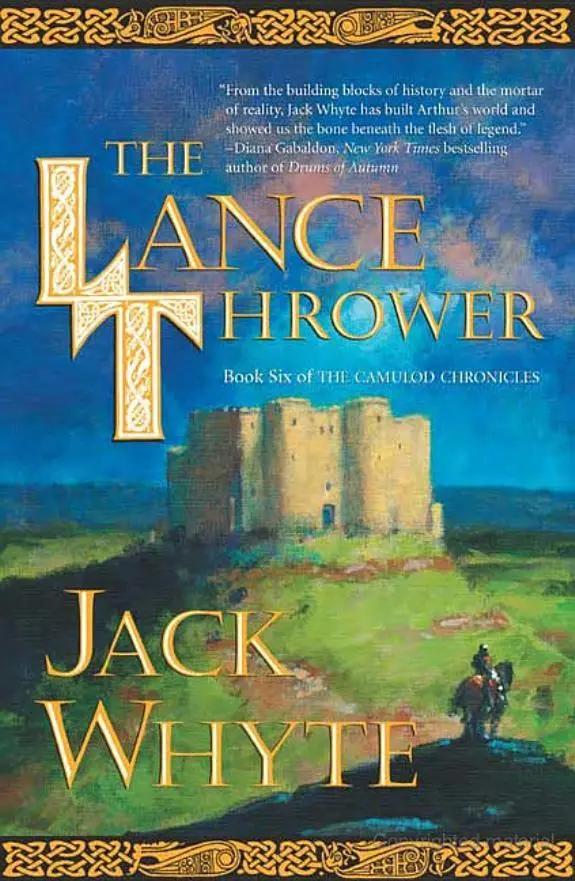
- Название:The Lance Thrower
- Автор:
- Жанр:
- Год:неизвестен
- ISBN:нет данных
- Рейтинг книги:5 / 5. Голосов: 1
-
Избранное:Добавить в избранное
- Отзывы:
-
Ваша оценка:
The Lance Thrower: краткое содержание, описание и аннотация
Предлагаем к чтению аннотацию, описание, краткое содержание или предисловие (зависит от того, что написал сам автор книги «The Lance Thrower»). Если вы не нашли необходимую информацию о книге — напишите в комментариях, мы постараемся отыскать её.
Clothar is a young man of promise. He has been sent from the wreckage of Gaul to one of the few schools remaining, where logic and rhetoric are taught along with battle techniques that will allow him to survive in the cruel new world where the veneer of civilization is held together by barbarism. He is sent by his mentor on a journey to aid another young man: Arthur Pendragon. He is a man who wants to replace barbarism with law, and keep those who work only for destruction at bay. He is seen, as the last great hope for all that is good.
Clothar is drawn to this man, and together they build a dream too perfect to last--and, with a special woman, they share a love that will nearly destroy them all...
The name of Clothar may be unknown to modern readers, for tales change in the telling through centuries. But any reader will surely know this heroic young man as well as they know the man who became his king. Hundreds of years later, chronicles call Clothar, the Lance Thrower, by a much more common name.
That of Lancelot.
The Lance Thrower — читать онлайн бесплатно полную книгу (весь текст) целиком
Ниже представлен текст книги, разбитый по страницам. Система сохранения места последней прочитанной страницы, позволяет с удобством читать онлайн бесплатно книгу «The Lance Thrower», без необходимости каждый раз заново искать на чём Вы остановились. Поставьте закладку, и сможете в любой момент перейти на страницу, на которой закончили чтение.
Интервал:
Закладка:
“A man called Caius Britannicus, grandsire to Merlyn and the founder of the place now called Camulod, had become a friend to Flavius Stilicho during the Regent’s campaign here. The Regent named this man Legatus emeritus and granted him temporary ownership of all the abandoned Roman cavalry mounts, charging him with keeping them safe and secure pending the return of the legions to Britain. But the legions never returned, and those Roman horses became the foundation of the cavalry of Camulod and triggered the ascendancy of Merlyn’s colony.”
I fell silent then, and it felt as though I had been talking for a very long time, but neither of my companions made any comment on anything I had said. We proceeded for almost a mile before Tristan broke the silence.
“It has not stopped raining in seven days,” he said. “Not once. I forget what the sky looks like without clouds. I can barely remember sunshine. I think we may die here in Britain, drowned in rainwater. Most of all, though, I’m longing for the warmth and dryness of that filthy old warehouse in Glevum. I think God must have forgotten we’re here.”
I sat gazing at him for long moments, slightly stunned by the obliqueness of what he had said. And then it occurred to me that he had offered an apt, valid, and pertinent comment on the importance of my impromptu history lesson and its relevance here and now. I nodded my head, accepting that I had been talking about something that was of absolutely no value today, and glanced up at the sky.
“Sweet Jesus!” As the others swung to face me I pointed upward. “Look!”
To the east, a golden beam of sunlight had sprung blazing, clean edged and brilliant from a narrow, bright blue gap in the clouds.
From that moment when I saw the first ray of sunshine breaking through the rain clouds, Britain seemed to change its mind and welcome us, showing us warmth and beauty and hospitality where before we had know only dankness, gloom, and despondency.
The memory of my first sight of the distant fortress of Camulod, sitting high on its wooded hill overlooking the rich and fertile plain beneath, has remained with me ever since. Strangely enough, looking back upon it across the distance of years, I realize now that I did not think of the place as a fortress at all when I first saw it. I saw Camulod from afar as a place of great and exciting beauty, rather than as a defensive bastion. I saw and accepted immediately that the place had none of the grandeur or magnificence of the great, castellated fortresses of Gaul, and in the years to come I would see many finer and stronger buildings and fortifications along the southeast coastline of Britain itself, the so-called Forts of the Saxon Shore, built by the Roman occupying forces hundreds of years earlier and abandoned when the legions left.
What I saw in the distance that first day, for reasons I have never known or sought to understand, was a symbol of hope and, most surprisingly in retrospect, of peace, because it had become obvious by the time we came within sight of Camulod that day that, despite what Philip had told us about Britain being at peace, we were in a land fully prepared for war. There were parties of soldiers moving everywhere we looked, mainly cavalry but with a substantial leavening of infantry, and we were challenged constantly by people demanding to know who we were and what we were about. Fortunately, the fact that we were all well-dressed and well-mounted worked in our favor, for it quickly became apparent to us that the enemy, whoever they might be, went largely afoot and owned little of the sophisticated weaponry carried by the troopers of Camulod. That word, troopers, was a new word to me, but one that was easy enough to understand, and I added it to my vocabulary instinctively. Close to the hilltop fort itself, at the bottom of the winding road that swept up to the main gates concealed behind the curtain wall, a vast training ground, of hard-packed earth that showed no single blade of grass, was filled to apparent capacity with constantly moving groups of training troopers.
That close to the castle walls, no one paid us any attention and we mounted all the way to the main gates before we were challenged again, this time by the senior member of a vigilant band of guards who stood before the gates, eyeing everyone who came and went, and from time to time questioning anyone who excited their curiosity or caution. I remained mounted and stated our business, saying that I knew Merlyn Britannicus was not available, but asking to meet with someone who could speak on his behalf.
That someone turned out to be a giant of a man, perhaps twice my own age, who strode out from the gates sometime later and stood looking down at us without speaking for several moments, his arms crossed upon his enormously broad chest as he examined each of us from head to foot. The guards had told us to dismount while we were waiting for this fellow to be summoned, and now that he had come I found myself wishing I had remained on horseback. Even unarmored and wearing only a simple tunic, the fellow was hugely tall and intimidating, even larger and stronger looking than my cousin Brach, the biggest, most muscular and imposing man I had ever known.
The giant made no effort to speak to us at first, more concerned with assessing any threat that we might represent to him or to his people. His eyes moved over each of us meticulously, missing nothing and even examining the harness and trappings of our horses. Finally, however, he seemed satisfied and nodded very slightly, the set of shoulders relaxing visibly. He introduced himself, in a voice that was pleasantly deep and surprisingly gentle, as Donuil Mac Athol, adjutant to Merlyn Britannicus. I heard the name at first as Donnel, and it was only months later, once I had come to know him and his speech, that I was able to identify the soft “oo” vowel that changed the pronunciation of his name from “Donn el ” to “Don ul. ” He spoke in Latin, as did we all, but with an intonation I had never heard before. Knowing him to be a local of some description merely from his name—Mac Athol meant “son of Athol” in the Gallic tongue—I assumed he was a northerner, from the mountains, perhaps a Cambrian. It transpired that I was wrong. He was a Scot, from the island of Hibernia across the western sea. He called his homeland Eire, disdaining Hibernia as a Roman name, but that, too, I would only learn later.
I had said nothing to him until then and had no way of knowing whether or not he had been told who we were or what we wanted with Merlyn, but he addressed me first, ignoring my two older companions.
“You come from Auxerre? From Germanus?” I nodded, and he continued before I could say anything. “Well, I hope there’s no great urgency to your mission. Merlyn is gone, where and for how long no one knows, not even my wife, and that’s a wonder, for she knows everything. Tell me your names.”
I introduced myself first, and then Perceval, Tristan, and Bors. Donuil stood silently as I did so, his eyes moving to each person as I said their names, and when I had finished he nodded again. “Good, then. I have them. Perceval, Tristan, and Bors. Be welcome in Camulod. Come inside now and we’ll find someone to look after your things for you, your gear, and your horses … although I imagine you, young fellow, will want to stay with your beasts and make sure no one touches anything without your say-so, am I right?” When Bors nodded, Donuil grinned in response. “Aye, I’d have been disappointed had you said otherwise. So be it. We’ll come back and find you in a while. But you three, are you thirsty? We have some fine brewers of beer here in Camulod. Come you and let’s see if we can find some of their best.”
After dinner that night, on what was merely the first of many long, pleasant evenings by the fire in the quarters belonging to Donuil and his lustrous and beautiful wife, Shelagh, we received our first lessons in the intimate, family tale of the development of Camulod and the two families, Britannicus and Varrus, that had brought it into being and shaped it into the self-contained and practically self-sufficient society it had become.
Читать дальшеИнтервал:
Закладка:
Похожие книги на «The Lance Thrower»
Представляем Вашему вниманию похожие книги на «The Lance Thrower» списком для выбора. Мы отобрали схожую по названию и смыслу литературу в надежде предоставить читателям больше вариантов отыскать новые, интересные, ещё непрочитанные произведения.







Обсуждение, отзывы о книге «The Lance Thrower» и просто собственные мнения читателей. Оставьте ваши комментарии, напишите, что Вы думаете о произведении, его смысле или главных героях. Укажите что конкретно понравилось, а что нет, и почему Вы так считаете.