Jack Whyte - The Lance Thrower
Здесь есть возможность читать онлайн «Jack Whyte - The Lance Thrower» весь текст электронной книги совершенно бесплатно (целиком полную версию без сокращений). В некоторых случаях можно слушать аудио, скачать через торрент в формате fb2 и присутствует краткое содержание. Жанр: Старинная литература, на английском языке. Описание произведения, (предисловие) а так же отзывы посетителей доступны на портале библиотеки ЛибКат.
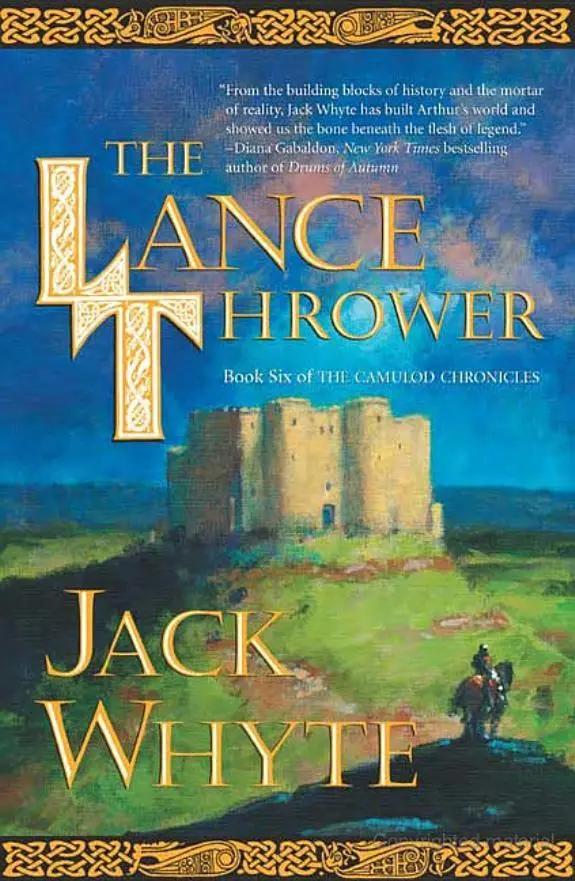
- Название:The Lance Thrower
- Автор:
- Жанр:
- Год:неизвестен
- ISBN:нет данных
- Рейтинг книги:5 / 5. Голосов: 1
-
Избранное:Добавить в избранное
- Отзывы:
-
Ваша оценка:
The Lance Thrower: краткое содержание, описание и аннотация
Предлагаем к чтению аннотацию, описание, краткое содержание или предисловие (зависит от того, что написал сам автор книги «The Lance Thrower»). Если вы не нашли необходимую информацию о книге — напишите в комментариях, мы постараемся отыскать её.
Clothar is a young man of promise. He has been sent from the wreckage of Gaul to one of the few schools remaining, where logic and rhetoric are taught along with battle techniques that will allow him to survive in the cruel new world where the veneer of civilization is held together by barbarism. He is sent by his mentor on a journey to aid another young man: Arthur Pendragon. He is a man who wants to replace barbarism with law, and keep those who work only for destruction at bay. He is seen, as the last great hope for all that is good.
Clothar is drawn to this man, and together they build a dream too perfect to last--and, with a special woman, they share a love that will nearly destroy them all...
The name of Clothar may be unknown to modern readers, for tales change in the telling through centuries. But any reader will surely know this heroic young man as well as they know the man who became his king. Hundreds of years later, chronicles call Clothar, the Lance Thrower, by a much more common name.
That of Lancelot.
The Lance Thrower — читать онлайн бесплатно полную книгу (весь текст) целиком
Ниже представлен текст книги, разбитый по страницам. Система сохранения места последней прочитанной страницы, позволяет с удобством читать онлайн бесплатно книгу «The Lance Thrower», без необходимости каждый раз заново искать на чём Вы остановились. Поставьте закладку, и сможете в любой момент перейти на страницу, на которой закончили чтение.
Интервал:
Закладка:
The decurion greeted us with a courteous nod and then sat silently beside us, and within a short time we heard the approaching cavalry squadrons. Their leaders, riding in the vanguard, drew rein on our side of the road as they neared us, and the decurion rode forward to explain our presence. They listened and nodded, then rode on by us with the decurion, nodding courteously but otherwise paying us no attention. When the last of the thousand had passed us by, their remounts, several hundreds in number, followed after them, herded by a large number of boys below fighting age, and we sat watching until the last of the animals had disappeared from view along the road behind the shrouds of falling rain.
Only then did Perceval turn to me with an admiring grunt. “I can’t believe that the only thing in this godforsaken country that I haven’t hated on sight is one and a half thousand of the finest horses I’ve ever seen. Where do they find beasts like that? I can’t believe they breed them here in such an unholy climate.”
“Believe it,” I told him. “They breed them all here now, according to Germanus, but their origins were Empire-wide. Let’s be off. It’s not far now to Camulod and I would like a roof over my head as soon as it can be arranged. I’ll tell you what Germanus told me about their cavalry as we ride.”
We kicked our horses into motion, and Perceval and Tristan ranged themselves on either side of me while young Bors rode close behind us, straining to hear.
I raised my voice until I was almost shouting over the noise of the rain. “The story goes that seventy-one years ago, in the year 376, in a place called Adrianopolis in Asia Minor beyond the eastern edges of the Middle Sea, a Roman consular army of forty thousand men, commanded by the Co-emperor Valens, was overrun and wiped out by a mounted force of Ostrogoths. It was a freakish accident and it should never have happened, but it did. The Goths were migrating from one region to another. They even had their women and children with them. But they were all mounted, on small, shaggy ponies, and they crested a mountain ridge to see an entire Roman army below them, marching in extended order along the edge of a lake. They charged immediately and caught the legions before they could form up in battle order, then rolled them up like a carpet. Forty thousand Romans died that afternoon, including Valens and his entire staff, and the word went out that the Romans were vulnerable to attack by massed formations of horsemen.” I glanced from side to side and saw that both my friends were listening closely, so I kept talking.
“Theodosius was still Emperor at that time, and Flavius Stilicho, who was half Roman and half Vandal, was his most brilliant legatus., Stilicho had been appointed commander in chief of the Imperial Household Troops—in other words, commander in chief of all Rome’s legions and the most powerful soldier in the world—at the age of twenty-two. They say he was the greatest natural military genius since Alexander the Great of Macedon. Anyway, Stilicho launched an immediate-priority program to reequip and retrain all the legions of Rome in order to counteract this new threat of mounted attack, and within the space of twenty-five years he had increased each legion’s cavalry strength from the traditional five percent of light, skirmishing cavalry—mounted archers whose sole duty was to form a mobile defensive screen while the legion was forming its battle lines—to twenty-five percent heavy, disciplined cavalry that operated in the manner of Alexander’s heavy cavalry of six hundred years earlier, riding in tightly packed, disciplined formations and carrying heavy spears.” I paused, allowing them to absorb what I had said before continuing. “Now that might not sound like much of a feat when you hear someone say it as quickly and plainly as I have just said it, but don’t let that mislead you. Think about what was involved in those changes.” I paused again.
“It was an enormous undertaking, according to everything the Bishop told me, and he had made a study of all it involved. That Stilicho was able to achieve such a transformation at all was astonishing, Germanus says, for in order to succeed he had first to confront and defeat the opinions and the plotting of the stubborn, old-guard traditionalists who didn’t want anything to change and who believed that the old ways were always and would always be the best ways. And the fact that most of them resented him for his youth and his brilliance did not make his task any easier. Stilicho simply never quit, never wavered in his resolve, and eventually he won. But that he was able to achieve what he did within twenty-five short years was nothing short of miraculous … .” I stopped talking and looked from one to the other of them and they stared back at me, waiting. “I know the Bishop likes to talk of miracles and miraculous occurrences. He is a bishop, after all is said and done. But it really is astounding, if you but think on it even for a few moments. Imagine, for a start, the sheer size, the scope of the program that was required, throughout the whole world, to breed the number of horses they would require to equip every single legion in the armies with that many horses, including remounts and pack animals. Then think about the size of the animals involved. Light skirmishing cavalry needed only small, light horses, and Rome had always had plenty of those. But for heavy cavalry you need big, heavy horses. Those they did not have, and they needed thousands of them. So where did they find them? Where did those big horses come from?
“Well, I’ll tell you where they came from. They created them; bred them out of what they had available. Once again, they launched a new, specially-designed program all across the Empire: a cross-breeding program, to mate the largest, strongest animals they could find with the best they had that were smaller, in order to breed larger offspring. By the end of twenty-five years, the results were astounding.
“But then they discovered, too, that the new ‘heavy’ cavalry, mounted on huge horses, was poorly equipped. The riders were armored heavily on top, as Roman troops had always been, but now their legs were vulnerable, hanging down among the enemy, who were on foot. So new armor had to be designed to protect the riders’ legs, and that required new techniques of metal crafting for making such armor. And swords had to be lengthened and strengthened, for even the traditional cavalry spatha was too short to be effective from the back of a large, tall horse. And so a new study of metal crafting and smithing was launched in order to find new ways of working iron and steel to make longer, stronger weapons. It goes on and on, each problem giving rise to new solutions that led in turn to other problems in a never-ending cycle.
“Eventually, however, after only twenty years, from 396 until 398, when Stilicho was Regent to the infant emperor Honorius, he brought the central corps of his new cavalry forces to train them here in Britain, in secrecy, against seaborne invasions of Picts, Saxons, and Hibernian Scots. They were extremely successful.” I paused, purely to emphasize the effect of my next words.
“Barely three years after that, however, when Stilicho had to summon the legions home in haste from Britain to defend Italia and Rome itself against invasion by Alaric and his Visigoths, they had to leave those cavalry mounts behind, simply because they couldn’t take them with them. It’s impossible to ship hundreds of large animals by sea unless you spend months and even years planning how to achieve it, and unless you have specialized ships in which to carry them. Stilicho had no time to do either one of those things. He was faced with an emergency situation … the first threat in a thousand years from foreigners against the City of Rome, and he needed his armies home immediately. And so he had to make arrangements to have his horses cared for until his armies returned to Britain.
Читать дальшеИнтервал:
Закладка:
Похожие книги на «The Lance Thrower»
Представляем Вашему вниманию похожие книги на «The Lance Thrower» списком для выбора. Мы отобрали схожую по названию и смыслу литературу в надежде предоставить читателям больше вариантов отыскать новые, интересные, ещё непрочитанные произведения.







Обсуждение, отзывы о книге «The Lance Thrower» и просто собственные мнения читателей. Оставьте ваши комментарии, напишите, что Вы думаете о произведении, его смысле или главных героях. Укажите что конкретно понравилось, а что нет, и почему Вы так считаете.