Bernard Cornwell - Wildtrack
Здесь есть возможность читать онлайн «Bernard Cornwell - Wildtrack» весь текст электронной книги совершенно бесплатно (целиком полную версию без сокращений). В некоторых случаях можно слушать аудио, скачать через торрент в формате fb2 и присутствует краткое содержание. Жанр: Старинная литература, на английском языке. Описание произведения, (предисловие) а так же отзывы посетителей доступны на портале библиотеки ЛибКат.
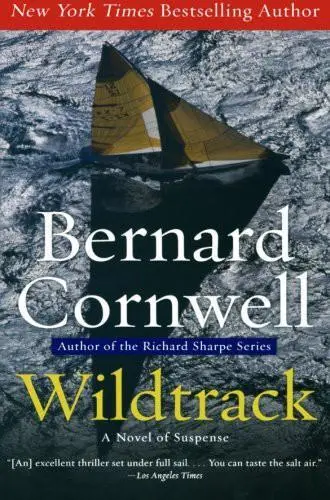
- Название:Wildtrack
- Автор:
- Жанр:
- Год:неизвестен
- ISBN:нет данных
- Рейтинг книги:3 / 5. Голосов: 1
-
Избранное:Добавить в избранное
- Отзывы:
-
Ваша оценка:
Wildtrack: краткое содержание, описание и аннотация
Предлагаем к чтению аннотацию, описание, краткое содержание или предисловие (зависит от того, что написал сам автор книги «Wildtrack»). Если вы не нашли необходимую информацию о книге — напишите в комментариях, мы постараемся отыскать её.
. But
is as crippled as he is, and to make her seaworthy again, Nick must strike a devil's bargain with egomaniacal TV star Tony Bannister. Signing on to the crew of Bannister's powerful ocean racer,
, Nick is expected to help sail her to victory. But the despised celebrity has made some powerful enemies who will stop at nothing for revenge. . . . From Publishers Weekly Some readers may quibble at the ambiguous ending, but Cornwell's first modern-day novel, after Redcoat and the Sharpe series, works very nicely. Narrator Nick Sandman, Falkland Islands hero and Victoria Cross recipient, is determined not only to walk again after a war wound but also to sail his ketch Sycorax to New Zealand. After two years' hospitalization, he is, barely, walking again, but Nick's return to Devon finds Sycorax beached and vandalized, apparently at the behest of TV talk-show host Tony Bannister. Legal difficulties force Nick into making a TV movie for Bannister in exchange for salvaging Sycorax. Complications arise immediately: Bannister is out to win the Cherbourg-Saint Pierre race and wants Nick to be navigator; Bannister's ex-father-in-law is out to avenge his daughter's "murder" aboard Bannister's ocean racer Wildtrack and wants Nick to help; Bannister's beautiful mistress Angela is out to make that TV movie; and Nick falls in love with Angela. The climax comes with Nick racing across the Atlantic in a howling gale to prevent Bannister's murder. Even landlubbers will enjoy Cornwell's terrific pacing, colorful characters and dry humor, and perhaps, will learn a few things, too (e.g., in sailing jargon, "scuttles" means portholes).
Wildtrack — читать онлайн бесплатно полную книгу (весь текст) целиком
Ниже представлен текст книги, разбитый по страницам. Система сохранения места последней прочитанной страницы, позволяет с удобством читать онлайн бесплатно книгу «Wildtrack», без необходимости каждый раз заново искать на чём Вы остановились. Поставьте закладку, и сможете в любой момент перейти на страницу, на которой закончили чтение.
Интервал:
Закладка:
I pushed the mainsheet traveller across as the wind backed a point or two. We were going softly eastwards, past shoals, but keeping within the buoys that marked the offshore channel. Two more motor-cruisers passed us, and both carried yet more people in evening dress. “Where’s the party?” I asked.
“There.” Jill-Beth pointed directly ahead towards a massive white house that occupied its own sand-edged promontory. The house was shielded on its landward side by trees while wide terraced lawns dropped to the private beaches and to the private docks that this night were strung with lanterns and crowded with boats. A string of headlamps showed where other guests drove along the spit of sand that led to the promontory. “The house belongs to Kassouli’s wife,” Jill-Beth said. “She’s not there, but Kassouli is. He wants to thank you.”
“Thank me for what?”
“For rescuing me.”
I suddenly felt nervous. There’s something about the very rich that always makes me nervous. Principles, I remembered, are soluble in cash, and I had already surrendered my privacy to Bannister’s cash and feared that something more might be asked of me this night. I pushed the helm away from me. “Why don’t we just bugger off to Nantucket? I haven’t been there for years.” Jill-Beth laughed and pulled the helm back again. “Yassir wants to see you, Nick. You’ll like him!”
I doubted it, but obediently steered for the dock where servants waited to berth our yacht. I could hear the thump of the music coming from the wide, lantern-hung gardens. I chose a windward berth, spilt air from the sails, and two men jumped aboard to take our warps.
We entered the garden of Kassouli’s delights. A pit had been dug on one of the beaches and a proper clambake of driftwood and seaweed sifted smoke into the evening and tantalized us with the smells of lobster, clams and sweetcorn. Higher up, on one of the terraces, steaks dripped on barbecues. There was champagne, music and seemingly hundreds of guests. It was clearly an important social occasion, for there were photographers hunting through the shoals of beautiful people. One flashed a picture of Jill-Beth and myself, but when he asked my name I told him I was no one important. “A Brit?” He sounded disappointed, then cheered up. “Are you a Lord?” I told him my name was John Brown. He wrote it down, but it was plain I was not destined to be the evening’s social lion.
“Why didn’t you say who you were?” Jill-Beth protested.
“I’m no one important.”
“Nonsense. You want to dance?”
I said my back hurt too much and so we sat at a table where we were joined by a noisy group. One of the men, after the introductions, told me how I could refinance my boat on a twelve-year amortization schedule. I made polite noises. I gathered that a good few of the guests worked for Kassouli, either in his finance houses, shipping line or oil companies. I looked for Kassouli himself, but the man who wanted to lend me money said that the boss probably wouldn’t show himself. “Yassir’s not a great partygoer. He likes to give ’em, though.” The man peered round the garden. “That’s his son, Charlie.”
I recognized the son from the pictures I’d seen in Bannister’s house, but there was one thing I was not prepared for. Charles Kassouli was now in a wheelchair. He was only in his early twenties, but had withered legs slewed sideways on the chair.
“What happened?” I asked my new acquaintance.
“Motorbike.” The reply was laconic. “Too many bucks and not enough sense. What do you expect of rich kids?” Jill-Beth introduced me to the son a few moments later.
Charles Kassouli’s face was startlingly handsome, but his character was distant and churlish. I thought he might be doped into lethargy with painkillers, though he proved snappish enough when Jill-Beth told him I was a sailor.
“Sailing sucks.” The resentful face turned to see whether I would take offence. I took none. If anything I felt a chill pity, for here was a boy born to the pleasures of the richest society on earth, and who had thrown them away with one twist of a motorcycle’s grip. At the same time I felt some scorn. I’d known scores of people in hospital who, denied the chance to walk, faced their lives with a courage that made me feel inadequate. Charles Kassouli, though, was clearly not cut from the same cloth.
“You’ve never sailed?” I asked him.
“I told you. Sailing sucks.”
“Charles owns a motor-cruiser,” Jill-Beth said in an attempt to chivvy him into cheefulness.
“Are you dancing, JB?” He threw away his cigarette and swivelled his chair away from me.
“Sure, Charlie.” She walked beside his electric wheelchair on to the dance floor and I watched how unself-consciously she gyrated in front of him. She grinned at me, but I turned away because a voice had spoken in my ear. “Captain Sandman?”
The speaker was a tall and fair-haired man who had broad shoulders beneath his white and braided uniform coat. He offered me a slight bow of his head. “Captain Sandman?” he asked again.
He had a Scandinavian accent.
“Yes.”
“If you’re ready, sir?” He gestured towards the big house.
I looked for Jill-Beth, but she had disappeared with Kassouli’s son, and so I followed the uniformed manservant into the great house that was more like a palace. We entered through a garden room hung with cool watercolour landscapes. A door led to a long air-conditioned hallway lined with the most superb ship models of the eighteenth century. Naval museums would have yearned for just one such model, but Kassouli owned a score of them. The walls were hung with pictures of ancient naval battles. An open door revealed a conservatory where a long indoor swimming pool rippled under palms.
At the hallway’s end the Scandinavian opened both leaves of a gilded door and bowed me into a library where he left me alone.
It was a lovely room; windowless, but perfectly proportioned.
It was lined with expensive leather-bound editions in English, French, Greek and Arabic. On rosewood tables in front of the library stacks were more ship models, but these were of Kassouli’s modern fleet. There were supertankers and bulk carriers, all painted with the Kassouli Line’s emblem of a striking kestrel. Each ship’s name began and ended with a K. Kalik, Kerak, Kanik, Komek . In the trade it was called the Kayak Line; a slighting nickname for one of the world’s great merchant fleets.
And a fleet run, I thought, by a modern merchant prince; a Le-vantine who had drawn me across the globe. I was suddenly very nervous. I stared up at the paintings which hung above the bookshelves. They were not pictures calculated to reassure a nervous Briton; they showed the battles of Bunker Hill, Saratoga, Yorktown, and, from a later war, New Orleans. The canvases were dark with varnish; the patina of ancient wealth giving gloss to a new American’s fortune.
On a table in the room’s centre there was a handsomely mounted family photograph. Yassir Kassouli, his plump face proud, sat next to his wife. She was a fair-haired, good-looking woman with amused eyes. Behind them stood Nadeznha and Charles; proud children, wholesome children, the finest products of the world’s richest melting pot. I saw how their father’s Mediterranean blood had dominated in their faces, but on Nadeznha I could see an echo of her mother’s humorous eyes.
“A photograph taken before the tragedies.” The voice startled me.
I turned to see a tall, thick-set and balding man standing in a doorway. It was Yassir Kassouli. His skin was very pale, as though he had seen little sunlight in the last few months. What was left of his hair was white. In the family photograph he had appeared as a man in his prime, but now he had the look of old age. Only his eyes, dark and suspicious, showed the immense and animal force of this immigrant who had made one of America’s great fortunes. He was in evening dress and bowed a courteous greeting. “I have to thank you, Captain Sandman, for coming all this way to see me.” I muttered some inanity about it being my pleasure.
Читать дальшеИнтервал:
Закладка:
Похожие книги на «Wildtrack»
Представляем Вашему вниманию похожие книги на «Wildtrack» списком для выбора. Мы отобрали схожую по названию и смыслу литературу в надежде предоставить читателям больше вариантов отыскать новые, интересные, ещё непрочитанные произведения.






Обсуждение, отзывы о книге «Wildtrack» и просто собственные мнения читателей. Оставьте ваши комментарии, напишите, что Вы думаете о произведении, его смысле или главных героях. Укажите что конкретно понравилось, а что нет, и почему Вы так считаете.