W.E.B. Griffin - Retreat, Hell!
Здесь есть возможность читать онлайн «W.E.B. Griffin - Retreat, Hell!» весь текст электронной книги совершенно бесплатно (целиком полную версию без сокращений). В некоторых случаях можно слушать аудио, скачать через торрент в формате fb2 и присутствует краткое содержание. Год выпуска: 0101, Жанр: Старинная литература, на английском языке. Описание произведения, (предисловие) а так же отзывы посетителей доступны на портале библиотеки ЛибКат.
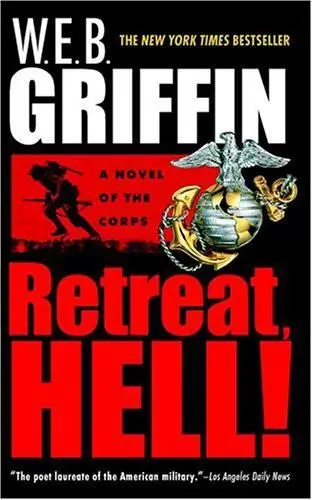
- Название:Retreat, Hell!
- Автор:
- Жанр:
- Год:0101
- ISBN:нет данных
- Рейтинг книги:3 / 5. Голосов: 1
-
Избранное:Добавить в избранное
- Отзывы:
-
Ваша оценка:
Retreat, Hell!: краткое содержание, описание и аннотация
Предлагаем к чтению аннотацию, описание, краткое содержание или предисловие (зависит от того, что написал сам автор книги «Retreat, Hell!»). Если вы не нашли необходимую информацию о книге — напишите в комментариях, мы постараемся отыскать её.
Megaseller Griffin (Honor Bound; Brotherhood of War; Men at War) musters another solid entry in his series chronicling the history of the U.S. Marines, now engaged in the Korean War. Gen. Douglas MacArthur, nicknamed El Supremo by his subordinates, is taken by surprise when the North Korean Army surges south across the 38th parallel. After early losses, he rallies his troops and stems the tide, but not for long. Intertwining stories of literally an army of characters reveal how MacArthur and his sycophantic staff overlook the entire Red Chinese Army, which is massed behind the Yalu River and about to enter the war. Brig. Gen. Fleming Pickering attempts to mediate the ongoing battles between feisty, give-'em-hell Harry Truman and the haughty MacArthur, while worrying about his pilot son, Malcolm "Pick" Pickering, who has been shot down behind enemy lines. The introduction of the Sikorsky H-19A helicopter into the war by Maj. Kenneth "Killer" McCoy and sidekick Master Gunner Ernie Zimmerman details the invention of tactics that will become commonplace in Vietnam. Readers looking for guts and glory military action will be disappointed, as barely a shot is fired in anger, but fans of Griffin's work understand that the pleasures are in the construction of a complex, big-picture history of war down to its smallest details: "There were two men in the rear seat, both of them wearing fur-collared zippered leather jackets officially known as Jacket, Flyers, Intermediate Type G-1." Veterans of the series will enjoy finding old comrades caught up in fresh adventures, while new-guy readers can easily enter here and pick up the ongoing story.
Retreat, Hell! — читать онлайн бесплатно полную книгу (весь текст) целиком
Ниже представлен текст книги, разбитый по страницам. Система сохранения места последней прочитанной страницы, позволяет с удобством читать онлайн бесплатно книгу «Retreat, Hell!», без необходимости каждый раз заново искать на чём Вы остановились. Поставьте закладку, и сможете в любой момент перейти на страницу, на которой закончили чтение.
Интервал:
Закладка:
"Will you behave, Ken?" Pickering asked.
Captain Schermer ordered: "Get the bed, Commander."
"Aye, aye, sir," Chief of Nursing Services Stenten said, and went to the telephone on Ernie's bedside table. She dialed a number and then issued several orders of her own: "Chief, this is Commander Stenten. Get the sumo bed out of the attic. Bring it, now, to 308 in the Maternity Ward, together with two new mattresses and linen." She hung up, then turned to Captain Schermer. "On the way, sir."
"As a matter of historical interest," Captain Schermer said, "when we took over this hospital after the last war, we found that it was equipped to handle sumo wrestlers in need of medical attention. Some of them weigh well over two hundred kilograms—more than four hundred pounds—and they apparently didn't fit in standard Japanese hospital beds. I think these two should both fit comfortably into it."
"Thank you," Pickering said.
"But I think I should tell you, Major," Commander Stenten said, "that if you don't behave, you will almost instantly find yourself in a single bed in Ward F-7, where we care for those suffering from what is euphemistically called 'social disease.' "
"Commander Stenten, Major," Captain Schermer said, "is more or less affectionately called, behind her back, of course, 'The Dragon Lady.' Don't cross her."
[FIVE]
Supreme Headquarters, United Nations Command
The Dai Ichi Building
Tokyo, Japan
O9OO 21 October 195O
As they started down the corridor to the office of the Supreme Commander, Brigadier General Fleming Pickering, USMCR, caught the arm of Colonel Edward Banning, USMC, who stopped and looked at him.
"When we march in there, Ed, we salute," Pickering said. "The Army salutes indoors."
"Yes, sir," Banning said. "I remember."
Pickering waved him down the corridor.
In the outer office, Colonel Sidney L. Huff, MacArthur's senior aide-decamp, stood up when Pickering and Banning walked in.
"Good morning, General," he said.
"How are you, Sid?" Pickering said. "You remember Ed Banning, don't you?"
"It's been a long time, Colonel," Huff said, and put out his hand.
Neither Pickering nor Banning thought his smile looked very sincere.
"The Supreme Commander will see you now, General. He's been expecting you."
"Not for long, certainly, Sid," Pickering said. "You said nine o'clock, and Banning and I stood out in the corridor for fifteen minutes looking at his very expensive Rolex until it was oh eight fifty-nine fifty-five."
"Yes, sir," Huff said.
He opened the right of the double doors to MacArthur's office and announced, "General Pickering, sir."
Pickering saw that Major General Charles M. Willoughby was in the office, sitting in an armchair by a coffee table.
"Come on in, Fleming," MacArthur called.
The two Marines marched in, stopped eighteen inches from MacArthur's desk, and saluted.
"Good morning, sir," Pickering said. "Thank you for seeing me on such short notice."
"It's always a pleasure to see you, as I've told you time and again. Will you have some coffee?"
"Yes, thank you. General, you remember Colonel Banning, don't you?"
"Yes, of course," MacArthur said. "Good to see you again, Colonel. And you remember General Willoughby, of course?"
"Yes, sir, I do," Banning said.
Willoughby gave Banning his hand but didn't say anything.
"This is fortuitous, General," Pickering said to Willoughby. "I was hoping to get a couple of minutes of your time this morning."
"I'm at your disposal, General," Willoughby said.
"Thank you," Pickering said. "The reason I asked to see you, sir, was to introduce—reintroduce?—Colonel Banning to you as my deputy."
"What does that make him, General?" Willoughby asked. "His title, I mean?"
Pickering chuckled. "General, General Smith and I got a laugh out of that, too, in Washington, when he made the appointment. General Smith asked, 'If Colonel Banning is going to be Deputy to the Deputy Director of the CIA for Asia, what are we going to call his number two, when he inevitably appoints one? The Deputy to the Deputy to the Deputy Director?' "
MacArthur chuckled.
"Obviously, the nomenclature on your manning chart needs some work. But Banning is obviously a sound choice for the job, whatever the title, and I look forward to working with you again, Colonel, and I'm sure General Willoughby is similarly pleased."
"Thank you, sir," Banning said.
"Speaking of intelligence, Fleming," MacArthur said, "I got several interesting bits of intelligence just now by officer courier from Ned Almond—on an Interoffice Memorandum form, which also seems a bit incongruous, with Ned's office right now being on the Mount McKinley and mine here—which I really wanted to talk to you about." "Yes, sir?"
"Ned said that he'd run into your man McCoy—more about that in a moment—and that McCoy had told him it is his belief that the Russians will not enter this war, but that the Chinese certainly will." It was a question as well as a statement.
"If Major McCoy said anything like that—and I don't doubt that he did— it was unofficial, out of channels, and if the rank difference were not so great, I'd say between friends. That was not the CIA speaking."
"General Almond took pains to make sure I understood that," MacArthur said. "McCoy, he said, admitted that he had absolutely nothing concrete on which to base this conclusion. But your man McCoy obviously impressed Ned to the point where Ned thought he should pass it on to me. And I would be grateful to learn what you think."
"General," Pickering said, "unofficially, out of channels, and between friends—if I may so presume—and absolutely not as a statement, or even an opinion, of the CIA, I'd bet on McCoy."
"My sources, General Pickering," Willoughby said coldly, "have turned up nothing that suggests that either the Chinese or the Soviets are coming in."
"Which I find disappointing," MacArthur said. He stopped when he saw the look on Willoughby's face. "Because, Willoughby," he went on, "if they crossed the border into northern Korea, I would have the opportunity to bloody the Chinese nose, something which could be rather easily accomplished with our available airpower, and without the political ramifications incident to our crossing the border into China."
MacArthur paused, then went on: "I was disappointed in the conclusions you have drawn from your intelligence, Willoughby, not with the intelligence."
"Yes, sir. Thank you, sir."
"Do you follow my reasoning, Fleming?" MacArthur asked.
"I'm not sure, sir."
"We're talking about face," MacArthur explained. "The importance of which never seems to be understood in Washington. Let me try to explain: My basic reasoning in not wanting to cross the Chinese border for any purpose, in any strength, for any distance—and, Fleming, I am fully aware there are many Washingtonians who sincerely believe I am frothing at the mouth for any excuse to cross the border—is face.
"A platoon of American soldiers in Manchuria would cause the Chinese to lose face. They would be forced to regain face, not only by expelling the American force, but by retaliating. They would feel wholly justified to send a company—or even a battalion—across the border to regain face. What would happen next I can only conjecture, but I know as certainly as I do that the sun will rise in the morning that the only circumstances under which a war with China should be fought is when the objective is total victory, the total destruction of the Chinese Communist infrastructure of government. I doubt if that could be accomplished without the use of nuclear weapons. And I certainly am not advocating such a move or, indeed, any military action which, even by accident, sees even the aforementioned platoon of infantry cross the border."
Читать дальшеИнтервал:
Закладка:
Похожие книги на «Retreat, Hell!»
Представляем Вашему вниманию похожие книги на «Retreat, Hell!» списком для выбора. Мы отобрали схожую по названию и смыслу литературу в надежде предоставить читателям больше вариантов отыскать новые, интересные, ещё непрочитанные произведения.








Обсуждение, отзывы о книге «Retreat, Hell!» и просто собственные мнения читателей. Оставьте ваши комментарии, напишите, что Вы думаете о произведении, его смысле или главных героях. Укажите что конкретно понравилось, а что нет, и почему Вы так считаете.