W.E.B. Griffin - Retreat, Hell!
Здесь есть возможность читать онлайн «W.E.B. Griffin - Retreat, Hell!» весь текст электронной книги совершенно бесплатно (целиком полную версию без сокращений). В некоторых случаях можно слушать аудио, скачать через торрент в формате fb2 и присутствует краткое содержание. Год выпуска: 0101, Жанр: Старинная литература, на английском языке. Описание произведения, (предисловие) а так же отзывы посетителей доступны на портале библиотеки ЛибКат.
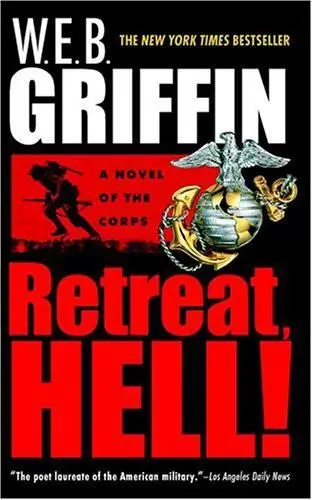
- Название:Retreat, Hell!
- Автор:
- Жанр:
- Год:0101
- ISBN:нет данных
- Рейтинг книги:3 / 5. Голосов: 1
-
Избранное:Добавить в избранное
- Отзывы:
-
Ваша оценка:
Retreat, Hell!: краткое содержание, описание и аннотация
Предлагаем к чтению аннотацию, описание, краткое содержание или предисловие (зависит от того, что написал сам автор книги «Retreat, Hell!»). Если вы не нашли необходимую информацию о книге — напишите в комментариях, мы постараемся отыскать её.
Megaseller Griffin (Honor Bound; Brotherhood of War; Men at War) musters another solid entry in his series chronicling the history of the U.S. Marines, now engaged in the Korean War. Gen. Douglas MacArthur, nicknamed El Supremo by his subordinates, is taken by surprise when the North Korean Army surges south across the 38th parallel. After early losses, he rallies his troops and stems the tide, but not for long. Intertwining stories of literally an army of characters reveal how MacArthur and his sycophantic staff overlook the entire Red Chinese Army, which is massed behind the Yalu River and about to enter the war. Brig. Gen. Fleming Pickering attempts to mediate the ongoing battles between feisty, give-'em-hell Harry Truman and the haughty MacArthur, while worrying about his pilot son, Malcolm "Pick" Pickering, who has been shot down behind enemy lines. The introduction of the Sikorsky H-19A helicopter into the war by Maj. Kenneth "Killer" McCoy and sidekick Master Gunner Ernie Zimmerman details the invention of tactics that will become commonplace in Vietnam. Readers looking for guts and glory military action will be disappointed, as barely a shot is fired in anger, but fans of Griffin's work understand that the pleasures are in the construction of a complex, big-picture history of war down to its smallest details: "There were two men in the rear seat, both of them wearing fur-collared zippered leather jackets officially known as Jacket, Flyers, Intermediate Type G-1." Veterans of the series will enjoy finding old comrades caught up in fresh adventures, while new-guy readers can easily enter here and pick up the ongoing story.
Retreat, Hell! — читать онлайн бесплатно полную книгу (весь текст) целиком
Ниже представлен текст книги, разбитый по страницам. Система сохранения места последней прочитанной страницы, позволяет с удобством читать онлайн бесплатно книгу «Retreat, Hell!», без необходимости каждый раз заново искать на чём Вы остановились. Поставьте закладку, и сможете в любой момент перейти на страницу, на которой закончили чтение.
Интервал:
Закладка:
"I thought I would seek your wise guidance on this one, sir," Davis said. "Commander MAG-33 has been heard from."
He walked into the office and laid the message from Lieutenant Colonel William C. Dunn on Captain Young's desk.
"I'll be damned," Young said when he'd read the message, then read from it: " 'The undersigned is unable to comply.' "
"What the hell does that mean?"
"Start out, Commander, by having faith in your fellow man," Young said. "It may mean just what he says. He is unable to comply. That is different, wouldn't you agree, from 'unwilling to comply'?"
"Yes, sir."
"And then, Commander, we must consider the circumstances. Actually, these circumstances should be considered first. The President has spoken. He thinks this officer should be awarded the Navy Cross. He desires that this officer be awarded the Navy Cross. What the President of the United States desires has the force and effect of a lawful order."
"Yes, sir," Commander Davis said, smiling.
"Furthermore, this jarhead obviously deserves a medal. Jesus Christ, he was shot down, and then evaded capture . . . three months?"
"About that, sir."
"Furthermore, when the Commander-in-Chief desires something, he desires it right then. He is not interested—and indeed, should not be—with administrative problems that get in the way of his desires. Agreed?"
"Yes, sir."
"Given (a) and (b) above, we cannot let a little thing like a misplaced citation get in the way of our carrying out what is clearly our duty, can we?" Captain Young asked reasonably.
"No, sir, we cannot."
"Why don't we ask Harrison to step in here for a minute, Commander?"
"Excellent idea, sir," Commander Davis said, and walked out of the office.
He returned a moment later with Chief Personnelman Robert C. Harrison, a slight thirty-five-year-old with eighteen years' naval service and a perfectly manicured pencil-line mustache.
"Yes, sir?" Harrison asked.
"Chief, we have a small problem that requires your literary skills," Captain Young said.
"Commander Davis showed me the TWX, Captain," Harrison said.
"Since the citation has been misplaced, Chief," Captain Young said, "we're going to have to duplicate what it must have said here so we don't keep the CNO—and indeed, the President—waiting. You take my meaning?"
"Yes, sir."
"Have you got your pad?"
"Yes, sir."
"Let's go over this together," Captain Young said. "What do we know, Commander Davis?"
"We know the major was shot down, sir."
"Okay. Let's go with that. To get shot down, he had to go up, right?"
“Yes, sir.”
"Despite severe weather conditions that in other circumstances would not have permitted flight operations, Major . . . What's his name?"
"Pickering, sir, Major Malcolm S., USMCR," Harrison furnished.
"Hereafter Pickering," Captain Young went on, ". . . took off from the USS Badoeng Strait to render air support'—make that 'desperately needed air support'—'to/U.S. Marine forces then engaged in combat'—make that 'outnumbered U.S. Marine forces' and 'fierce combat' . . ."
"Sir, I get the idea," Chief Harrison said. "Why don't you give me the basics and let me fill in the blanks?"
"Okay. He was shot down while doing this."
"Wounded?"
"I don't think so, but he almost certainly suffered painful injuries making the crash landing. . . ."
"Because he crash-landed the airplane away from civilian houses?" Chief Harrison asked.
"Good thought, Harrison!" Captain Young agreed. "And if he got shot down, the plane had to be on fire, right?"
"Got it," Harrison said. "Then what?"
"While he was supporting the troops on the ground, he encountered fierce antiaircraft fire. . . ."
"Which, at great risk, he ignored?"
"Right."
"Then what?"
"He spent the next . . . what?"
"Find out when he was shot down and when he was rescued. That many days. 'Avoiding the determined efforts of the enemy to capture him,' et cetera. . . ."
"Got it, sir."
"We need that now, Harrison."
"Aye, aye, sir."
"Length is a criterion here, too. Make sure that the citation fills a sheet of paper, and that the signature block goes on the next page," Captain Young said.
"Signature blocks sometimes get lost, sir, right?"
"I guess they do," Captain Young said.
"Take me thirty or forty minutes, sir."
"Good man, Harrison!"
[THREE]
U.S. Naval Hospital
U.S. Navy Base, Sasebo
Sasebo, Japan
22O5 19 October 195O
Security for U.S. Naval Hospital, Sasebo—the guards at the gate and around the perimeter—was provided by a five-man detachment of U.S. Marines who set up and supervised the system, using sailors from the hospital staff—Corps-men, others—assigned to "Shore Patrol" duty on a roster basis to man the various posts.
Sergeant Victor C. Wandowski, USMC, very rarely spent any time at all at Post Number One, which was the guard shack at the main gate, but tonight was an exception. He had been given a heads-up that a Marine major, named McCoy, was going to arrive at the hospital either sometime tonight or—probably— early tomorrow morning. The major was to be sent immediately to see the medical officer of the day, and the hospital commander, Captain Schermer himself, was to be notified of Major McCoy's arrival, no matter what the hour.
Under these circumstances, Sergeant Wandowski had decided, it behooved him to be at the main gate around 2200. He knew there was a courier flight arriving at the airfield around 2130, and it seemed likely this Major McCoy would be on it.
When he saw an Air Force jeep approaching just after 2200, Sergeant Wandowski congratulated himself on his foresight. If one of the swabbie pecker-checkers fucked up meeting this major—which was very likely—it would have been his ass in the crack, not theirs.
"I'll handle this one," he said to the swabbie on duty, and stepped out of the guard shack, crisply raising his hand to stop the jeep.
An Air Force buck sergeant was driving the jeep. If his passenger was a Marine major, he goddamned sure didn't look like it.
He was coverless, insignia-less, and wearing an Army field jacket.
Whatever it was, it did not rate a salute, and Sergeant Wandowski did not offer one.
"What can I do for you?" he demanded.
"You can tell me where I can find Brigadier General Pickering," McCoy said.
"Never heard of him," Sergeant Wandowski said, both truthfully and as sort of a challenge.
"Trust me, Sergeant," McCoy said. "He's somewhere around here. How about getting on the horn and calling the officer of the guard and asking?"
"I'm the officer of the guard," Wandowski said.
"Then call the officer of the day," McCoy said patiently.
"Can I ask who you are?"
"My name is McCoy," McCoy said.
"You're Major McCoy?"
McCoy nodded.
Sergearit Wandowski was unable to accept that.
"Sir, have you got any identification?"
"Get on the horn—and right now, Sergeant," McCoy said icily. "Call the OD and tell him to get word to General Pickering that Major McCoy is at the gate."
There was something about Major McCoy's tone of voice that made Sergeant Wandowski decide that he really didn't have to check the major's . ID card.
He picked up the telephone, and had the operator connect him with the commanding officer's quarters.
"Hold the major there, Sergeant," Captain Schermer ordered. "Someone will be there shortly."
Captain Schermer's Navy-gray 1950 Ford station wagon rolled up to the main gate several minutes later. A Marine captain, who looked like a circus strong man, jumped out of the front passenger seat and walked quickly to where Sergeant Wandowski was standing by the Air Force jeep. Sergeant Wandowski saluted.
Читать дальшеИнтервал:
Закладка:
Похожие книги на «Retreat, Hell!»
Представляем Вашему вниманию похожие книги на «Retreat, Hell!» списком для выбора. Мы отобрали схожую по названию и смыслу литературу в надежде предоставить читателям больше вариантов отыскать новые, интересные, ещё непрочитанные произведения.






Обсуждение, отзывы о книге «Retreat, Hell!» и просто собственные мнения читателей. Оставьте ваши комментарии, напишите, что Вы думаете о произведении, его смысле или главных героях. Укажите что конкретно понравилось, а что нет, и почему Вы так считаете.