W.E.B. Griffin - Retreat, Hell!
Здесь есть возможность читать онлайн «W.E.B. Griffin - Retreat, Hell!» весь текст электронной книги совершенно бесплатно (целиком полную версию без сокращений). В некоторых случаях можно слушать аудио, скачать через торрент в формате fb2 и присутствует краткое содержание. Год выпуска: 0101, Жанр: Старинная литература, на английском языке. Описание произведения, (предисловие) а так же отзывы посетителей доступны на портале библиотеки ЛибКат.
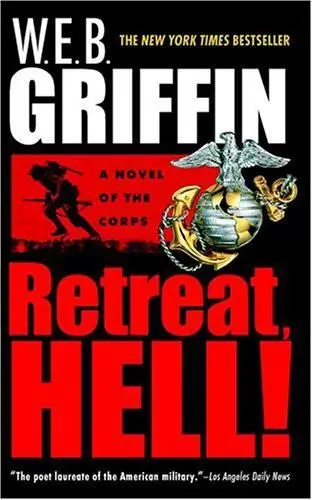
- Название:Retreat, Hell!
- Автор:
- Жанр:
- Год:0101
- ISBN:нет данных
- Рейтинг книги:3 / 5. Голосов: 1
-
Избранное:Добавить в избранное
- Отзывы:
-
Ваша оценка:
Retreat, Hell!: краткое содержание, описание и аннотация
Предлагаем к чтению аннотацию, описание, краткое содержание или предисловие (зависит от того, что написал сам автор книги «Retreat, Hell!»). Если вы не нашли необходимую информацию о книге — напишите в комментариях, мы постараемся отыскать её.
Megaseller Griffin (Honor Bound; Brotherhood of War; Men at War) musters another solid entry in his series chronicling the history of the U.S. Marines, now engaged in the Korean War. Gen. Douglas MacArthur, nicknamed El Supremo by his subordinates, is taken by surprise when the North Korean Army surges south across the 38th parallel. After early losses, he rallies his troops and stems the tide, but not for long. Intertwining stories of literally an army of characters reveal how MacArthur and his sycophantic staff overlook the entire Red Chinese Army, which is massed behind the Yalu River and about to enter the war. Brig. Gen. Fleming Pickering attempts to mediate the ongoing battles between feisty, give-'em-hell Harry Truman and the haughty MacArthur, while worrying about his pilot son, Malcolm "Pick" Pickering, who has been shot down behind enemy lines. The introduction of the Sikorsky H-19A helicopter into the war by Maj. Kenneth "Killer" McCoy and sidekick Master Gunner Ernie Zimmerman details the invention of tactics that will become commonplace in Vietnam. Readers looking for guts and glory military action will be disappointed, as barely a shot is fired in anger, but fans of Griffin's work understand that the pleasures are in the construction of a complex, big-picture history of war down to its smallest details: "There were two men in the rear seat, both of them wearing fur-collared zippered leather jackets officially known as Jacket, Flyers, Intermediate Type G-1." Veterans of the series will enjoy finding old comrades caught up in fresh adventures, while new-guy readers can easily enter here and pick up the ongoing story.
Retreat, Hell! — читать онлайн бесплатно полную книгу (весь текст) целиком
Ниже представлен текст книги, разбитый по страницам. Система сохранения места последней прочитанной страницы, позволяет с удобством читать онлайн бесплатно книгу «Retreat, Hell!», без необходимости каждый раз заново искать на чём Вы остановились. Поставьте закладку, и сможете в любой момент перейти на страницу, на которой закончили чтение.
Интервал:
Закладка:
"Deal," McCoy said. "That is, if General Pickering will loan me enough money to buy a uniform."
"I think that can be worked out," Pickering said.
[FOUR]
Major Kenneth R. McCoy sat with a white hospital blanket over his knees in a wheelchair in a small dressing cubicle in the officers' sales store. He was waiting for his new uniform trousers to be taken in an inch at the waist, and for them to be provided with precisely the correct crotch-to-cuff length. While he was waiting, he was giving serious, just about completely futile, thought about what bright and witty comment, or comments, he would make to his wife when he walked into her room.
He had just about decided that he was not going to be able to come up with something useful when his reverie was interrupted by Captain George F. Hart coming into the cubicle with a dozen roses.
"Where the hell did you get those?" McCoy asked.
"It wasn't easy," Hart said. "A lesser dog robber than myself probably would have had to settle for one of those miniature trees—"
"Bonsai," McCoy furnished.
"—of which the Japanese seem so fond."
"Thanks, George."
"On the other hand, maybe a bonsai tree would have been better," Hart said. "The roses are going to wilt. The bonsai would last for the next century, as a souvenir of this unexpected encounter."
A Japanese seamstress pushed the curtain aside, handed McCoy the trousers, and then folded her arms over her breast, obviously intending to see how well she had done her job.
"Would you please wait outside for a minute?" McCoy said to her.
Her eyes widened when she heard the faultless Japanese. She bowed and backed out of the dressing cubicle.
"That always bugs me," Hart said. "They're always surprised as hell when one of us speaks Japanese, but a hell of a lot of them speak English."
"That's because we're barbarians, George," McCoy said. He handed Hart the hospital blanket, then started to put his left leg in the trousers. He winced.
"You need some help with that?" Hart asked.
"They are surprised when we use indoor plumbing, take showers, and don't eat with our fingers," McCoy went on as if he hadn't heard the offer of help.
He got the right leg mostly inside the trousers, and then, awkwardly, got out of the wheelchair and pulled them up. He tucked his shirttail in, then pulled up the zipper and closed the belt.
"Hand me the field scarf, please," he asked, pointing to the necktie hanging from a hook.
Hart handed it to him, and McCoy turned around to face the mirror and worked the field scarf under his shirt collar.
"That hurt. I was better off before I let the doc talk me into the wheelchair."
"What did you do on the plane?" Hart asked.
"Planes," McCoy corrected him. "The Beaver from Wonsan to Seoul, and it hurt to move when I got out of that. Then a C-54 to Pusan. I walked up and down the aisle in that—it was the courier plane, full of chair warmers giving me dirty looks because I was wearing Al Haig's shirt and pants—and it didn't hurt—or hurt less—when I got off it. And I walked—not far—around Pusan to keep it from getting stiff until I got on a Navy Gooney Bird that brought me here. Hospital plane, full of wounded Marines. I walked up and down the aisle of that one, too. And I was doing pretty good until I got here. Now it hurts like hell."
"Moving pulls on the sutures," Hart said.
"Thank you, Dr. Hart. I had no idea what was making me hurt."
He pulled on a tunic, examined himself in the mirror, then turned away from it.
"I think I'll pass on the wheelchair," he said.
"Not only did you give your word as an officer and gentleman, but Ernie's room is way to hell and gone across the hospital."
"Well, maybe I can ride part of the way," McCoy said, and carefully lowered himself into the wheelchair.
Outside the room with the sign "McCoy, Mrs. Ernestine NO VISITORS," Hart took the roses from McCoy's lap and held them while McCoy got out of the wheelchair and painfully moved his leg around. Then, when McCoy nodded, Hart handed him the roses and pushed open the heavy door.
"That will be all, Captain Hart, thank you," McCoy said, and walked into the room.
Ernie was in bed, with the back raised, reading a book. She looked up when she saw him.
"You apparently can't read, Major," she said after a long moment. "The sign says no visitors."
"What are you reading?"
"A novel. The Egyptian."
"Is it any good?"
"It is not about Korea or childbearing," Ernie said. "What's with the roses?"
He walked to the bed and handed them to her.
If I limped, she didn't seem to notice.
"Knowing you as I do, these were somebody else's idea," Ernie said.
"Hart's," McCoy admitted. "You almost got a bonsai tree."
"Are you going to put your arms around me, or I am that repulsive in my bloated condition?"
He leaned over the bed and put his arms around her.
"Oh, Ken, I've missed you!" she said into his neck.
"Me, too, baby," he said.
"How much do you know?" Ernie asked, still speaking into his neck.
"I know it was a damned fool thing to do, taking a train down here," he said.
"I almost lost it," she said. "But I had to see Pick."
"I know."
She let him go, and sort of pushed him away.
"Okay. Now what's wrong with you?" she asked.
"Nothing's wrong with me," he said.
"You're as pale as a sheet, and there's something wrong with your leg," she said.
"I took a little piece of shrapnel," he said.
"Is that why you're walking that way?"
"What way?"
"Ken, is that why you're walking that way?"
"I suppose."
"You want to lie down with me?"
"I want to, but is it smart?"
She shifted herself to the far side of the narrow bed, then patted the near side.
He very carefully got into the bed beside her, but was unable to do so without wincing several times.
"I don't think this is going to work," he said.
"You want to feel him or her? Him or her just kicked me again."
"Is that good or bad?"
She took his hand and guided it to her stomach.
"Jesus!" he said. "Does it do that all the time?"
"Him or her does that frequently," Ernie said. "Do not call him or her 'it.' "
"Yes, ma'am."
Their eyes met again. He moved his hand from her stomach to her face.
"My God, I love you so much," he said.
"It took you long enough to say it," she said.
The door swung open, and Captain E Howard Schermer, MC, USN, marched in, followed by a middle-aged, gray-haired, short and stocky nurse whose badge identified her as Commander J. V. Stenten, NC, USN, Chief Nursing Services, and Brigadier General Fleming Pickering, USMCR.
"When I told you, Major McCoy," Captain Schermer said, "that you would have to spend at least the next four days in bed, I really had a bed of your own in mind."
McCoy, looking guilty, started to swing his legs out of bed.
"Belay that!" Captain Schermer ordered.
McCoy stopped moving.
"How bad is he, Doctor?" Ernie asked.
"He has been sewn up," Dr. Schermer said. "If he does what he's ordered to do, in three weeks or a month he should be as good as new."
"He very seldom does what he's ordered to do," Ernie said.
"So General Pickering has been telling me," Dr. Schermer said.
"Is there any reason another bed can't be brought in here for him?" Ernie said. "I'll see he does what he's told to do."
"It is against both regulation and policy," Dr. Schermer said.
"That wasn't her question, Captain Schermer," Pickering said.
"Doctor, the sumo bed?" Commander Stenten asked.
"You're one step ahead of me again, Commander Stenten," Captain Schermer said. He turned to Pickering. "What I was thinking, General, was that if, in contravention of regulation and policy, we rolled another bed in here for Major McCoy"—he pointed across the room—"the first thing either or both of them would do the minute the door was closed would be to push the beds close to each other. Neither of them should be (a) on their feet and (b) pushing furniture around. This applies even more to Major McCoy, since he is about to take the medicine for pain prescribed, which is certain to make him more than a little groggy."
Читать дальшеИнтервал:
Закладка:
Похожие книги на «Retreat, Hell!»
Представляем Вашему вниманию похожие книги на «Retreat, Hell!» списком для выбора. Мы отобрали схожую по названию и смыслу литературу в надежде предоставить читателям больше вариантов отыскать новые, интересные, ещё непрочитанные произведения.









Обсуждение, отзывы о книге «Retreat, Hell!» и просто собственные мнения читателей. Оставьте ваши комментарии, напишите, что Вы думаете о произведении, его смысле или главных героях. Укажите что конкретно понравилось, а что нет, и почему Вы так считаете.