W.E.B. Griffin - Retreat, Hell!
Здесь есть возможность читать онлайн «W.E.B. Griffin - Retreat, Hell!» весь текст электронной книги совершенно бесплатно (целиком полную версию без сокращений). В некоторых случаях можно слушать аудио, скачать через торрент в формате fb2 и присутствует краткое содержание. Год выпуска: 0101, Жанр: Старинная литература, на английском языке. Описание произведения, (предисловие) а так же отзывы посетителей доступны на портале библиотеки ЛибКат.
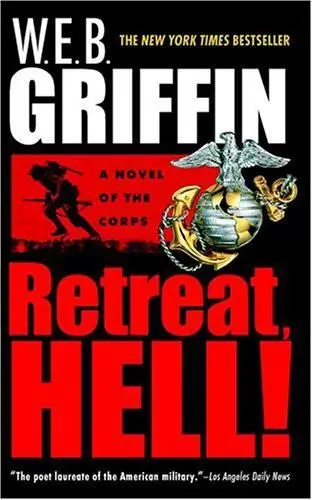
- Название:Retreat, Hell!
- Автор:
- Жанр:
- Год:0101
- ISBN:нет данных
- Рейтинг книги:3 / 5. Голосов: 1
-
Избранное:Добавить в избранное
- Отзывы:
-
Ваша оценка:
Retreat, Hell!: краткое содержание, описание и аннотация
Предлагаем к чтению аннотацию, описание, краткое содержание или предисловие (зависит от того, что написал сам автор книги «Retreat, Hell!»). Если вы не нашли необходимую информацию о книге — напишите в комментариях, мы постараемся отыскать её.
Megaseller Griffin (Honor Bound; Brotherhood of War; Men at War) musters another solid entry in his series chronicling the history of the U.S. Marines, now engaged in the Korean War. Gen. Douglas MacArthur, nicknamed El Supremo by his subordinates, is taken by surprise when the North Korean Army surges south across the 38th parallel. After early losses, he rallies his troops and stems the tide, but not for long. Intertwining stories of literally an army of characters reveal how MacArthur and his sycophantic staff overlook the entire Red Chinese Army, which is massed behind the Yalu River and about to enter the war. Brig. Gen. Fleming Pickering attempts to mediate the ongoing battles between feisty, give-'em-hell Harry Truman and the haughty MacArthur, while worrying about his pilot son, Malcolm "Pick" Pickering, who has been shot down behind enemy lines. The introduction of the Sikorsky H-19A helicopter into the war by Maj. Kenneth "Killer" McCoy and sidekick Master Gunner Ernie Zimmerman details the invention of tactics that will become commonplace in Vietnam. Readers looking for guts and glory military action will be disappointed, as barely a shot is fired in anger, but fans of Griffin's work understand that the pleasures are in the construction of a complex, big-picture history of war down to its smallest details: "There were two men in the rear seat, both of them wearing fur-collared zippered leather jackets officially known as Jacket, Flyers, Intermediate Type G-1." Veterans of the series will enjoy finding old comrades caught up in fresh adventures, while new-guy readers can easily enter here and pick up the ongoing story.
Retreat, Hell! — читать онлайн бесплатно полную книгу (весь текст) целиком
Ниже представлен текст книги, разбитый по страницам. Система сохранения места последней прочитанной страницы, позволяет с удобством читать онлайн бесплатно книгу «Retreat, Hell!», без необходимости каждый раз заново искать на чём Вы остановились. Поставьте закладку, и сможете в любой момент перейти на страницу, на которой закончили чтение.
Интервал:
Закладка:
Commander Fisher stopped at each row of NPs, but they were out of it, and he didn't speak to them, only gave them a little smile.
At the extreme rear of the passenger compartment was a patient whom Dwayne Fisher wanted to talk to. He was an NP, but the flight physician had told him that was probably just a technical classification to get him to the States. The poor bastard was a Marine fighter pilot who'd just been rescued after three months behind the enemy's lines.
"He's nothing but skin and bones, but he's not over the edge," the flight physician had told him.
"Hi!" Commander Fisher said.
What does this asshole want?
"I understand you're also an airplane driver."
What are you doing, writing a book?
"Guilty."
"Fighters?"
And also Lockheed 1049s. You are conversing, sir, with the current holder of the Trans-Pacific scheduled passenger service speed record.
"Corsairs."
"I flew P-38s in War Two," Fisher said. "Which twin-engine time I parlayed into a job with Eastern. Where I flew these. Which kept me out of fighters when they called me up."
"Reservist?"
Dumb fucking question. If he was called up, he was in the reserve.
"Yeah. You?"
"Me, too. I was flying for Trans-Global."
"Ten-forty-nines?"
"That's all Trans-Global has."
"Nice airplane."
"Very nice."
"You were shot down?"
Back to your fucking book, are we?
"Uh-huh."
"I'm surprised they didn't grab you for NATS," Commander Fisher said. "Most of our guys are called-up airline pilots."
"They didn't."
"I just called our ETA—one hour—to San Diego," Fisher said. "It's been a long haul."
It's been a fucking nightmare.
"It's been a nightmare."
"Walking down that aisle is tough," Fisher said. "The amazing thing is, you don't get complaints."
Not from the drugged or the dead, I guess you don't.
"A couple of hours out of Honolulu, I went to the head. I saw . . . the sheets. How many didn't make it?"
"I counted four."
"I guess the rest of us are lucky, huh?"
"From what I hear, you're luckier than most. You were behind the enemy's lines for three months, right?"
"Yeah."
"And you're walking around. You look like you're in pretty good condition?"
"Yeah. I'm in good condition."
The way my commanding officer put it, with devastating honesty, Commander, is that I am a self-important sonofabitch whose delicate condition is my own goddamn fault. He went on to say that my childish behavior caused a lot of good people to put their necks out to save me from the consequences of my sophomoric showboating.
That should be me under one of those white sheets. Commander Fisher put out his hand.
"I better get back up and drive the bus," he said. "Nice to meet you, Major. Good luck." "Thanks."
[EIGHT]
Naval Air Station, San Diego
San Diego, California
174O 25 October 195O
As the C-54 taxied through the rain, Pick could see a line of ambulances and buses, and beside them a small army of medical personnel and a long line of poncho-covered gurneys.
The C-54 stopped on the tarmac before the passenger terminal, and when the cargo door opened, Pick saw that a forklift had been driven up to the aircraft. It held a platform, on which were four gurneys and eight Corpsmen in raincoats with Red Cross brassards.
The dead were off-loaded first. Four Corpsmen came onto the aircraft, went to one of the bodies, unfastened the litter, and carried it down the aisle to the door and the waiting gurneys. The body was gently moved from the litter to the gurney and covered with a poncho, but not before enough rain had fallen on the sheet to make it translucent.
Then the litter was carried back onto the aircraft, and a second body on its litter carried out to the gurneys waiting in the rain.
When all four gurneys had bodies, the forklift lowered the platform.
When it came back up, there were four Corpsmen, different ones, on it. The flight physician was now waiting for them. They exchanged a few words, then the flight physician turned to Pick.
"Okay, Major, you're next," he said. "Do you need help to go out there and get on a gurney?"
"I don't need a gurney."
"It's policy."
"Fuck your policy."
"You made it all the way here without giving anybody any trouble. Please don't start now."
"I'm not going to get on a fucking gurney."
"You're going to get on it, Major. The only question is whether you do it now or after I sedate you."
"Major," one of the Corpsmen said, "with respect. It's raining out here. Please."
Pick stood up, walked through the door, and climbed onto one of the gurneys. One of the Corpsmen laid a poncho over him.
Three more NPs were brought off the aircraft. They were not transferred to the gurneys. Rather, their litters were laid on top of the gurneys and then they were strapped to it.
A Corpsman appeared with two lengths of canvas webbing.
"Let me get this around you, and we're on our way," he said.
"You're going to strap me to this fucking thing?"
"That's the SOP," the Corpsman said. "Take it easy. The sooner we get to the hospital, the sooner we can take it off."
Fuck it.
What do I care?
What do I care about anything?
When the straps were in place, Pick could not move his arms and wipe the rain from his exposed face.
So what the fuck?
The forklift lowered the platform, and the gurneys were rolled off it—Pick's first—with a double bump, and then to one of the buses. The buses had enormous rear doors that permitted the gurneys to be wheeled aboard them.
The way he was strapped in, he could raise his head. But all he could see out the bus's windshield was the open door of the bus ahead of his.
He laid his head back down.
Several minutes later, he heard the door being closed, and when he looked up, he saw a white hat come down the aisle, get behind the wheel, and start the engine.
The bus turned out of the line.
The next thing Pick saw was a sign: WELCOME TO THE U.S. NAVAL HOSPITAL, SAN DIEGO!
Chapter Fifteen[ONE]
Room 3O8, Maternity Ward
U.S. Naval Hospital
U.S. Navy Base, Sasebo
Sasebo, Japan
O815 25 October 1950
Captain F. Howard Schermer, MC, USN, as Hospital Commander, was not required to make routine morning or afternoon rounds with members of his medical staff—after all, he had a lot else to occupy his time—but of course he had the unquestioned right to do so.
When he had the time, in other words, he often would join one of the teams making rounds to keep his fingers, so to speak, on the pulse of the hospital. And he would usually ask Commander J. V. Stenten, NC, USN, his Chief of Nursing Services, to accompany him. Between the two of them, very little that needed correction escaped notice.
Since McCoy, Mrs. Ernestine and later McCoy, Major K. R. had been admitted, Captain Schermer had found the time to make morning and afternoon rounds of the maternity ward every day, and Commander Stenten had been free to accompany him.
There were several reasons for this, and chief among them was that both Captain Schermer and Commander Stenten genuinely liked the young couple sharing the sumo wrestler's bed. But Schermer was also aware that he had a delicate situation in his care of Major and Mrs. McCoy.
It hadn't been, for example, the first time General of the Army and Mrs. MacArthur had come to Sasebo to visit the wounded and ill. Since the war had started, they had made ten, maybe twelve such visits. But never had Mrs. MacArthur brought a box of candy to a maternity ward patient.
Читать дальшеИнтервал:
Закладка:
Похожие книги на «Retreat, Hell!»
Представляем Вашему вниманию похожие книги на «Retreat, Hell!» списком для выбора. Мы отобрали схожую по названию и смыслу литературу в надежде предоставить читателям больше вариантов отыскать новые, интересные, ещё непрочитанные произведения.











Обсуждение, отзывы о книге «Retreat, Hell!» и просто собственные мнения читателей. Оставьте ваши комментарии, напишите, что Вы думаете о произведении, его смысле или главных героях. Укажите что конкретно понравилось, а что нет, и почему Вы так считаете.