W.E.B. Griffin - Retreat, Hell!
Здесь есть возможность читать онлайн «W.E.B. Griffin - Retreat, Hell!» весь текст электронной книги совершенно бесплатно (целиком полную версию без сокращений). В некоторых случаях можно слушать аудио, скачать через торрент в формате fb2 и присутствует краткое содержание. Год выпуска: 0101, Жанр: Старинная литература, на английском языке. Описание произведения, (предисловие) а так же отзывы посетителей доступны на портале библиотеки ЛибКат.
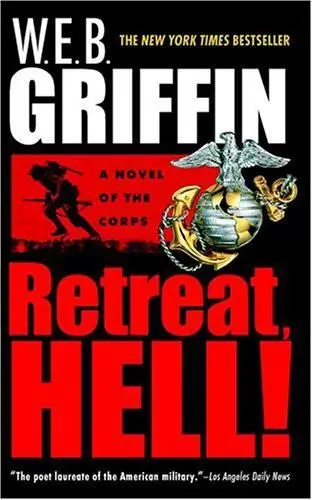
- Название:Retreat, Hell!
- Автор:
- Жанр:
- Год:0101
- ISBN:нет данных
- Рейтинг книги:3 / 5. Голосов: 1
-
Избранное:Добавить в избранное
- Отзывы:
-
Ваша оценка:
Retreat, Hell!: краткое содержание, описание и аннотация
Предлагаем к чтению аннотацию, описание, краткое содержание или предисловие (зависит от того, что написал сам автор книги «Retreat, Hell!»). Если вы не нашли необходимую информацию о книге — напишите в комментариях, мы постараемся отыскать её.
Megaseller Griffin (Honor Bound; Brotherhood of War; Men at War) musters another solid entry in his series chronicling the history of the U.S. Marines, now engaged in the Korean War. Gen. Douglas MacArthur, nicknamed El Supremo by his subordinates, is taken by surprise when the North Korean Army surges south across the 38th parallel. After early losses, he rallies his troops and stems the tide, but not for long. Intertwining stories of literally an army of characters reveal how MacArthur and his sycophantic staff overlook the entire Red Chinese Army, which is massed behind the Yalu River and about to enter the war. Brig. Gen. Fleming Pickering attempts to mediate the ongoing battles between feisty, give-'em-hell Harry Truman and the haughty MacArthur, while worrying about his pilot son, Malcolm "Pick" Pickering, who has been shot down behind enemy lines. The introduction of the Sikorsky H-19A helicopter into the war by Maj. Kenneth "Killer" McCoy and sidekick Master Gunner Ernie Zimmerman details the invention of tactics that will become commonplace in Vietnam. Readers looking for guts and glory military action will be disappointed, as barely a shot is fired in anger, but fans of Griffin's work understand that the pleasures are in the construction of a complex, big-picture history of war down to its smallest details: "There were two men in the rear seat, both of them wearing fur-collared zippered leather jackets officially known as Jacket, Flyers, Intermediate Type G-1." Veterans of the series will enjoy finding old comrades caught up in fresh adventures, while new-guy readers can easily enter here and pick up the ongoing story.
Retreat, Hell! — читать онлайн бесплатно полную книгу (весь текст) целиком
Ниже представлен текст книги, разбитый по страницам. Система сохранения места последней прочитанной страницы, позволяет с удобством читать онлайн бесплатно книгу «Retreat, Hell!», без необходимости каждый раз заново искать на чём Вы остановились. Поставьте закладку, и сможете в любой момент перейти на страницу, на которой закончили чтение.
Интервал:
Закладка:
And never, to his knowledge, had the hospital had in its care a CIA agent who had suffered wounds behind enemy lines. And whose commanding officer, a brigadier general, the assistant director of the CIA for Asia, obviously had an interest in both of them that went beyond official to in loco parentis.
Captain Schermer, followed by Commander Stenten and then by the Rounds Staff, marched into room 308, where the patients were lying beside one another reading Stars and Stripes and So, You're Going to Be a Mother!
"Good morning," Captain Schermer said. "And how are we this morning?"
"I don't know how we are, Doctor," Mrs. McCoy replied. "But speaking for my husband and myself, I'm pregnant and uncomfortable, ready to go home, and he's pawing the ground to get out of here."
Commander Stenten chuckled.
Captain Schermer picked up their medical record clipboards from the foot of the bed and studied both.
"Well," he said. "Why don't we get Major McCoy into a wheelchair, and have Dr. Haverty have a look at you?"
One of the nurses rolled a wheelchair to his side of the bed, and another started to pull the drapes around the bed.
"I won't need that, thank you," McCoy said, and got out of the bed and slid his feet into slippers.
Dr. Schermer thought: He seems to be able to do so without pain.
Or without much pain.
Or he's very good at concealing pain.
As the privacy drapes were drawn around the bed and Lieutenant Commander Robert Haverty, MC, USNR, Chief of Gynecological Services, and a nurse went behind it, McCoy walked to the window and rested his rear end on the sill.
Dr. Schermer walked over to him.
"She means that, sir," McCoy said. "She wants to go home. Is there any reason she can't?"
"To the States? I'm afraid she doesn't meet the criteria for medical evacuation, and I don't think a flight that long would be the thing for her to do."
"She means Tokyo, sir," McCoy said. "We have a house there."
"You know what happened when she came here from Tokyo," Schermer said.
"She couldn't get a sleeper—for that matter, even a first-class seat—on the train, so she sat up all the way, all night, on a wooden seat in third class," McCoy said.
"I didn't know that," Schermer said as Commander Stenten stepped up beside him.
"Neither did I, until I tried to talk her out of going back to Tokyo," McCoy said. "You're going to have to convince her there is good reason—that she would lose the baby—if she went back to Tokyo in a sleeper on the train."
"Why does she want to go to Tokyo?" Commander Stenten asked.
"She says she'd rather be in her own bed, at home, than here."
"Especially since you won't be here?" Commander Stenten asked.
"Yes, ma'am," McCoy said.
"Let me think—long and hard—about this. After I speak with Dr. Haverty," Dr. Schermer said.
"Yes, sir. Thank you."
"And how's your leg?"
"I don't think I'd want to do any squat jumps, sir," McCoy said. "But I can maneuver, and I really have to get out of here and back to work."
"Back to what you were doing when you were hit?" Commander Stenten asked.
"No, ma'am," McCoy said, chuckling. "I don't think I'm quite up to that yet. But I'm okay for limited duty."
"Let me talk this over with Dr. Haverty," Dr. Schermer said.
[TWO]
Office of the Hospital Commander
U.S. Naval Hospital
U.S. Navy Base, Sasebo
Sasebo, Japan
O855 25 October 195O
"I didn't know about her sitting up all night on a train," Dr. Haverty said. "That explains a good deal."
"How is she?" Dr. Schermer asked.
"At the moment, she's fine," Haverty replied. "But the idea of her taking another train ride ..."
"Even flat on her back in a sleeper?" Commander Stenten asked.
The question seemed argumentative. Nurses are not permitted to question the opinions of physicians, much less argue with them. But this was not an ordinary nurse, this was the Dragon Lady.
"Well, what if she had trouble on the way?" Dr. Haverty asked.
"Yeah," Dr. Schermer agreed. "The husband wouldn't be much help. If something happened . . . anything could start her off again."
"She would need medical attention right then," Dr. Haverty said.
"But nothing a nurse couldn't handle, right?" the Dragon Lady asked. "Worst case, she starts—"
"You're not suggesting we send a nurse with her, are you?" Dr. Schermer asked. "I couldn't authorize anything like that."
"In addition to the train ride," the Dragon Lady said, "she got a hell of an emotional shock when she heard her friend had been killed. And when she got a good look at Major Pickering. You don't think that had anything to do with the trouble she had?"
"Of course it did," Dr. Haverty said.
"Then you would suggest her mental peace would be a factor in whether she can carry to term or not?'
"Obviously," Dr. Haverty said.
"She's a nice young woman, a very nice young woman," the Dragon Lady said. "Tough, but not as tough as she thinks she is. Who is far from home and alone."
"That's true."
"The prospect of being here alone terrifies her. She wants to be in her own home," the Dragon Lady said. "I can understand that."
"So can I," Captain Schermer agreed. "But what if something happens at home? She'd be alone there, too."
"They have three live-in servants. She speaks Japanese."
"Three live-in servants?" Captain Schermer said. "In a major's quarters?"
"How do you know that?" Dr. Haverty asked.
"I've talked to her. Yeah, three live-in servants. Maybe the CIA pays better than the Marine Corps. But she's got three servants, and she doesn't live in government quarters. They own a house in Denenchofu."
"Which brings us back to the question of the trip to Tokyo. As much as I'd like to, I can't authorize sending a nurse with her.'
"I'm up to my ears in use-it-or-lose-it leave," the Dragon Lady said. "I herewith apply for up to thirty days' ordinary leave."
They both looked at her in surprise.
"I've got some friends at Tokyo General," the Dragon Lady said. "I can explain the situation to them and make sure they lay on whatever might be needed if it's needed."
Dr. Schermer looked at Dr. Haverty, and said, "Bob, if she's not in immediate danger of losing the baby ..."
"She really would be better off in her own bedroom. If she had quarters here, I'd recommend her release and tell her to get in bed and stay there, and to call for help the moment . . . But she doesn't have quarters here."
"So the question, then, is how to get her to her quarters?"
Haverty nodded.
"Commander Stenten," Captain Schermer said, "in connection with your Temporary Duty to confer with the nursing staff of the U.S. Army General Hospital, Tokyo, you are authorized up to thirty days' ordinary leave."
"Thank you, sir," the Dragon Lady said.
[THREE]
Room 16, Neuro-Psychiatric Ward
U.S. Naval Hospital
San Diego, California
O83O 26 October 195O
"Come on in, Major," Lieutenant Patrick McGrory, MC, USN, said to Major Malcolm S. Pickering, USMCR.
Pickering was in pajamas, a blue bathrobe, and felt slippers. After a moment's hesitation, he walked into the office.
"Have a seat," McGrory said. "I'm Pat McGrory."
He leaned across his desk and put his hand out.
Pick made no move to take the hand.
"Funny about the seat," Pick said. "I seem to remember that officers are supposed to get out of their seats when a more senior officer enters a room."
McGrory stood up. "Sorry," he said.
Читать дальшеИнтервал:
Закладка:
Похожие книги на «Retreat, Hell!»
Представляем Вашему вниманию похожие книги на «Retreat, Hell!» списком для выбора. Мы отобрали схожую по названию и смыслу литературу в надежде предоставить читателям больше вариантов отыскать новые, интересные, ещё непрочитанные произведения.











Обсуждение, отзывы о книге «Retreat, Hell!» и просто собственные мнения читателей. Оставьте ваши комментарии, напишите, что Вы думаете о произведении, его смысле или главных героях. Укажите что конкретно понравилось, а что нет, и почему Вы так считаете.