Hood, Bruce - Supersense
Здесь есть возможность читать онлайн «Hood, Bruce - Supersense» весь текст электронной книги совершенно бесплатно (целиком полную версию без сокращений). В некоторых случаях можно слушать аудио, скачать через торрент в формате fb2 и присутствует краткое содержание. Год выпуска: 2009, Издательство: Constable Robinson, Жанр: Старинная литература, на английском языке. Описание произведения, (предисловие) а так же отзывы посетителей доступны на портале библиотеки ЛибКат.
- Название:Supersense
- Автор:
- Издательство:Constable Robinson
- Жанр:
- Год:2009
- ISBN:нет данных
- Рейтинг книги:3 / 5. Голосов: 1
-
Избранное:Добавить в избранное
- Отзывы:
-
Ваша оценка:
Supersense: краткое содержание, описание и аннотация
Предлагаем к чтению аннотацию, описание, краткое содержание или предисловие (зависит от того, что написал сам автор книги «Supersense»). Если вы не нашли необходимую информацию о книге — напишите в комментариях, мы постараемся отыскать её.
Supersense — читать онлайн бесплатно полную книгу (весь текст) целиком
Ниже представлен текст книги, разбитый по страницам. Система сохранения места последней прочитанной страницы, позволяет с удобством читать онлайн бесплатно книгу «Supersense», без необходимости каждый раз заново искать на чём Вы остановились. Поставьте закладку, и сможете в любой момент перейти на страницу, на которой закончили чтение.
Интервал:
Закладка:
Around the world, governments are anxiously weighing up the concerns raised by genetic engineering with the potential benefits of new solutions to problems. For example, stem cells are the juvenile cells in fetuses that have the potential to replace damaged cells in adults. 28Many people suffering from illnesses and diseases such as Alzheimer’s disease would benefit if stem cells could achieve this repair. Unfortunately, there are not enough spare human eggs available to conduct this research, and so one solution has been to create animal eggs containing almost entirely human DNA. The resultant embryo, however, would still contain a small proportion of the donor animal’s original genetic material. This hybrid human–animal embryo could in principle be a potential real Seth Brundle. In truth, these embryos would never be viable, but the prospect of animal–human hybrids is simply too unacceptable for most of us. In March 2008, the British government faced a crisis as the Catholic Church urged Catholic politicians to resign over the introduction of the Human Fertilization and Embryology Bill, which allowed research inserting human DNA into animal cells. Ethics used to be a rather sleepy academic division of moral philosophy where one could ponder life’s hypotheticals. Today, advances in genetic engineering have thrust ethics into the public spotlight, with the expectation that it will provide answers to this minefield of moral dilemma. Philosophers have never been busier. Your average member of the public has never taken courses in philosophy or genetics, but they can still be appalled by the prospect of combining species. This is because of essentialism. It’s the way we all chop up the living world into its different groups. We intuitively think that members of the same category share this invisible property that defines their group membership. For example, we think that all dogs have a ‘dogginess’ essence that makes them members of the canine family and that all cats have a ‘cattiness’ essence that separates them from dogs and makes them members of the feline fraternity. When we hear about scientists inserting genes of fish into mice and potatoes, we feel squeamish. It just does not seem right. It’s not natural.
Who did not feel the ‘yuck’ factor when they first saw the picture of a hairless mouse with what looked like a human ear growing on its back, circulated around the world’s media? It wasn’t actually an example of gene manipulation but rather a demonstration of how an animal could be a surrogate host for growing an implanted bioframe. 29But it certainly looked like a hu-mouse! Our revulsion was not simply because it was a weird image. Rather, we felt simultaneously sick and fascinated because the prospect of human–animal hybrids violates the essentialist view of the world that we developed naturally as children. When I was preparing this chapter, my youngest daughter looked over my shoulder and saw the image of the mouse with the human ear. At first she let out an audible ‘yugh!’ Then she asked if it could hear better. Apparently she is still telling her classmates about it.
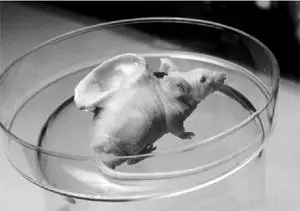
FIG. 13: Mouse with an implanted bioframe. Many people have misinterpreted this image as an example of genetic engineering. © BRITISH BROADCASTING CORPORATION.
MAY THE FORCE BE WITH YOU
Related to the notion of essence is the idea of a life force, something that is in living animals but not in dead ones. This is vitalism, an ancient belief that the body is motivated by an inner energy. Up until the nineteenth century, this was recognized in the West as the ‘ élan vital ’, a vital force that does not obey the known laws of physics and chemistry. 30In most conceptions of a life force, it is equated with the unique identity of the individual. In other words, it is the essential soul that many believe inhabits our bodies but departs on death to move on to another dimension/body/location/time (delete terms as appropriate depending on your afterlife belief system).
Although we cannot see the energy generated in our bodies, most of us intuitively feel it is there – not within every living cell, as Krebs’s cycle describes it, but rather as a unified whole thing that animates the body. I can relate to why people think this. On occasion, I have had to kill animals, either for food or because they have become a nuisance. I live in the country and raise my own chickens for the table. When they are ready, I pull their necks. When you kill a largish animal up close, as opposed to squashing a fly with a rolled-up newspaper, you can experience a sense that something leaves the body. A living entity that a moment ago was animated, flapping around and agitated, is now still. But there seems to be more involved than just an absence of movement.
I have seen a number of corpses in the dissection room, but I have not watched someone die in front of me. However, I have talked to friends and colleagues who have been at the bedside of a dying person, and they often report that something seems to depart. So far no one has told me that they actually saw something leave a body. Rather, they get a feeling that someone or something has left. Maybe this is what our minds create in order to makes sense of the change in the situation: suddenly there is one less person in the room. How can there be one person less in the room unless someone has left?
In popular culture, the moment of death is often depicted as a life force or energy leaving the body like some semitransparent copy of the person. This notion may be purely psychological, but there are many people who think a tangible soul exits the body at death. 31In 1907 Dr Duncan Macdougall of Massachusetts reported that the soul weighs precisely twenty-one grams based on his careful measurement of six dying patients on a set of industrial scales. 32His findings were and have since been treated with much scepticism, with alternative explanations ranging from fraud to methodological weakness. Because the weight loss was not reliable or replicable, his findings were unscientific. When he was prevented from further human studies, Dr Macdougall moved on to dogs that he sacrificed in his scientific search for the soul. The results of these studies showed no evidence of a weight loss at the time of death. Undeterred, Macdougall interpreted this as evidence for the Christian belief that animals don’t have souls. In which case the word ‘animal’ is inappropriate, as it comes from the Latin anima , for soul.
Scientifically, death is another continuous stage of life. At death, the meat machine no longer functions as a unified system and begins to decompose. It starts to disassemble itself. In the absence of oxygen, the cells start to die. Krebs’s metabolic cycle shuts down, and the system starts to go into reverse. The bacteria colonies that once helped to sustain life now begin to break the body down. Like opportunistic looters, they requisition various material substances to embark on their own life cycles in isolate. It’s like the breakup of an army. Once the battle is over, the individual soldiers take what they can and then head off. The state of death is simply the process of life in different directions. With the defence systems down, all manner of microbe, insect, and beast plunder the body for resources. If we could record and play our lives out as one of those time-lapse movies of decaying fruits and animals, we would realize that composition and decomposition are continuous.
Such an account is neither comforting nor acceptable for most. Where has the person gone in this version? The body remains, but the person is absent. A departing life force that energized the body is the only sensible explanation for most people. The mind–body dualism we intuit when we are alive explains to us what happens when we are dead. And, like dualism, the notion of a vital energy inhabiting the body is a concept that emerges early.
Читать дальшеИнтервал:
Закладка:
Похожие книги на «Supersense»
Представляем Вашему вниманию похожие книги на «Supersense» списком для выбора. Мы отобрали схожую по названию и смыслу литературу в надежде предоставить читателям больше вариантов отыскать новые, интересные, ещё непрочитанные произведения.











Обсуждение, отзывы о книге «Supersense» и просто собственные мнения читателей. Оставьте ваши комментарии, напишите, что Вы думаете о произведении, его смысле или главных героях. Укажите что конкретно понравилось, а что нет, и почему Вы так считаете.