Hood, Bruce - Supersense
Здесь есть возможность читать онлайн «Hood, Bruce - Supersense» весь текст электронной книги совершенно бесплатно (целиком полную версию без сокращений). В некоторых случаях можно слушать аудио, скачать через торрент в формате fb2 и присутствует краткое содержание. Год выпуска: 2009, Издательство: Constable Robinson, Жанр: Старинная литература, на английском языке. Описание произведения, (предисловие) а так же отзывы посетителей доступны на портале библиотеки ЛибКат.
- Название:Supersense
- Автор:
- Издательство:Constable Robinson
- Жанр:
- Год:2009
- ISBN:нет данных
- Рейтинг книги:3 / 5. Голосов: 1
-
Избранное:Добавить в избранное
- Отзывы:
-
Ваша оценка:
Supersense: краткое содержание, описание и аннотация
Предлагаем к чтению аннотацию, описание, краткое содержание или предисловие (зависит от того, что написал сам автор книги «Supersense»). Если вы не нашли необходимую информацию о книге — напишите в комментариях, мы постараемся отыскать её.
Supersense — читать онлайн бесплатно полную книгу (весь текст) целиком
Ниже представлен текст книги, разбитый по страницам. Система сохранения места последней прочитанной страницы, позволяет с удобством читать онлайн бесплатно книгу «Supersense», без необходимости каждый раз заново искать на чём Вы остановились. Поставьте закладку, и сможете в любой момент перейти на страницу, на которой закончили чтение.
Интервал:
Закладка:
Famous freaks became celebrities, such as Joseph Merrick, ‘the Elephant Man’, who was a regular on the Victorian London social scene. 1Others, such as ‘Aloa, the Alligator Boy’, enjoyed minor fame trawling through the Dust Bowl towns of the American Midwest during the Great Depression. 2Many of the acts were billed as part-human, part-animal monstrosities. They were abominations who crossed the boundaries between beast and man.
Although freak shows are now long gone, their publicity memorabilia and postcards are still highly collectible today. I keep a small collection as a poignant reminder of how the sensibilities of society have changed. While it may be no longer acceptable to gawk at physical abnormality, modern confessional TV reveals that we are still fascinated by the more deviant members of our society.
Human freaks challenge our view of the living world. We expect people to look a certain way and be a certain size and shape, and individuals who do not fit these expectations are deemed unnatural. When they have properties that violate our boundaries for grouping the world, they become freaks. For example, bearded ladies, hermaphrodites, and various transsexual combinations contradict our naive biological concepts about what it is to be a man or a woman. Our obsession with genitalia may be motivated by sexual interest, but they are also conspicuous markers for males and females. Whenever genitals are missing, diminished, shared, or on the wrong body, the individual’s identity is questionable. Likewise, those endowed with above-average sexual characteristics are judged to be more of a man or more of a woman. Size does matter in this judgement, rather than number. Those unfortunate enough to have multiple penises or vaginas and anything other than two nipples or breasts are generally regarded as freaks. 3
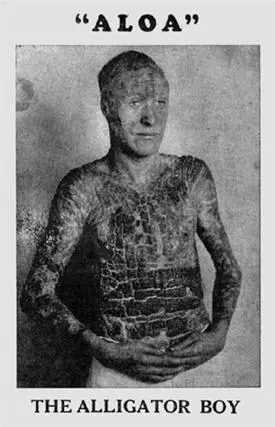
FIG. 12: Aloa, the unfortunate ‘Alligator Boy’. AUTHOR’S COLLECTION.
Where do we get our biological concepts? In this chapter, we are going to look at how the child constructs an understanding of the living world by applying the same intuitive theory-building we saw with minds and objects. 4Children begin by organizing the world and sorting it into categories. In trying to explain what they observe, they naturally assume that the living world is permeated by invisible life forces, energies, and patterns that define which categories things belong to. This is the stuff that animates matter and makes living things unique. Just like the intuitive theories of the mind that we saw in the last chapter, intuitive biological theories of life lead us to assume a number of ideas that lay the foundation for supernatural thinking.
Like the ancient Greek philosophers, children infer that living things have something special inside that makes them uniquely alive. They assume that there are essences 5that define what a living thing is, that there are vital life energies 6that cause things to be alive, and that everything is connected by forces. In philosophy these different but related notions are called ‘essentialism’, ‘vitalism’, and ‘holism’. As far as they go, they are pretty good approximations of what we know from science about life. If you open any modern biology textbook, you will find that such beliefs are in fact scientifically valid. For example, DNA is a biological mechanism for identity and uniqueness, which are core components of essentialism. Within all living cells there is a chemical reaction known as Krebs’s cycle that produces measurable quantities of energy. 7This is the vital life force that keeps the cell alive. Symbiosis is the study of the interconnectedness of biological systems. The connectedness of living systems can be found in evolutionary theory, in symbiotic physiology, and, more recently, in James Lovelock’s ‘Gaia’ theory of ecology. 8No man – and for that matter no microbe – is an island; all must be understood as part of a complex system. Most of us are ignorant of these various discoveries and theories, but long before DNA, Krebs’s cycle, and symbiosis became mainstream science, humans naturally assumed their existence in the form of intuitive essentialism, vitalism, and holism. However, such intuitive reasoning also forms the core of the supersense because we infer essential, vital, and connected properties operating in the world that go beyond what has been scientifically proven.
Although we intuitively think of essences, life forces, and holism, we would be hard-pressed to describe what we mean. We can’t easily articulate these concepts because we often lack the appropriate terms or language. In Eastern cultures, such notions are recognized by ancient terms such as ‘ chi ’ (Chinese), ‘ ki ’ (Japanese), and ‘ mana ’ (Polynesian). In Europe we used to have the term ‘ élan vital ’ (life force), but this has been mostly abandoned. Having good or bad ‘vibes’ is the closest that most of us come to phrasing these concepts. We may have lost our words to describe them, but our behaviour and opinions reveal that essentialism, vitalism, and holism are still guiding our reasoning. When people respond negatively to wearing a killer’s cardigan, this is a reflection of their naive biological reasoning at work. The evil they think is imbued in the cloth is a reflection of the same mechanisms that children apply to infer the hidden properties of living things.
If such metaphysical beliefs are rarely discussed in the West and no one told us about them, then where did they come from? Once again, the most likely explanation can be found in the developing mind. They must come from our natural way of reasoning about life. In this way, children’s intuitive biology sows the seeds of adults’ supernaturalism, especially as our understanding about life influences much of our attitudes and beliefs.
KOSHER CATEGORIES
Jewish dietary law forbids the consumption of certain animals described in Leviticus of the Old Testament as unclean. At first, the lists seem rather arbitrary. Unclean animals include camels, ostriches, sharks, eels, chameleons, moles, and crocodiles. I have actually eaten three off this list without any ill effects. Some of the animals deemed fit for eating are even more unappetizing to modern tastes, such as gazelles, frogs, grasshoppers, and some locusts. On what basis did someone decide that sharks are unclean but most fish are acceptable? Sharks are fish after all.
Some people have suggested that avoiding certain taboo foods reduces the risk of infection. For example, there is a high risk of food poisoning from shellfish, which can spoil rapidly in hot climates. Undercooked pork can be a source of the parasitic infection trichinosis. However, such an explanation fails to account for many of the unclean animals.
One intriguing alternative is that originally the animals were deemed either clean or unclean depending on how well they fit properties of the group to which they belonged. 9In the case of mammals, it is clear that the clean or unclean judgement had something to do with how well each example fit general categories when it came to hooves and chewing the cud.
But this is what you shall not eat from among those that bring up their cud or that have split hooves; the camel, for it brings up its cud, but its hoof is not split – it is unclean to you; and the hyrax, for it brings up its cud, but its hoof is not split – it is unclean to you; and the hare, for it brings up its cud, but its hoof is not split – it is unclean to you; and the pig, for its hoof is split and its hoof is completely separated, yet it does not chew its cud – it is unclean to you. You shall not eat of their flesh nor shall you touch their carcass – they are unclean to you.
Читать дальшеИнтервал:
Закладка:
Похожие книги на «Supersense»
Представляем Вашему вниманию похожие книги на «Supersense» списком для выбора. Мы отобрали схожую по названию и смыслу литературу в надежде предоставить читателям больше вариантов отыскать новые, интересные, ещё непрочитанные произведения.






Обсуждение, отзывы о книге «Supersense» и просто собственные мнения читателей. Оставьте ваши комментарии, напишите, что Вы думаете о произведении, его смысле или главных героях. Укажите что конкретно понравилось, а что нет, и почему Вы так считаете.