Hood, Bruce - Supersense
Здесь есть возможность читать онлайн «Hood, Bruce - Supersense» весь текст электронной книги совершенно бесплатно (целиком полную версию без сокращений). В некоторых случаях можно слушать аудио, скачать через торрент в формате fb2 и присутствует краткое содержание. Год выпуска: 2009, Издательство: Constable Robinson, Жанр: Старинная литература, на английском языке. Описание произведения, (предисловие) а так же отзывы посетителей доступны на портале библиотеки ЛибКат.
- Название:Supersense
- Автор:
- Издательство:Constable Robinson
- Жанр:
- Год:2009
- ISBN:нет данных
- Рейтинг книги:3 / 5. Голосов: 1
-
Избранное:Добавить в избранное
- Отзывы:
-
Ваша оценка:
Supersense: краткое содержание, описание и аннотация
Предлагаем к чтению аннотацию, описание, краткое содержание или предисловие (зависит от того, что написал сам автор книги «Supersense»). Если вы не нашли необходимую информацию о книге — напишите в комментариях, мы постараемся отыскать её.
Supersense — читать онлайн бесплатно полную книгу (весь текст) целиком
Ниже представлен текст книги, разбитый по страницам. Система сохранения места последней прочитанной страницы, позволяет с удобством читать онлайн бесплатно книгу «Supersense», без необходимости каждый раз заново искать на чём Вы остановились. Поставьте закладку, и сможете в любой момент перейти на страницу, на которой закончили чтение.
Интервал:
Закладка:
Remarkably, this is something that pre-school children find difficult. They search for the ball directly below. They will search underneath over and over again, even though you can show them each time that it is in the box connected to the chimney by the tube. What’s going on?
This weird ‘gravity error’ reveals some interesting things about the minds of young children. The first is that they reason in a theory-like way. They try to apply the knowledge they already possess to make sense of and predict what might happen next. Just like reticent old scientists, they don’t want to believe the evidence when it conflicts with what they expected. All that practice with pushing things off the high chair as an infant has led them to a theory that all objects fall straight down. But when objects don’t behave as expected, young children persist with the theory and think something is wrong with the setup. This is because they have trouble ignoring intuitive beliefs.
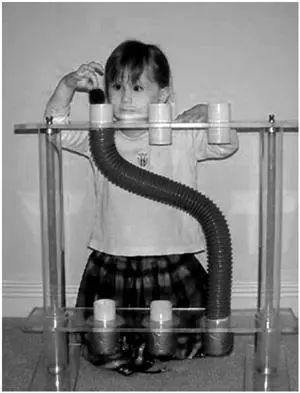
FIG. 7: The tubes apparatus. Children typically search directly below. AUTHOR’S COLLECTION.
Humans share the gravity error with chimpanzees, monkeys, and dogs, which have all been tested on tubes. 37Only dogs seem to learn the correct solution relatively quickly. Are they smarter than young children and primates? Probably not. I think they are more flexible on this task because they don’t hold such a strong belief in falling objects in the first place. They are like the four-year-olds on the task of balancing the ruler – not particularly committed to one solution over another.
Eventually children can learn to ignore the gravity error, but even adults can trip up on it. This brings us back to one of the central points in this book. Early ideas may never be truly abandoned. Consider another example from the world of falling objects. What happens to a cannonball fired from the edge of a cliff? Visualize it for a moment. What path would it take? Most pre-school children think that, just like Wile E. Coyote in the Road Runner cartoons, the cannonball would travel forward until it loses momentum and then drop straight down. 38Such beliefs can still operate in adults. If you ask adults what path a bomb takes when dropped from a plane, most of them think that it falls straight down, and they behave accordingly. 39In games where adults have to release a tennis ball to fall into a cup as they walk by, they typically overshoot because they try to release the ball when directly above the cup. 40In both examples, the motion is actually a curve, but our childish, naive straight-down theory still operates. These examples show that intuitive theories are not always abandoned when we become adults. If such naive physical reasoning reveals that childish beliefs lurk in adults, what happens if those beliefs are supernatural?
CHILDREN AS INTUITIVE MAGICIANS
When does supernatural thinking first appear? So far in this chapter I have been describing how infants understand the natural world. This process begins long before education has any role to play. Children chop the world of experience up into different categories of things and events. To make sense of it all, they generate naive theories that explain the physical world, the living world, and eventually the psychological world of other people. While children’s naive theories are often correct, they can be wrong because the causes and mechanisms they are trying to reason about are invisible. For example, no one can see gravity, but you can assume that something makes objects fall straight down if they are released. Or consider an example from biology. We can easily recognize when something is alive. You can tell by how it looks and more importantly by how it moves, but you can’t actually see life in something. All you can do is infer it, and sometimes you will be wrong. Sometimes things do not always fall straight down. Sometimes living things do not move, and sometimes moving things are not alive. When we misapply the property of one natural kind to another, we are thinking unnaturally. If we continue to believe it is true, then our thinking has become supernatural. This is where I think our supersense comes from. Let me unpack this important idea for you further.
Children naturally categorize the world into different kinds of things. If the child is not certain about where to draw the boundaries or misattributes properties from one area to another, the child is going to be thinking supernaturally. For example, if a child thinks that a toy (physical property) can come alive at night (biological property) and has feelings (psychological property), this would represent a violation of the natural order of things. If the child thinks that thoughts can transfer between minds, he is misunderstanding what a thought is and where it comes from. Children who mix up the properties of their naive categories are thinking supernaturally. Inanimate objects that come alive and have feelings are magical. A thought transferring between minds is otherwise known as telepathy.
In hundreds of interviews with children between the ages of four and twelve years, Piaget asked them to explain the workings of the world. 41He asked them about natural phenomena such as the sun, clouds, rivers, trees, and animals. Where do they come from? Do they have minds? And so forth. What he discovered was recurrent supernatural beliefs, especially in the youngest children. They thought that the sun follows them around and can think. That’s why children paint smiley faces on suns. It’s much more reassuring to think of it as a friendly being who makes summer days pleasant and people smile than as an inanimate ball of nuclear energy that would frazzle us if it were not for the earth’s protective ozone layer. The children Piaget studied believed that trees have minds and can feel. In short, they thought the inanimate world is alive, something Piaget called ‘animism’. Animism means attributing a soul (Latin, anima ) to an entity, and it can be found in many religions as well as in secular supernaturalism. Where do children get these ideas? No one tells them to think like this. It’s just the way the child makes sense of the world.
One reason children make these sorts of mistakes is that they make sense of everything from their own perspective. Piaget recognized that young children are so caught up in their own worldview that they interpret everything in the world according to the way it relates to them. Piaget called this ‘egocentrism’ to reflect this self-obsessed perspective. The sun does appear to follow you around, as it is always there when you look over your shoulder.
Children also attribute purpose to everything in the world by assuming things were made for a reason. The sun was made for me. This is not surprising considering that modern children are immersed in a world of artefacts that have been designed and made for a reason. Young children do not readily make the distinction between things that have been created for a purpose and those that just happen to be useful for a purpose. For example, if I can use a stick for prodding, I may be inclined to see sticks as having a purpose. In other words, sticks exist as something for me to use.
This way of thinking leads the child to what has been called ‘promiscuous teleology’. 42Teleology means thinking in terms of function – what something has been designed for. This way of thinking is promiscuous because the child over-applies the belief of purpose and function to everything. For example, there are 101 ways to travel down a hillside, including walking, skipping, running, roller-blading, skateboarding, sledding, skiing, trail-biking, Zorb balling, and so on. But no adult would make the mistake of saying that the hill exists because of any of these different activities. Children, on the other hand, say that hillsides are for rolling down and so on.
Читать дальшеИнтервал:
Закладка:
Похожие книги на «Supersense»
Представляем Вашему вниманию похожие книги на «Supersense» списком для выбора. Мы отобрали схожую по названию и смыслу литературу в надежде предоставить читателям больше вариантов отыскать новые, интересные, ещё непрочитанные произведения.







Обсуждение, отзывы о книге «Supersense» и просто собственные мнения читателей. Оставьте ваши комментарии, напишите, что Вы думаете о произведении, его смысле или главных героях. Укажите что конкретно понравилось, а что нет, и почему Вы так считаете.