Hood, Bruce - Supersense
Здесь есть возможность читать онлайн «Hood, Bruce - Supersense» весь текст электронной книги совершенно бесплатно (целиком полную версию без сокращений). В некоторых случаях можно слушать аудио, скачать через торрент в формате fb2 и присутствует краткое содержание. Год выпуска: 2009, Издательство: Constable Robinson, Жанр: Старинная литература, на английском языке. Описание произведения, (предисловие) а так же отзывы посетителей доступны на портале библиотеки ЛибКат.
- Название:Supersense
- Автор:
- Издательство:Constable Robinson
- Жанр:
- Год:2009
- ISBN:нет данных
- Рейтинг книги:3 / 5. Голосов: 1
-
Избранное:Добавить в избранное
- Отзывы:
-
Ваша оценка:
Supersense: краткое содержание, описание и аннотация
Предлагаем к чтению аннотацию, описание, краткое содержание или предисловие (зависит от того, что написал сам автор книги «Supersense»). Если вы не нашли необходимую информацию о книге — напишите в комментариях, мы постараемся отыскать её.
Supersense — читать онлайн бесплатно полную книгу (весь текст) целиком
Ниже представлен текст книги, разбитый по страницам. Система сохранения места последней прочитанной страницы, позволяет с удобством читать онлайн бесплатно книгу «Supersense», без необходимости каждый раз заново искать на чём Вы остановились. Поставьте закладку, и сможете в любой момент перейти на страницу, на которой закончили чтение.
Интервал:
Закладка:
Rule 4:
Objects generally only move when something else makes them move by force or collision. Otherwise, they are likely to be living things, which, as you will see in the next chapter, come with a whole different set of rules.
How do we know that these rules are operating in babies? For the simple reason that babies look longer when each of them is broken in a bit of stage-show magic. By applying the principles of conjuring and illusion, scientists have been able to show that young infants have knowledge about the physical world that they must be discovering for themselves. And, if they are figuring out the physical world by themselves, then it stands to reason that they must be thinking about other things in the world.
INTUITIVE THEORIES
The things we know best are the things we haven’t been taught.
– MARQUIS DE VAUVENARGUES
The magic trick experiments have revolutionized the way we interrogate babies about what they know. If you think about it, all the different things in the world have properties that make them what they are. Inanimate objects have inanimate object properties. Living things have living thing properties, and so on. If you can set up a magic show that violates properties of each of these things, then you can see if the baby spots the mistake.
In a game called twenty questions, you have to work out the identity of something that another player is thinking about. It starts off with the question, ‘Is it an animal, vegetable, or mineral?’ From there the player has to phrase each question to require a yes or no response. ‘Is it bigger than a bread box?’ ‘Does it come in more than one colour?’ If you can guess the identity within twenty questions, you win. An electronic handheld version called ‘20Q’ won the 2006 Toy of the Year Award from the American toy industry association. It’s remarkable. It can almost always figure out whatever obscure object you might have in mind. People find this amazing, but, there again, people overestimate how many different objects they think they know. The reason twenty questions starts with animal, vegetable, or mineral is that this division describes most of the different kinds of things there are in the natural world.
Babies also chop the natural world up into groups of different kinds of things. Not unlike twenty questions, they first decide whether something is an object, a living thing, or a living thing that possesses a mind. From very early on, children reason about the nature of inanimate objects as being different from living things that can move on their own and are alive. 31They also start to see living things as motivated by goals and intentions. 32In other words, they are beginning to think about the notion of what it means to have a mind. Well before young children have been taught anything at school, they are already reasoning about the physical world, the living world, and the psychological one. They are in effect little physicists, little biologists,
and little psychologists. 33
However, the knowledge they have in each of these areas is more than just a list of facts. Their knowledge of the world is theorylike. What this means is that when babies encounter a new problem, they try to make sense of it in terms of what they already know. This is what theories do. They give us a framework in which to make sense of something. More importantly, theories allow children to make predictions in a new situation. For example, having established that a spoon pushed off the edge of a high-chair tray falls down, the baby will theorize that other solid objects should do the same and will happily explore this by dropping everything over the edge. The baby is beginning to understand the effects of gravity.
Babies also reason about people. Having witnessed that Mum will pick up the spoon and replace it on the table, they theorize that adults are predictable whereas the family hamster is not. They are beginning to understand that actions differ between living things and to appreciate goals and intentions as mental states. From the moment babies start to pay attention and anticipate events in the world, they are forming theories about how the world works. No one has to teach them about gravity or the mind. They are figuring these out for themselves. It is not even clear that they are fully aware of exactly what they are figuring out, but their thinking is not haphazard. These organized ways of thinking are the intuitive theories that all infants develop. 34
Most people are familiar with the word ‘theory’ in the context of science, such as Einstein’s theory of relativity or Wegener’s plate tectonic theory of continental drift. These are formal scientific theories that have been worked out, discussed, written about, tested, and argued over by hundreds of educated adults. By contrast, children’s intuitive theories are spontaneous and naive. However, children do share one interesting property with scientists. Both children and scientists are stubborn when it comes to changing their minds.
CAUGHT IN THE GRIP OF A THEORY
Academics love witty titles for their scientific papers. It not only livens up what could be a very dry piece of writing, but it demonstrates that even scientists can have a sense of humour. In a paper entitled ‘If You Want to Get Ahead, Get a Theory’, Annette Karmiloff-Smith and Barbel Inhelder describe how children appear to reason in a theory-like way when trying to solve everyday physics problems. 35The pun is on getting ‘a head’, which of course can mean either get an advantage or the bony box that houses our brain. However, the paper also makes a very serious point about the role of intuitive theories in intellectual development.
In their study, four-, six-, and eight-year-olds were given wooden rods of different lengths to balance. Imagine trying to balance a ruler on a pencil. How would you go about it? I bet that you would estimate where the middle of the ruler is and balance it on the pencil at this point, which would be the correct solution. The children also balanced the rods in the middle. However, when given rods that were secretly weighted at one end so that they could not balance in the middle, something interesting happened. Initially, all of the children tried to balance these in the middle, but of course they failed. The eldest children looked confused at first, but then realized something was not quite right. They then shifted the rod until they found the point of balance. The youngest children did not seem surprised by the weighted rods and again found the point of balance by moving the rods until they balanced. In contrast, the six-year-olds failed miserably at the task.
Over and over again, the six-year-olds placed the rod in the middle, and every time the rod tipped over. They were so sure that the rods must balance in the middle that they persisted with the strategy until they eventually got frustrated, threw the rods down, and stormed off say-ing that the task was impossible. They were so convinced by the theory that things balance in the middle that they were unable to see that there might be exceptions. This was their theory of balance and, like stubborn adults who refuse to abandon ideas when they are proven wrong, they were unable to be flexible in their behaviour.
Unlike the six-year-olds, the younger children did not have any theory or expectations. They just approached and solved the problem through trial and error. The older children had a theory and also predicted the rods should balance in the middle. However, on discovering this was not so, they had the mental flexibility to realize that sometimes there are exceptions in life. The inflexible six-year-olds were caught in the grip of a theory.
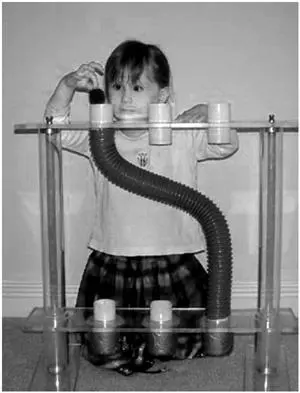
Ten years ago, I discovered a similar phenomenon. 36Imagine a flexible tube like the one on a vacuum cleaner. Now imagine the tube connected from a chimney to a box below. If I dropped a ball down the chimney, you would know to search for it in the box. You would predict that the ball would fall down the tube into the box. Now imagine that I put a bend in the tube so that the box is not directly below the chimney anymore. If I drop a ball down the chimney, where would you look for it now? In the box of course, because the box is connected to the chimney. What could be easier?
Читать дальшеИнтервал:
Закладка:
Похожие книги на «Supersense»
Представляем Вашему вниманию похожие книги на «Supersense» списком для выбора. Мы отобрали схожую по названию и смыслу литературу в надежде предоставить читателям больше вариантов отыскать новые, интересные, ещё непрочитанные произведения.







Обсуждение, отзывы о книге «Supersense» и просто собственные мнения читателей. Оставьте ваши комментарии, напишите, что Вы думаете о произведении, его смысле или главных героях. Укажите что конкретно понравилось, а что нет, и почему Вы так считаете.