SS
Здесь есть возможность читать онлайн «SS» весь текст электронной книги совершенно бесплатно (целиком полную версию без сокращений). В некоторых случаях можно слушать аудио, скачать через торрент в формате fb2 и присутствует краткое содержание. Жанр: Справочники, на английском языке. Описание произведения, (предисловие) а так же отзывы посетителей доступны на портале библиотеки ЛибКат.

- Название:SS
- Автор:
- Жанр:
- Год:неизвестен
- ISBN:нет данных
- Рейтинг книги:5 / 5. Голосов: 1
-
Избранное:Добавить в избранное
- Отзывы:
-
Ваша оценка:
SS: краткое содержание, описание и аннотация
Предлагаем к чтению аннотацию, описание, краткое содержание или предисловие (зависит от того, что написал сам автор книги «SS»). Если вы не нашли необходимую информацию о книге — напишите в комментариях, мы постараемся отыскать её.
SS — читать онлайн бесплатно полную книгу (весь текст) целиком
Ниже представлен текст книги, разбитый по страницам. Система сохранения места последней прочитанной страницы, позволяет с удобством читать онлайн бесплатно книгу «SS», без необходимости каждый раз заново искать на чём Вы остановились. Поставьте закладку, и сможете в любой момент перейти на страницу, на которой закончили чтение.
Интервал:
Закладка:
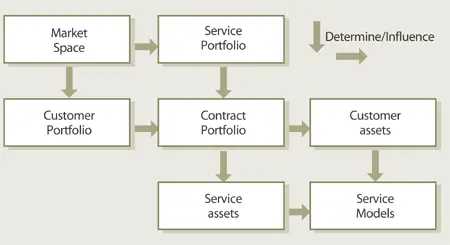
Figure 7.6 Service models are shaped by market spaces
Service models codify the structure and dynamics of services. The structure and dynamics are influenced by factors of utility and warranty to be delivered to customers (Figure 5.29). The structure and dynamics have consequences for Service operation s, which are evaluated by Service Transition (Figure 7.7).
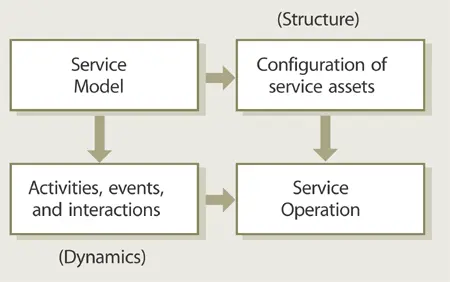
Figure 7.7 Service models describe the structure and dynamics of a service
Structure is defined in terms of particular service assets needed and the patterns in which they are configured. Service models also describe the dynamics of value creation. Activities, flow of resource s, coordination, and interactions describe the dynamics (Figure 7.8). This includes the cooperation and communication between service user s and service agents. The dynamics of a service include patterns of business activity , demand patterns, exceptions and variations.
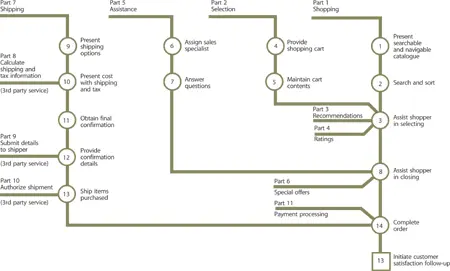
Figure 7.8 Dynamics of a service model
The methods and tools of system s engineering and workflow management are useful for developing the process maps, workflow diagrams, queuing models and activity patterns necessary for completeness of service models. Service Transition evaluates detailed service models to ensure they are fit for purpose and fit for use before entering Service Operation through the Service Catalogue . It is necessary for service models to be under change control because the utility and warranty of a service can have undesired variation if there are changes to the service assets or their configuration . The integrity of a service model depends on the integrity of the structure.
Service models are useful for effectiveness in Continual Service Improvement . Improvements can be made to the structure or the dynamics of a model. Service Transition evaluates the options or paths for improvements and recommends solutions that are cost-effective and low-risk. Service models continually evolve, based on external feedback received from customers and internal feedback from service management processes. CSI processes ensure the feedback to the strategy , design , transition and operation processes.
7.2.2 Design driven by outcomes
Attribute s of a service are the characteristics that provide form and function to the service from a utilization perspective. The attributes are traced from business outcomes to be supported by the service. Determining which attributes to include is a design challenge. Certain attributes must be present for value creation to begin. Others add value on a sliding scale determined by how customers evaluate increments in utility and warranty . Service level agreement s commonly provide for differentiated levels of service quality for different sets of user s.
Some attributes are more important to customers than others. They have a direct impact on the performance of customer asset s and therefore the realization of basic outcomes. Such attributes are must-have attributes.28 Table 7.1 describes the type of attributes that influence the customer’s perception of utility from a service.
Type of attribute
Fulfilment and perceptions of utility (gain/loss)
Basic factors (B)
(Must-have, non-linear)
Attributes of the service expected or taken for granted. Not fulfilling these will cause perceptions of utility loss. Fulfilling them results in utility gain but only until the neutral zone after which there is no gain.
Excitement factors (E)
(Attractive utility, non-linear)
Attributes of the service that drive perceptions of utility gain but when not fulfilled do not cause perceptions of utility loss.
Performance factors (P)
(Attractive utility, linear)
Attributes of the service that result in perceptions of utility gain when fulfilled and utility loss when not fulfilled in an almost linear one-dimensional pattern.
Indifferent attributes (I)
Cause neither gains nor losses in perceptions of utility regardless of whether they are fulfilled or not.
Reversed attributes (R)
Cause gains in perceptions of utility when not fulfilled and losses when fulfilled. Assumptions need to be reversed.
Questionable response (Q)
Responses are questionable possibly because questions were not clear or misinterpreted.
Table 7.1 The Kano Model28 and service attributes
Take the example of an online storage service with synchronized backup and restore capabilities. It must provide round-the-clock access, with high upload and download speeds. It must protect from corruption, unauthorized access and accidental disclosure. At the same time, it must be very accessible to the rightful owners. There is utility gain from having access to the storage service on a public network through a secure browser. The service is a substitute for a portable storage device, which needs careful handling and transport by the users to maintain access to the stored data. To an extent, security and accessibility are basic factors. Their provision does not result in utility gains for the customer. It takes utility to the level of no difference or the neutral zone (Figure 7.9). Not providing them causes a dramatic drop in customer satisfaction.
Some users have need for a greater amount of storage than others. Within a certain range, they value an increasing amount of storage and are willing to pay a proportionally higher price. The size of storage is a performance factor with one-dimensional utility, along with which it is meaningful to offer options. Within the range, the relationship between utility and storage space is approximately linear. Outside this range, the customers have diminishing utility on additional storage or the lack of it. Another type of one-dimensional utility could be the number of ‘sub-accounts’ so that customers can assign different storage boxes for different purposes such as project s, media type, and personal information. More sub-accounts mean greater utility with diminishing utility after a particular number of sub-accounts.
Service s can have excitement attributes, which customers do not expect but are happy to have, given a reasonable offer. The storage service may offer attributes such as scheduled backups and notification, administrator-style privileges, multiple sub-accounts, metering, access control , account administration and secure file transfer protocols. Some customers may view these as performance factors with one-dimensional utility. For others these are excitement factors. Their absence does not cause dissatisfaction. Their presence causes a dramatic increase in satisfaction at a reasonable price.
Excitement factors and performance factors are the basis for market segmentation and differentiated service level s. They are used to fulfil the needs of particular types of customers. Such attributes are necessary for any strategy involving the segmenting of customers into groups and serving them with an appropriate utility package. Basic factors are the cost of entry into the market space . Without basic factors the service provider cannot enter the market space. As time passes, excitement factors become commonly available, losing their ability to differentiate. Competition, changes in customer perceptions, and new innovations can cause excitement factors to drift towards becoming performance or basic factors.
Читать дальшеИнтервал:
Закладка:
Обсуждение, отзывы о книге «SS» и просто собственные мнения читателей. Оставьте ваши комментарии, напишите, что Вы думаете о произведении, его смысле или главных героях. Укажите что конкретно понравилось, а что нет, и почему Вы так считаете.