SS
Здесь есть возможность читать онлайн «SS» весь текст электронной книги совершенно бесплатно (целиком полную версию без сокращений). В некоторых случаях можно слушать аудио, скачать через торрент в формате fb2 и присутствует краткое содержание. Жанр: Справочники, на английском языке. Описание произведения, (предисловие) а так же отзывы посетителей доступны на портале библиотеки ЛибКат.

- Название:SS
- Автор:
- Жанр:
- Год:неизвестен
- ISBN:нет данных
- Рейтинг книги:5 / 5. Голосов: 1
-
Избранное:Добавить в избранное
- Отзывы:
-
Ваша оценка:
SS: краткое содержание, описание и аннотация
Предлагаем к чтению аннотацию, описание, краткое содержание или предисловие (зависит от того, что написал сам автор книги «SS»). Если вы не нашли необходимую информацию о книге — напишите в комментариях, мы постараемся отыскать её.
SS — читать онлайн бесплатно полную книгу (весь текст) целиком
Ниже представлен текст книги, разбитый по страницам. Система сохранения места последней прочитанной страницы, позволяет с удобством читать онлайн бесплатно книгу «SS», без необходимости каждый раз заново искать на чём Вы остановились. Поставьте закладку, и сможете в любой момент перейти на страницу, на которой закончили чтение.
Интервал:
Закладка:
The key advantages of a network structure:
It avoids the high bureaucratic costs of operating a complex organizational structure
The organization can be kept flat with fewer managers required
The organization can quickly adapt or alter its structure.
The practical disadvantages of a network structure:
Managers must ensure the activities of the staff are integrated
The coordination problems are significant
There are difficulties in externally sourcing functional activities.
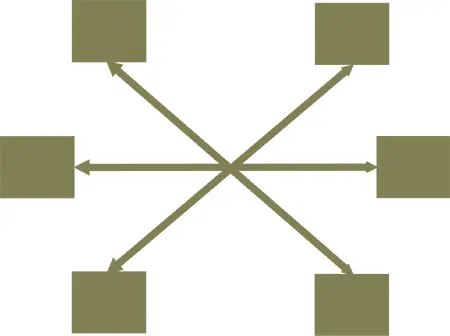
Figure 6.4 Services through network
Guidance: to grow past this challenge requires a significant change in leadership style. While this is accomplished through a variety of human performance techniques and methods, the desired outcome is a cadre of strong managers skilled and experienced in service management structures. Their influence and business focus are essential for moving to the next stage.
6.1.2 Stage-2: Directive
The Stage-1 crisis of leadership ends with a strong management team. They take responsibility for directing strategy and direct low-level managers to assume functional responsibilities (Figure 6.5).
The focus of a Stage-2 organization is on hierarchical structures that separate functional activities. Communication is more formal and basic processes are in place. Although effort and energy are diligently applied to services, they are likely to be inefficient. Functional specialists are frequently faced with the difficult decision of whether to follow the process or take the initiative on their own.
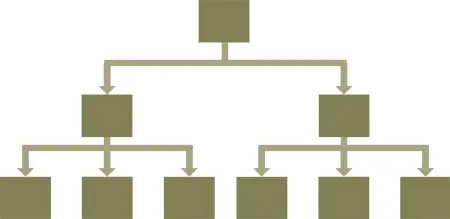
Figure 6.5 Services through direction
A crisis of autonomy arises because the centralization limits decision making and the freedom to experiment or innovate. Entrepreneurial motivation is degraded. For example, high-level approval is needed to start new project s, while successful performance at the lower levels goes unnoticed or unrewarded. Staff become frustrated with their lack of autonomy. By not solving this crisis, the organization limits its ability to grow and prosper.
Guidance: to grow past this challenge requires a shift to greater delegation. Responsibility for service processes should be driven lower in the organization, allowing process owner s to be responsible for lower-level decision making and service accountability.
6.1.3 Stage-3: Delegation
The Stage-2 crisis ends with the delegation of authority to lower-level managers, linking their increased control to a corresponding reward structure (Figure 6.6). Growth through delegation allows the organization to strike a balance between technical efficiency and the need to provide room for innovation in the pursuit of new means to reduce costs or improve services.
The focus of a Stage-3 organization is on the proper application of a decentralized organizational structure. More responsibility shifts from functional owners to process owners. Process owner s focus on process improvement and customer responsiveness . The challenge here is when functional and process objective s clash. Functional owners feel a loss of control and seek to regain it. At this stage, top managers intervene in decision making only when necessary.
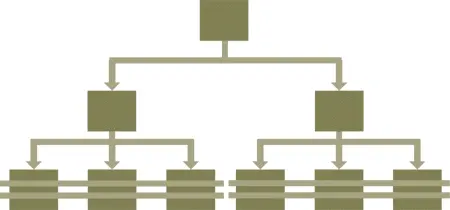
Figure 6.6 Services through delegation
Guidance: Rather than the frequent reaction of returning to a functionally centralized model , the recommended approach is to enhance the organization’s coordination techniques and solutions. The most common approach is through formal system s and programme s.There are occasions when an organization attempts to resolve the coordination challenge by centralizing on a process , rather than functional model . Rather than creating a white space between function s, this leads to white space between processes. In other words, a pure process model is as problematic as a purely functional organizational model. A balance should be sought or the organization will revert back to a crisis of autonomy.
6.1.4 Stage-4: Coordination
The focus of a Stage-4 organization is on the use of formal system s in achieving greater coordination (Figure 6.7). Senior executives acknowledge the criticality of these systems and take responsibility for success of the solutions. The solutions lead to planned service management structures that are intensely review ed and continually improved. Each service is treated as a carefully nurtured and monitored investment. Technical functions remain centralized while service management processes are decentralized.
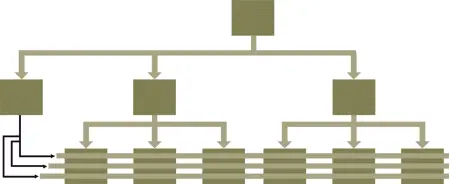
Figure 6.7 Services through coordination
The challenge here is the ability to respond to business needs in an agile manner. The business often adopts a perception that IT, despite its service orientation, has become too bureaucratic and rigid. While the linkages to the business may be well understood, innovation is dampened and service procedure s have taken precedence over business agility.
6.1.5 Stage-5: Collaboration
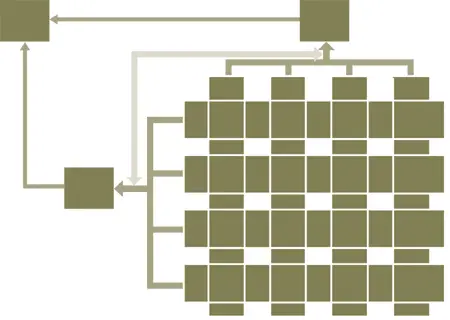
Figure 6.8 Services through collaboration
The focus of a Stage-5 organization is on stronger collaboration with the business (Figure 6.8). Relationship management is more flexible, while managers are highly skilled in teamwork and conflict resolution. The organization responds to changes in business conditions and strategy in the form of teams across functions. Experiments in new practices are encouraged. A matrix-type structure is frequently adopted in this phase.
A matrix structure is a rectangular grid that shows the vertical flow of functional responsibility and a horizontal flow of product or customer responsibility. The provider effectively has two (or more) line organizations with dual lines of authority and a balance of power; two (or more) bosses, each actively participating in strategy setting and governance .
An organization with a matrix structure adopts whatever functions the organization requires to achieve its goals. Functional personnel report to the heads of their respective functions but do not work under their direct supervision. Rather, the work of the functional staff is primarily determined by the leadership of the respective cross-functional product or customer team. The matrix relies on minimal formal vertical control and maximum horizontal control from the use of integrated teams.
The key advantages of a matrix structure:
Reduces and overcomes functional barriers
Increases responsiveness to changing product or customer needs
Opens up communication between functional specialists
Provides opportunities for team members from different function s to learn from each other
Читать дальшеИнтервал:
Закладка:
Обсуждение, отзывы о книге «SS» и просто собственные мнения читателей. Оставьте ваши комментарии, напишите, что Вы думаете о произведении, его смысле или главных героях. Укажите что конкретно понравилось, а что нет, и почему Вы так считаете.