Alexander Theroux - Darconville’s Cat
Здесь есть возможность читать онлайн «Alexander Theroux - Darconville’s Cat» весь текст электронной книги совершенно бесплатно (целиком полную версию без сокращений). В некоторых случаях можно слушать аудио, скачать через торрент в формате fb2 и присутствует краткое содержание. Год выпуска: 1996, Издательство: Holt Paperbacks, Жанр: Современная проза, на английском языке. Описание произведения, (предисловие) а так же отзывы посетителей доступны на портале библиотеки ЛибКат.
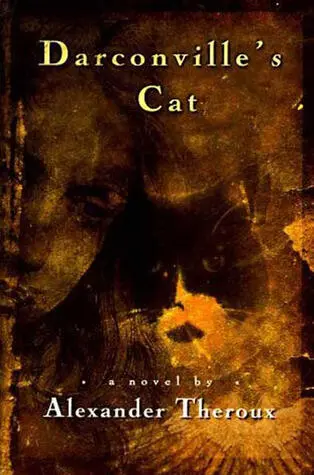
- Название:Darconville’s Cat
- Автор:
- Издательство:Holt Paperbacks
- Жанр:
- Год:1996
- ISBN:нет данных
- Рейтинг книги:3 / 5. Голосов: 2
-
Избранное:Добавить в избранное
- Отзывы:
-
Ваша оценка:
Darconville’s Cat: краткое содержание, описание и аннотация
Предлагаем к чтению аннотацию, описание, краткое содержание или предисловие (зависит от того, что написал сам автор книги «Darconville’s Cat»). Если вы не нашли необходимую информацию о книге — напишите в комментариях, мы постараемся отыскать её.
Darconville's Cat Its chapters embody a multiplicity of narrative forms, including a diary, a formal oration, an abecedarium, a sermon, a litany, a blank-verse play, poems, essays, parodies, and fables. It is an explosion of vocabulary, rich with comic invention and dark with infernal imagination.
Alexander Theroux restores words to life, invents others, liberates a language too long polluted by mutters and mumbles, anti-logic, and the inexact lunacies of the modern world where the possibility of communication itself is in question. An elegantly executed jailbreak from the ordinary,
is excessive; funny; uncompromising; a powerful epic, coming out of a tradition, yet contemporary, of both the sacred and the profane.
Darconville’s Cat — читать онлайн бесплатно полную книгу (весь текст) целиком
Ниже представлен текст книги, разбитый по страницам. Система сохранения места последней прочитанной страницы, позволяет с удобством читать онлайн бесплатно книгу «Darconville’s Cat», без необходимости каждый раз заново искать на чём Вы остановились. Поставьте закладку, и сможете в любой момент перейти на страницу, на которой закончили чтение.
Интервал:
Закладка:
“For Christ’s sake,” he hooted through the library, “I only wanted an excuse in the eyes of the world for existing ! I was a weakling, a trembling mouse of a boy with dirty hands and eyespots and yet growing in me was this readiness to substitute the hand of God for any whim of my persecutors. I gorged myself with sticky sweets. My schoolmates, broadcasting it, avoided touching the books I’d been using and spat upon my very shadow. Fat? Awkward? Seine Figur lacht ihn aus ? That kind of thing, exactly. I escaped a good deal of painful attention, I confess, by the periodic aegrotat of the school physician, but then I was always released, wasn’t I? And, always, there they were waiting for me. They put me in the middle of circles and pulled down my pants — I was so frightened I could have killed them — and taunted me with archabominational threats and heaped up such obscenities upon this subhuman body you see here, even then as white and plump as that of some fat woodboring larva, that in that dreadful macédoine at the heart of all adolescent confusion I found I myself came to agree with them! But did I complain? Would I run to the Prior to weep, to peach, to accuse? I did not, I would not. My altruism, inversely proportionate to my low esteem of myself, knew no bounds.
“It had come to this pass, you see, that I began to love my neighbor more than myself. Now what theology, may I ask, supports that, what paradosis, what transmission of spirit? To love your neighbor more than yourself? Can you understand? I saw no fault in others that I might not have committed myself and forgave in them for doing what I for causing couldn’t absolve in myself !”
Crucifer’s mouth was distended terribly, stretching as if it would separate. The severe grip he had on the arms of the chair gradually loosened then, and he paused for composure.
“I slept in fear, woke in terror, lived in anxiety. I spent every night of my childhood listening . Yes, Darconville, all the spiteful, vile, stupid, cruel, vulgar, petty, errant human acts I’d seen from the day I was born taxed me for the explanation I saw I myself simultaneously provided in the question the vanity in my very own mind was asking! I knew it was committing a sin if I continued to think I had sinned, but I thought, at the risk of presumption of course, I could only not despair by failing to think, the which paradoxically preoccupied my every waking hour. A guilty conscience is the mother of invention. So I took another refuge. I became ashamed. I wanted not to be human, to be non-human, to be unhuman! I wanted to repudiate myself to the degree that in that self-repudiation I would necessarily repudiate the very self repudiating me! The you that is seeing yourself, you see, is the you that is seen. But one would be all,” he said, leaning back, “and, in that one cannot be, here is loneliness. I’d done nothing actually to be ashamed of — except it made me ashamed to have had to think so. When I tried to become ashamed to be ashamed to be human, I then felt the ultimate shame — and became stationary. And, pray, in all this what age do you suppose this boy to be, Darconville? Name it now before I tell you. Why, twelve or fourteen. Or say eleven. No such thing: he is not quite nine years old !”
Dr. Crucifer drew his hands, pausing in a grim clench at the eyes, down his face.
“I craved release from the world — was it from pride or from humility? — and found it. I soon fell under the influence of a Nubian hieromonk named Fâdi, the very same holy man who had once answered my prurient question. (The name is Arabic for empty.) His austere and ruthless intelligence was allied, I noticed even then, to a certain melancholy. Living alone on an eremitic dependency on the river brink, though still on cloistered ground, he was a Christian, as we all were, but with a secret: a subtle dogmatic difference from the orthodoxy of the neighboring monastic community who, in countenancing, ignoring, really, what seemed to them to be the traditional isolation and excesses of the anchorite, bothered never to learn more— unlike me, who did. But I’m ahead of myself. I worried about Fâdi, always. He lived on bean-flour bread, onions and water, and long hesychastic vigils, intervals of prayer he several times a night imposed on himself, despite broken sleep. Fâdi alone understood my sorrow; correctly, he saw that the twentieth-century crisis was the worship of life ; and one day he revealed to me how all could be overcome— briefly, simply, by the rigors of self-denial which I came to call ‘The Naught One Can’t Untie.’ He told me that the highest spiritual knowledge led to the union of the knower, the known, and knowledge itself. How, I wondered, might that be achieved? ‘By privation,’ said Fâdi, ‘for no spirit can rest until it is naughted of all things that are made.’ A mystical commonplace? Perhaps. But with what joy did I receive his words, I who felt in sequent toil all sorrow did contend, I who had long known it was impossible to seize life without violating it, I who held humanity to be so spotted, so tragic a failure. I wanted to be nothing. A circle. A round straight line with a whole in the middle. I wanted to hear the inner sound which perforce kills the outer. I wanted to be eyeless and thouless — to reach le point vierge : the inmost center of the soul, the diamond essence, an absolute poverty. The Funklein!
“The existence of a perfect being, you know,” said Crucifer, ad-monishingly tapping the side of his nose with his ring-finger, “is comprised in the idea of it alone. It became for me, somehow, the one universal element in a world of unsatisfying particulars.
“I abrogated humanity, then. I realized that everything human in us is an obstacle in the way of holiness. You turn away, do you? You sneer at me? But are you aware of Ibn Roshd’s double truth wherein something may be theologically untrue but philosophically true at the same time? I found proof of my hope, comfort in my decision. Will you hear how? Good. Now, realize here that few nations in the East embraced the Gospel more zealously than the dwellers on the Nile. Accustomed as they had long been to regard life as a pilgrimage to death, as a school of preparation for another world, and weary of their motley and confused pantheon of divinities, whose self-seeking priesthood designedly disguised the truth, they eagerly welcomed the simple doctrines of Christianity. But, like Eutyches, they revered the divine nature of the Savior only , in which they held that every human element was absorbed; and when the Council of Chalcedon in 451 sanctioned the doctrine that Christ combined a human with a divine nature, the Egyptians, with their characteristic tenacity, adhered to their old views and formed a sect termed Eutychians, or Monophysites, to which the Copts of the present day still belong. Such a one was Fâdi.
“I learned his Gospel by heart — and lived it, emptying myself of values generally identified as worldly. Salacities, during my post-adolescent years, occurred to me. I fought them, violently. I abounded in youthful cupidity of every sort in my mind, and as I imagined my wickedness, wailed over what mentally I wallowed in, I wished I had wilted in my cradle! I was nightly fitted out at my own pious request with an Onaniebandagen —a little suit of armor fitted over my genitals and attached as a prophylaxis for masturbation to a locked belt, for the body, as time passed, was the only part of the world, I felt, which my thoughts alone could alter. A virtue cannot be said to exist, they say, until it is expressed in nature, correct? I thought about nothing else: wouldn’t the ultimate action, I wondered, lead then to the ultimate virtue? But what was ultimate action? Ultimate virtue? Was it wrong to believe that being is not and that non-being must be? That to die out is distinguished? Absterben ist vornehm ! Between volition and nolition there is a middle thing: non-volition. O, the sweet nothings I whispered in my ears! I desired in the strangest way to elevate myself above human weakness — from jealousy, voluptuousness, even the need for joy ! I craved to emerge from the illusion and instincts of the universe, a pretense, a mask, I knew, of the secret beyond it. And Fâdi knew it — who, finally urged by the impulse of grace to approximate in me the divinity of his Lord, no longer withheld his final sacramental, and in a cave one night at the age of sixteen, while morphiated with an admixture of yagé, hyascin, and anti-convulsant sedatives, I willingly submitted to the mutilation of my ‘precious.’ Annihilation obtained a foothold on a living body in one rapid knife-slash. The keys to hell dropped off the lock. I lost my stones.”
Читать дальшеИнтервал:
Закладка:
Похожие книги на «Darconville’s Cat»
Представляем Вашему вниманию похожие книги на «Darconville’s Cat» списком для выбора. Мы отобрали схожую по названию и смыслу литературу в надежде предоставить читателям больше вариантов отыскать новые, интересные, ещё непрочитанные произведения.









Обсуждение, отзывы о книге «Darconville’s Cat» и просто собственные мнения читателей. Оставьте ваши комментарии, напишите, что Вы думаете о произведении, его смысле или главных героях. Укажите что конкретно понравилось, а что нет, и почему Вы так считаете.