John Gardner - The Sunlight Dialogues
Здесь есть возможность читать онлайн «John Gardner - The Sunlight Dialogues» весь текст электронной книги совершенно бесплатно (целиком полную версию без сокращений). В некоторых случаях можно слушать аудио, скачать через торрент в формате fb2 и присутствует краткое содержание. Год выпуска: 2010, Издательство: Open Road Media, Жанр: Современная проза, на английском языке. Описание произведения, (предисловие) а так же отзывы посетителей доступны на портале библиотеки ЛибКат.
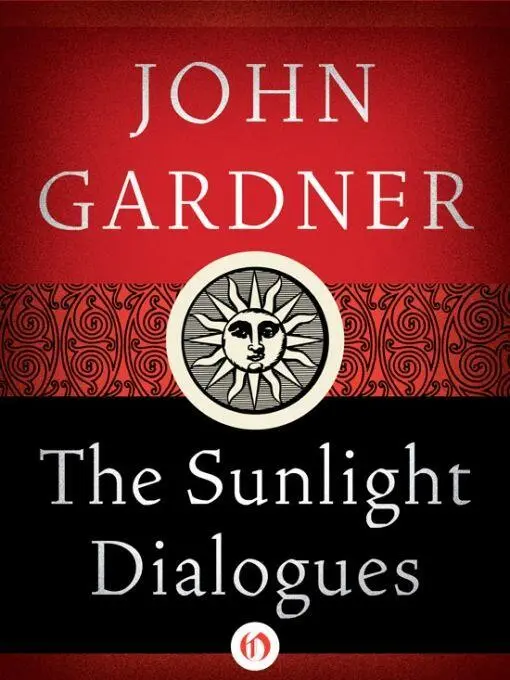
- Название:The Sunlight Dialogues
- Автор:
- Издательство:Open Road Media
- Жанр:
- Год:2010
- ISBN:нет данных
- Рейтинг книги:4 / 5. Голосов: 1
-
Избранное:Добавить в избранное
- Отзывы:
-
Ваша оценка:
The Sunlight Dialogues: краткое содержание, описание и аннотация
Предлагаем к чтению аннотацию, описание, краткое содержание или предисловие (зависит от того, что написал сам автор книги «The Sunlight Dialogues»). Если вы не нашли необходимую информацию о книге — напишите в комментариях, мы постараемся отыскать её.
Beautifully expansive and imbued with exceptional social insight,
is John Gardner’s most ambitious work andestablished him as one of the most important fiction writers in post — World War II America.
The Sunlight Dialogues — читать онлайн бесплатно полную книгу (весь текст) целиком
Ниже представлен текст книги, разбитый по страницам. Система сохранения места последней прочитанной страницы, позволяет с удобством читать онлайн бесплатно книгу «The Sunlight Dialogues», без необходимости каждый раз заново искать на чём Вы остановились. Поставьте закладку, и сможете в любой момент перейти на страницу, на которой закончили чтение.
Интервал:
Закладка:
Kleppmann smiled, still hiding behind his curtain pushing buttons. “These are shameless times,” he said.
“Maybe. Yes, certainly, I suppose. But you get me wrong, I think. I’m no scoffer, proud of having risen out of my middle-class morality. I have no pentecostal urge to declare the new dawn of fornication — no such thing! I have merely lost my feeling for what I have believed.” He pursed his lips, struggling to be precise. “It happens to many people, I suspect. I have known some.” He nodded. “And it seems to me it could be dangerous to pretend, when the feeling dies, that it’s there. There was a woman in our family — generations back, this was — who had a child that wandered off and was never seen again. She kept his room for him, dusted it and kept things tidy for years, and one day she began to see him when he wasn’t there, so they locked her up. That’s how it would be.” His expression went stern as it came to him that he’d run on more than the conversation required. But when he looked at Kleppmann it seemed to him that the old man understood that Will Hodge was not talking to him now, Kleppmann, but to himself. And strangely enough, Kleppmann had taken on a human look, though his eyes were not friendly. He was listening.
“Shameless, no,” Will said, “I’m not that. Taking my middle-class values from me is like pulling teeth, and when the value’s gone, how dizzying and jagged the abyss revealed to the tongue! But holes must not be denied.”
Kleppmann nodded, smiling again, a nervous flicker. “Up-mobility, it’s called.”
Will scowled. “It’s what?” Then: “Nonsense. Are you purposely misunderstanding?” Absurdly, he was furious. “I tell you the truth, Mr. Kleppmann, as a believer in Law. Law in the old sense, Justinian. I have never for one minute, so far as I know—” He was shaking his finger, and noticing the ridiculous gesture he lost track of what he was saying. Kleppmann was piling the meat onto trays. It was black. Will remembered again, abruptly. “I’m not social-climbing. Another thing entirely. I am stubbornly trying to understand, in my own rational middle-class terms, why it is that I no longer feel what I believe.”
Three men with white faces stood watching like birds at the rim of the fire’s influence.
“You say it again and again, though, don’t you. ‘Middle-class,’ ‘middle-class,’“ Kleppmann said.
“That’s pride, Mr. Kleppmann. My family’s been middle-class for centuries. Doctors, lawyers, ministers, farmers, a Congressman once. We’re all very proud of that.”
For the first time all night, Kleppmann looked at him levelly, not merely snatching an impression to manipulate with from behind his curtain, but scrutinizing his face. “We’re somewhat alike, you and I,” he said. He bent down for the meat.
It was not until hours later that they talked again. Kleppmann, at his wife’s suggestion, was showing Will to his room. Will still had the pistol, a great bulge in his suitcoat pocket which Kleppmann could not possibly have failed to notice. It seemed now more ludicrous than ever, as Will sat on the side of the bed in the large, farmhouse room, and Kleppmann stood remote but curious at the door.
Will said, “It’s come to me, I think. It’s the money. The tax business. They’ll beat me, you figure — because though God knows justice is on my side, I was never a ‘responsible officer,’ merely a legal consultant, whatever the fancy title they gave it, it’s not so clear that Federal law is neatly squared with justice.”
Kleppmann bowed as if to acknowledge that it might indeed be something along that line.
“You forget what ego-gratification I get out of honesty,” Will said.
Again Kleppmann bowed, admitting it might be so.
Will stood up and went to the window to look out. He felt cramped, here inside the house. But the fog was thicker now. He could barely see to the pillars of the high portico.
“Ego-gratification,” Will said with disgust. “I sound like the rest of them.”
“Ah well, one may as well be honest,” Kleppmann said. It sounded as though he were mimicking someone, and at first Will couldn’t think who. He remembered then. He could feel his neck swelling.
“Scoff if you like,” he said. “But consider this. You can’t get me through the tax business either. It’s true, they may beat me, and it’s true that I haven’t got even the cash to buy them off. Nevertheless, and you can call it what you like — ego-gratification, whatever — I’m as indifferent to jail as to scandal.” It sounded grandiose, and he tried to think of a better way to say it. He looked at his hands, white and soft as a woman’s. “I have this image of virtue. Idea of nobility. Something.”
Kleppmann nodded. “And you actually feel it,” he said.
“Sometimes.” He was not sure that even that was true, but he kept the doubt to himself.
“I understand, of course. Yes. If you were caught in shady dealings — not, in fact, that I have anything of that kind to propose, for all this strange talk of yours — it would be the end. Disbarred, or whatever the phrase is.”
“Good night,” Will said.
“You’re right.” He tipped his head, slow and poised, and glanced at his watch. “It’s after two. Forgive me.” He drew the door partway shut and added, “I look forward to talking more with you in the morning.”
And so, at last, he was alone.
He lay in the dark, drifting gently between daydream and nightmare.
One final question, Mr. Hodge.
There are no final questions.
One. I grant, and without reservation, that you are invulnerable. Yes. I can offer no reason under the sun why you should capitulate to my insidious suggestion. But let me ask, indifferently, for mere logic’s sake, is there any reason on earth why you should not?
“I know what I feel,” he whispered. In the deathly still farmhouse, the sound was like fire in straw.
And what do you feel for sure? the echoes asked.
There was an answer to that. He could not quite put his hand on it, but it was there, he would have it in a moment. He must wait.
The girl at Buz Marchant’s had a squeezed-shut face. She was a good girl, no doubt. Pretty, kind in the usual ways. Not intelligent, no, but not all saints were intelligent either. The thing was — he struggled to get hold of it, nail it down once and for all — but again it came merely to this: she had a face that marked her, singled her out not as the bearer of any particular virtue or defect but as, simply, the bearer of her singleness. In adolescent dreams one coupled with radiant beauties with indefinite and lovely faces, but then one day it all turned real, no longer airy wet-dream vision — a girl one knew, with a name, brittle hair, a chin just a little too deeply cleft. That was love, if it was anything. Not the other. Not the sunlight but the sunlight entrapped in the cloud.
“Bullshit,” he whispered.
Nevertheless, what was true of the girl was true of Mrs. Kleppmann too, and of Kleppmann. An objectness neither significant nor beautiful but there, singular; and they spoke words to him neither significant nor beautiful either; and by agreement, he understood them.
He understood, suddenly, what had gone wrong between him and Louise, and between him and his children, between his own mother and father, between, even, the Congressman and his sons. A kind of power failure, a sickly decline into vision. As simple as that. The discovery ran through his body like a shock and made his skin tingle, the way music did sometimes, or a brilliant point perfectly timed in a piece of litigation. All rhythm, he thought in wild excitement, pure matter in its rhythm. His head filled with an image of atoms going off, on, off, on, spinning — or planets, maybe, there was no telling now. He felt himself swinging in a wide arc around — someone. The face was obscure, a threatening shadow.
Читать дальшеИнтервал:
Закладка:
Похожие книги на «The Sunlight Dialogues»
Представляем Вашему вниманию похожие книги на «The Sunlight Dialogues» списком для выбора. Мы отобрали схожую по названию и смыслу литературу в надежде предоставить читателям больше вариантов отыскать новые, интересные, ещё непрочитанные произведения.




Обсуждение, отзывы о книге «The Sunlight Dialogues» и просто собственные мнения читателей. Оставьте ваши комментарии, напишите, что Вы думаете о произведении, его смысле или главных героях. Укажите что конкретно понравилось, а что нет, и почему Вы так считаете.