John Gardner - The Sunlight Dialogues
Здесь есть возможность читать онлайн «John Gardner - The Sunlight Dialogues» весь текст электронной книги совершенно бесплатно (целиком полную версию без сокращений). В некоторых случаях можно слушать аудио, скачать через торрент в формате fb2 и присутствует краткое содержание. Год выпуска: 2010, Издательство: Open Road Media, Жанр: Современная проза, на английском языке. Описание произведения, (предисловие) а так же отзывы посетителей доступны на портале библиотеки ЛибКат.
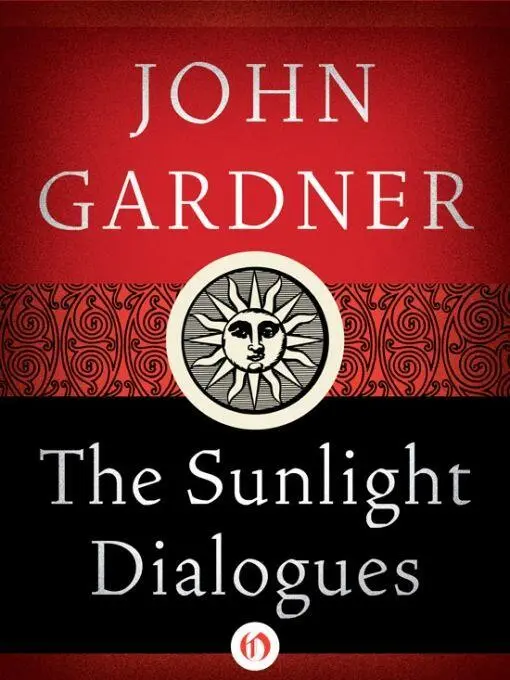
- Название:The Sunlight Dialogues
- Автор:
- Издательство:Open Road Media
- Жанр:
- Год:2010
- ISBN:нет данных
- Рейтинг книги:4 / 5. Голосов: 1
-
Избранное:Добавить в избранное
- Отзывы:
-
Ваша оценка:
The Sunlight Dialogues: краткое содержание, описание и аннотация
Предлагаем к чтению аннотацию, описание, краткое содержание или предисловие (зависит от того, что написал сам автор книги «The Sunlight Dialogues»). Если вы не нашли необходимую информацию о книге — напишите в комментариях, мы постараемся отыскать её.
Beautifully expansive and imbued with exceptional social insight,
is John Gardner’s most ambitious work andestablished him as one of the most important fiction writers in post — World War II America.
The Sunlight Dialogues — читать онлайн бесплатно полную книгу (весь текст) целиком
Ниже представлен текст книги, разбитый по страницам. Система сохранения места последней прочитанной страницы, позволяет с удобством читать онлайн бесплатно книгу «The Sunlight Dialogues», без необходимости каждый раз заново искать на чём Вы остановились. Поставьте закладку, и сможете в любой момент перейти на страницу, на которой закончили чтение.
Интервал:
Закладка:
In the morning, what he remembered of all this seemed the usual dim-wittedness of dream, when the circuits are weak. Kleppmann spoke casually of horrors in Germany and scoffed at trials of war criminals as self-congratulation. They could not agree. Will Jr boarded the train for St. Louis at noon, integrity intact (conventions intact), though he had not had time, as yet, to work out his reasons. He would think it out on the train and plane, he told himself. But he didn’t. The truth was, there was no need. Kleppmann had chosen — for whatever reason, evil or good, despite his habit in such cases, and despite the hatred that flickered inside him like summer lightning, a hatred of life itself, perhaps (but tradition be damned) — to send him home alive.
XIX. Workmen in a Quarry
The Caverns of the Grave I’ve seen,
And these I show’d to England’s Queen,
But now the Caves of Hell I view,
Who shall I dare to show them to?
— William Blake1
Miller said, “They want you over at the Mayor’s at ten o’clock.”
Clumly nodded and moved on toward his office.
“I got some stuff for you,” Miller said.
“Bring it in.” He opened the door, took his hat off, and went to his desk. Miller came with his clipboard and two or three folders in the crook of his arm. Chief Clumly sat waiting, his elbows firmly planted. The two small eyes at the peak of his white, mole’s nose were as red as a wolfs. It was nine a.m. One hour yet before Mayor Mullen’s “investigation.”
Miller said, “Lot of activity last night. Some kids beat up a couple in a parked car, behind the racetrack.” He handed the reports to Clumly. “And somebody got into Salway’s Hardware last night. Took some money and some papers out of the safe and also—” he held the sheet to Clumly “—twenty-six guns, seventeen of them rifles. Got in the same way as at Francis and Mead. Could be the same outfit. Professional work.”
“You know when it happened?”
“Not for sure. Ed Tank was on prowl. He discovered it at eleven-thirty. There’s more.”
“Go ahead.”
“Early this morning, around five-twenty-five, a guy went into Greco’s Garage in Darien, took a whole lot of car parts. He must’ve hauled ’em off in a truck. The State Police—”
“How you know the time?”
“Trooper called in at five-twenty-five, said he was at Greco’s, going in to investigate. Then nothing. They found his car there burnt to a cinder.”
“Find the trooper?”
“Not a trace.”
Clumly half-closed his eyes, and they looked more than ever like a wolf’s. “Dead, you think?”
“I don’t know.”
Clumly said, “Sounds like vigilantes. You think so? Guns. Parts for bombs.”
Miller nodded. “That’s what it sounds like. The State Police have already got hold of the Federal.”
“Ok, that’s all?”
“Not quite,” Miller said. “You wanted a description of the man who registered in Paxton’s name at that ranch in Colorado. We got it. Man with a scarred face, yellow hair, and a yellow beard.”
“The Sunlight Man.”
He nodded. “As for the stone — the little white stone you gave me — it’s out of a deer. Very rare, they say. Forms inside the deer’s stomach, one deer in a thousand.”
“Anything else?”
“That’s all so far on the stone. But this: your hunch was right about Kathleen Paxton. She was transferred from the place in Palo Alto on August sixteenth. Shipped to Rochester. Papers signed by her brother.”
“You’ve got the address?”
Miller nodded and handed him the paper from his clipboard.
“Good work. First-rate. That’s all for now. Have Kozlowski wait for me. There’s just about time for—” He paused, thought better of it. “That’s all,” he said with finality. “Have Kozlowski wait.”
Miller brooded a moment, then nodded. He said, “Your wife was in.” After a moment: “She had some tapes she wanted me to hear.”
“You heard ’em?” He kept himself calm.
Miller nodded. “So did Uphill. He was right outside the door.”
Clumly tipped the desk with one finger. “All right,” he said. A whisper.
Miller nodded again, then saluted and went out.
Now that he was alone, Clumly jumped up and paced and made no attempt to contain his anger. The Sunlight Man had been laughing at him all the time. Taggert Hodge! No doubt had the whole damn family working for him. Keeping him up all day and night, wrecking his health, ruining his brains, robbing him of his job, robbing him even of the dignity a Chief of Police ought to have when he retired. No doubt out there someplace watching him right now. Disguised as a fireman maybe. How else would Uphill have known?
Clumly paused at the window and scowled, then abruptly went to the door and called Figlow. “I want that firehouse raided,” he said.
“What?” Figlow said.
“You heard me. Raid the firehouse. The Sunlight Man’s there, in disguise.”
Figlow put his fist on his mouth, eyebrows lowered. “Yes-sir,” he said.
Clumly stormed back to his desk. The paper the Judge had brought for him to read still lay there. He looked away from it guiltily. “Ok, my magical friend,” he said aloud, “you were right. Your time’s running out.” He looked at his watch. 9:30. Appointment with the Mayor at ten. Uphill would be there. Fred Clumly’s time, too, was running out.
“Kozlowski,” Clumly said, “we’re in an age of technology. A great time to be alive, but also a dangerous one.”
Kozlowski kept his eyes on the traffic.
“A time of great prosperity. Enormous buildings, enormous businesses, factories, institutions of learning! And what’s in the shadow of those glorious buildings? Hovels, Kozlowski. Misery and crime and despair. More violence than ever before in history. More sorrow and hopelessness and rage. America leads the world in it. The Russians are hurrying to catch up, of course — they’ll be mass-producing cars by next year, I read, and also refrigerators and I forget what-all else: turning out a glorious civilization by technology, pushbutton factories where no humans need apply. Ha. It’s something to think about. Khrushchev tried to boost the economy, but he was cowardly, come right down to it. There’s why Koseygen or whatever-his-name-is took over. Gross national profit has jumped this year, matched by gross national violence. Fact. They’re catching up with us!” Clumly rubbed his hands. “You ever stop to think just exactly what happens in slums, Kozlowski? They start out a little pocket of Negroes, say, who are living there while they look for a job that will move them out. No jobs. In 1900, fifty-six per cent of the total employed population was engaged in farming and fisheries and forestry. Now that’s down to I think it was seven per cent. Mechanization, Kozlowski. Technology. No matter what price supports you put in, no matter what kind of advertising you put on the doors of your pick-up truck — like DRINK MORE MILK — it’s over. Finished. Going to be six, seven companies doing all the farming in the whole damn country. As for industry, used to be in 1900 almost half the population was engaged in that, but it’s slipping by leaps and bounds. Industries bigger than ever, but now they’re mechanized. Telecontrol in the shop — you know what that is, Kozlowski? One machine, a man sitting in an office running all the whole damn plant, with maybe six, eight men with brooms and college educations keeping an eye on things in case anything happens to go wrong. And as for the office, who needs secretaries? They got computers can make out the check for the man at the telecontrol! What’s to happen to all that labor that’s no longer needed? Government, you say. But just think about it. 1900 there was sixteen per cent of the people in State and Federal government jobs. Now it’s forty per cent and rising. Doing what? Maybe sixteen different agencies all doing the same damn job, checking up on each other — providing they happen to know about each other’s existence. That’s insanity, boy. When a whole country’s got nothing to do but watch somebody, well sir, that’s insanity. Big brother, they say. Shoot! Watch the little brother! That’s the dangerous one! Keep on putting labor in the only place left for it to go and in another ten years there’ll be eighty per cent of the U.S. population in Government jobs, paying theirselves with their own taxes. That’s called incest, Kozlowski. You know what results when brothers and sisters reproduce?”
Читать дальшеИнтервал:
Закладка:
Похожие книги на «The Sunlight Dialogues»
Представляем Вашему вниманию похожие книги на «The Sunlight Dialogues» списком для выбора. Мы отобрали схожую по названию и смыслу литературу в надежде предоставить читателям больше вариантов отыскать новые, интересные, ещё непрочитанные произведения.


Обсуждение, отзывы о книге «The Sunlight Dialogues» и просто собственные мнения читателей. Оставьте ваши комментарии, напишите, что Вы думаете о произведении, его смысле или главных героях. Укажите что конкретно понравилось, а что нет, и почему Вы так считаете.