John Gardner - The Sunlight Dialogues
Здесь есть возможность читать онлайн «John Gardner - The Sunlight Dialogues» весь текст электронной книги совершенно бесплатно (целиком полную версию без сокращений). В некоторых случаях можно слушать аудио, скачать через торрент в формате fb2 и присутствует краткое содержание. Год выпуска: 2010, Издательство: Open Road Media, Жанр: Современная проза, на английском языке. Описание произведения, (предисловие) а так же отзывы посетителей доступны на портале библиотеки ЛибКат.
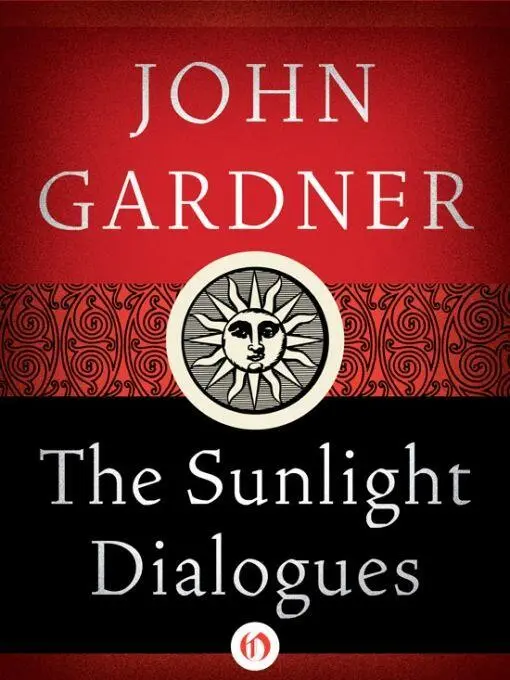
- Название:The Sunlight Dialogues
- Автор:
- Издательство:Open Road Media
- Жанр:
- Год:2010
- ISBN:нет данных
- Рейтинг книги:4 / 5. Голосов: 1
-
Избранное:Добавить в избранное
- Отзывы:
-
Ваша оценка:
The Sunlight Dialogues: краткое содержание, описание и аннотация
Предлагаем к чтению аннотацию, описание, краткое содержание или предисловие (зависит от того, что написал сам автор книги «The Sunlight Dialogues»). Если вы не нашли необходимую информацию о книге — напишите в комментариях, мы постараемся отыскать её.
Beautifully expansive and imbued with exceptional social insight,
is John Gardner’s most ambitious work andestablished him as one of the most important fiction writers in post — World War II America.
The Sunlight Dialogues — читать онлайн бесплатно полную книгу (весь текст) целиком
Ниже представлен текст книги, разбитый по страницам. Система сохранения места последней прочитанной страницы, позволяет с удобством читать онлайн бесплатно книгу «The Sunlight Dialogues», без необходимости каждый раз заново искать на чём Вы остановились. Поставьте закладку, и сможете в любой момент перейти на страницу, на которой закончили чтение.
Интервал:
Закладка:
4
The meeting dragged on. Walter Benson’s feet ached from standing up, and he’d shifted so often from one leg to the other that he had no way left to rest himself unless, like some of the people around him, he should choose to sit on the fender of someone’s parked car. One of the white men standing with a beer bottle said to the man beside him, “They gonna march or something? They just going to talk all night?” The other man said, “Don’t you worry. Those people that organize these things, they know what they’re doin’.” “What are they doin’, Harrison?” another man said. The second man nodded and winked and merely repeated, “They know what they’re doin’, don’t worry.” But people were beginning to leave, the old people first, and then some of the fat men in fancy clothes. For all the shouting, it was going to come to nothing. The police continued to drive slowly and without interest around the park. “Just letting off steam,” a man to Benson’s left said. He kept tapping the brick wall with his ring, like an impatient man waiting for someone. “It’s like one of those summer band concerts, only louder. Makes them feel good, talking about how much they hate the son-of-a-bitching whites.” He spoke as if to himself, but when he saw Walter Benson looking at him he jerked his chin up, a kind of tic, “Takes the place of church, a lot of ’em. They’ve seen through all that stuff, a lot of ’em, and now there they are, all dressed up and noplace to go.” He jerked his chin again and tapped rapidly, in the rhythm of some almost recognizable song. He said, “Don’t look at me, buddy. I didn’t take away their religion.”
The leaders seemed to realize that the meeting was coming to nothing. Or maybe, as one of the observers in front of the tavern thought, the leaders hadn’t meant it to come to anything in the first place, it was a simple show of numbers. In any case, they were winding it up. Then there was a brief period of confusion. A big-shouldered white man with sideburns was on the platform, shouting into the microphone, “Is this a public park or isn’t it?” Several people close to the platform answered him at once, but their voices didn’t come over the loudspeaker. The man with sideburns said, “I just want to talk for one minute. Let me have—” The rest of his sentence didn’t come through. People were pulling the microphone away. Someone else’s voice said into the mike, “It’s a rented speaker system. You want to have a rally, go rent yourself a speaker. This one—” More lost. The man with sideburns: “—pay you, then.” There were bumping noises through the loudspeaker as they tussled over the microphone. The man with sideburns started hitting with his fists. “Heil Hitler!” he yelled, not through the mike. And then through the mike someone yelled, “Nah Hitler uns!” People down by the platform were yelling. The police car rolled indifferently by between Benson and what was left of the crowd. In a minute or two it was over. People began singing again, and now everyone was leaving.
Benson walked back to his car to watch for Nuper to come to his. According to the clock on the dashboard, it was five-to-two in the morning.
“Why are you doing this?” he asked himself.
But he knew the answer, or knew, anyway, that there was an answer, but one too complicated to unravel. Again and again he had wanted to say to the guard in the jail, “Be careful. Don’t be so trusting. They’re after you.” But he had said nothing. He had wanted to say, “They’re going to break out. I can feel it coming.”; But he’d said nothing. And they had said, “What did you see?” and he had said — had almost believed—“I was asleep.”
All that had nothing to do with Ollie Nuper, though. And it had nothing to do with his straining, tonight, to hear what the speakers were saying, or with the feeling of elation that had come to him during the thunderstorm. It was simply that he was restless, full of a tortured sense of something waking up inside him, whether good or evil he could not make out. He coughed, then coughed again. The tickle in his throat was still there.
He suddenly remembered the old woman, the poetess, whom the Batavia Chief of Police had taken him to see. She looked a thousand years old, and peering in her eyes he had seen to his horror that there was nothing, no one in there: an empty husk. It made him remember a time, more than forty years ago now, when he’d gotten himself locked up in the Buffalo bolt factory at closing time. He couldn’t get out, and as darkness came on he’d wandered back and forth through the vast silent rooms where all day long there was a roar of big machinery and a bustle of men, and the belts were all turning and there was a constant gurgle of oil pouring over hot steel. Now nothing stirred, the big machines were still, and he felt like the last survivor on a dead planet. And suddenly — not because of shadows or imagined creatures in the dark, not because he was alone and only a boy — he was afraid.
The Negroes were still leaving, but there were only a few of them left now. They too made him think of the abandoned factory he had thought he’d forgotten, though he couldn’t say what the connection between the factory and the Negroes was. Their walk was slow and deliberate, and you could not tell, to look at them, that they had somewhere definite to go.
He caught sight, at last, of Ollie Nuper. He was coming this way, carrying a box and an armload of his signs, walking with a giant, well-dressed white man, some kind of politician, it looked like. When they got to the sidewalk they paused, about to walk in different directions, and they talked rapidly, trying to finish their argument. The big man had his back to Benson. He seemed extremely angry. Something about him was familiar — it seemed to Benson that any moment the recognition was going to burst into his mind — but try as he might, he couldn’t make out where he’d seen the man before or who it was he looked like. Finally the big man turned and came striding toward Benson, and for an instant Benson knew him: it was the Sunlight Man. But it was a mistake. It was some stranger. He was clean-shaven and so angry his temples looked swollen. Benson followed him with his eyes as far as the corner, then lost him to the shadows.
The light went on in Nuper’s car and Nuper got in and closed the door; the light went off again. Benson switched on his ignition. The car parked directly behind him started up at almost the same moment. The overhead light went on as the driver reached across to open the door for a friend, and the friend got in. They had black bands around their arms. The light went off. Now Nuper was pulling out of his parking place. When Benson pulled out the car behind him followed. The headlights weren’t on. “What is this?” Benson whispered. “Good Lord, what’s happening?”
XVIII. The Dragon’s Dwelling-Place and the Court for Owls
But Yudhisthira was resolute and
would not enter heaven without his dog.
— The Maha-Bhrata1
Regardez.
Nous considérons aujourd’hui un homme perdu.
C’est triste. Misérable.
Condition de vie.
Mais oui, et c’est misérable.
Outside, fog. Drone of the engines, aisle lights very dim, stewardess asleep no doubt, or smoking a cigarette in her tight barren cloister musing on a dress she has half-finished, folded up in her closet to await her return, hidden carefully, sullenly, like all other signs of her existence, because her roommate has gentleman friends when she is gone, a working agreement: when she returns, exit roommate, and when she leaves again she vanishes utterly, like smoke. Or no. Avec sa mère. Va de temps à temps aux maisons des amis. TA ta, Mama. Je retournerai. Et la mère? Est-ce qu’elle aussi a les amis? “Good evening Mr. Hodge.” Jumped half out of his skin. And did the regulation kind eyes see, the regulation soft lips draw down, momentarily distressed by an intuition of damnation? Ha! Nous considérons ce soir un homme perdu.
Читать дальшеИнтервал:
Закладка:
Похожие книги на «The Sunlight Dialogues»
Представляем Вашему вниманию похожие книги на «The Sunlight Dialogues» списком для выбора. Мы отобрали схожую по названию и смыслу литературу в надежде предоставить читателям больше вариантов отыскать новые, интересные, ещё непрочитанные произведения.




Обсуждение, отзывы о книге «The Sunlight Dialogues» и просто собственные мнения читателей. Оставьте ваши комментарии, напишите, что Вы думаете о произведении, его смысле или главных героях. Укажите что конкретно понравилось, а что нет, и почему Вы так считаете.