Jerzy Pilch - A Thousand Peaceful Cities
Здесь есть возможность читать онлайн «Jerzy Pilch - A Thousand Peaceful Cities» весь текст электронной книги совершенно бесплатно (целиком полную версию без сокращений). В некоторых случаях можно слушать аудио, скачать через торрент в формате fb2 и присутствует краткое содержание. Год выпуска: 2010, Издательство: Open Letter, Жанр: Современная проза, на английском языке. Описание произведения, (предисловие) а так же отзывы посетителей доступны на портале библиотеки ЛибКат.
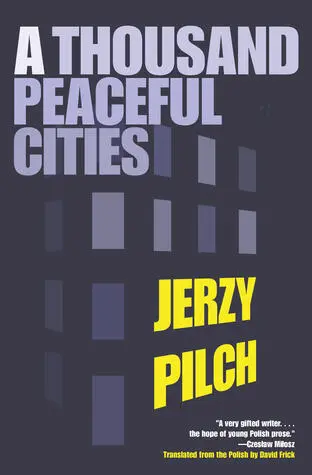
- Название:A Thousand Peaceful Cities
- Автор:
- Издательство:Open Letter
- Жанр:
- Год:2010
- ISBN:нет данных
- Рейтинг книги:3 / 5. Голосов: 1
-
Избранное:Добавить в избранное
- Отзывы:
-
Ваша оценка:
A Thousand Peaceful Cities: краткое содержание, описание и аннотация
Предлагаем к чтению аннотацию, описание, краткое содержание или предисловие (зависит от того, что написал сам автор книги «A Thousand Peaceful Cities»). Если вы не нашли необходимую информацию о книге — напишите в комментариях, мы постараемся отыскать её.
takes place in 1963, in the latter days of the Polish post-Stalinist “thaw.” The narrator, Jerzyk (“little Jerzy”), is a teenager who is keenly interested in his father, a retired postal administrator, and his father’s closest friend, Mr. Trąba, a failed Lutheran clergyman, alcoholic, would-be Polish insurrectionist, and one of the wildest literary characters since Sterne’s Uncle Toby. One drunken afternoon, Mr. Trąba and the narrator’s nameless father decide to take charge of their lives and do one final good turn for humanity: travel to distant Warsaw and assassinate the de facto Polish head of state, First Secretary of the Polish United Workers’ Party, Władysław Gomułka — assassinating Mao Tse-tung, after all, would be impractical. And they decide to involve Jerzyk in their scheme…
A Thousand Peaceful Cities — читать онлайн бесплатно полную книгу (весь текст) целиком
Ниже представлен текст книги, разбитый по страницам. Система сохранения места последней прочитанной страницы, позволяет с удобством читать онлайн бесплатно книгу «A Thousand Peaceful Cities», без необходимости каждый раз заново искать на чём Вы остановились. Поставьте закладку, и сможете в любой момент перейти на страницу, на которой закончили чтение.
Интервал:
Закладка:
He fell silent for a moment. He opened his lips wider. A stream of tawny saliva flowed down over the gray growth on his cheek. He sighed and raised his lowered eyelids. He looked at me with an unconscious glance, and he half-whispered, half-wheezed:
“You shouldn’t see me like this, Jerzyk. I am in both moral and physical decay.”
And he reached out his trembling hand for the bottle I was still holding, and I bent over him. I carefully placed the bottle on his lips, and he drank. Then, having pulled himself together somewhat, he looked at me. In fact, you would have to say that he examined my intent most carefully. In a flash he understood the elementary goal of my visit, and he said:
“Drink to my return to health, Jerzyk. Do this as quickly as possible, since I am expecting the arrival of the sister of mercy at any minute.”
And indeed, the dose I drank didn’t even have time to reach my spiritual parts, when the massive figure of Mrs. Rychter — the widow of old Mr. Rychter, the owner of the department store — suddenly appeared in the room, as if out of thin air, dressed in a beautiful flowery dress.
“Good day, good day,” she shouted, accenting the word “good” extravagantly and enunciating it theatrically. She immediately began to run around Mr. Trąba’s bed. She ran, waved her arms, and shouted “Good! Good! Good! Gut! Gut! Sehr Gut! Good life! Good life! To good life!”
She ran, and time and again she raised and dropped her hands. She clasped and unclasped her hands. She thrashed the air with her arms. She also performed knee bends, full of unexpected stateliness and at full speed. She was like a mad gymnast who had decided to commit suicide by performing all the sequences of exercises known to her to her last breath.
“Positive thinking! Positive thinking!” she roared at the top of her voice. “A well-disposed attitude to the world!” she screamed like a buffalo with its throat cut. “A well-disposed attitude toward the world works wonders. In the monthly America I read an interview with a man who, thanks to his well-disposed attitude toward the world, came back from prostate cancer! Prostate cancer!”
•
For a good while I had been withdrawing step by step. I had already crossed the dark entryway, and finally I felt warmth and light upon my manly shoulders. If it were not for the fact that I well remembered Mr. Trąba’s indubitable arguments about warmth and light as the indispensable attributes of Satan, perhaps it would have seemed to me that I was returning from hell to the earth. But since I remembered and — what is more — believed, I surveyed the demon-filled world without any illusions.
Grand Master Swaczyna glided with a decisive gait through the empty and cleanly swept Market Square, dressed in a faultlessly tailored light-blue suit. I had received wings, and I was already prepared to commit an act of betrayal, but my enlightened mind now began to play for time and to consider the fundamental question of whether there was any need for committing an act of betrayal. I was enveloped by the smell of the world’s most expensive eau-de-cologne. I bowed. Grand Master Swaczyna politely returned my bow.
“A beautiful day, Jerzy, my good man, as beautiful as, excuse the expression, five hundred new złotys,” he began the conversation with his perfect low voice.
“The dearest day in the world,” I responded.
Grand Master Swaczyna looked at me with his splendid blue eyes — to match them he chose the most expensive blue shirts and the most expensive blue suits in the world — and he sighed in relief.
“Conversation with you, sir, my good Jerzy, is a true pleasure. If you don’t mind, if you have a little time, let’s look in on my shooting-gallery for a moment.”
Grand Master Swaczyna winked perfectly, smiled dazzlingly, and added playfully:
“My shooting-gallery worth all the money in the world. After you, sir,” and he offered his hand.
I turned around, and I caught sight of a spanking-new Citroën in the shadow of an old spreading willow tree. The sky-blue body had in it the intensity of the heavens of August.
“I brought it here from Warsaw yesterday. I crawled along all day long. I was afraid I would destroy the engine. I sold the Moskwicz for a small profit.”
Grand Master Swaczyna jingled the keys. He opened the windows and doors. He wiped invisible dust from the dashboard with a chamois. He started the engine, and, with his head thrown back, like a director listening to the first notes of an orchestra, he listened to the music of the first revolutions. The interior of the car smelled of the eternal odor of nothingness delimited by matter. It was the odor of the most expensive bars, exclusive clubs, and elegant apartments, the odor of costly hotels, rare substances, and harmonious objects.
We drove along the river. The first vacationers were taking off their dresses, rubbing suntan lotion onto their shoulders, and carefully spreading out gray blankets on the grassy banks. Grand Master Swaczyna nervously adjusted the collar of his deluxe shirt time and again.
“More than one body worthy of attention will be brought to the light of day today. More than one, Jerzy.” His intonation misled me. I was certain that immediately thereafter he would add the necessary conclusion, or that he would offer me unambiguous advice about life. But he unexpectedly fell silent, and having lost my concentration and irritated at myself, I was no longer able to guess where he was headed, what he had in mind.
“Is it true what people say about you?” I asked after a while.
“It depends which of the numerous legends that circulate about me you mean. Just what do they say?”
“They say,” I started stammering, although I had sworn that I wouldn’t stammer, “they say, that you are the richest man in the world.”
Grand Master Swaczyna waved it off scornfully.
“What do you mean?” he said with distaste and irritation. “What do you mean? Don’t believe every rumor you hear. The richest man in the world! That’s a good one!” Grand Master Swaczyna was enjoying his own scorn and irritation. “The richest man in the world! I’m not even in the top ten!” Now he spoke quickly and forcefully, with the bitter sarcasm of a man who was conscious of his defeats in life. “Come on, I’m not even in the top ten. It isn’t enough that I’m not there, I’m falling. To put it bluntly, I’m falling on my face. Last year I was number fifteen, but today I’m seventeen. That, among other things, was precisely what I wanted to check on in Warsaw. Do you realize, Jerzy, what it means to be number seventeen!? It means not to exist at all.”
•
Flakes of green paint were falling off the brittle walls of the shooting gallery. Through the crevices in the crooked boards and battered sheet metal arose straight streams of light. In the depths, in the thick green shadow, stood rows of glass tubes, paper flowers, and matches. Cigarettes hung on invisible threads. Black-and-white photos of film stars, petrified candies, above that shields full of shots, in the corner a monstrous doll no one could win — you had to have seventy-two points from six free-hand shots in order to win it, a result that even an Olympic champion could never achieve.
Małgosia Snyperek sat on a stool outside that rickety pavilion, which, it seemed, would collapse with the least puff of air. She exposed her freckled little face to the sun. She had rolled up her sad little dress, which was sewn together from various mismatched fabrics, and you could see her paper-white thighs. She was startled at the sight of us, and putting her sackcloth gown and her indifferent hairstyle in order, she fled inside and attempted to lend an expression of business-like readiness to her happenstance features.
Читать дальшеИнтервал:
Закладка:
Похожие книги на «A Thousand Peaceful Cities»
Представляем Вашему вниманию похожие книги на «A Thousand Peaceful Cities» списком для выбора. Мы отобрали схожую по названию и смыслу литературу в надежде предоставить читателям больше вариантов отыскать новые, интересные, ещё непрочитанные произведения.









Обсуждение, отзывы о книге «A Thousand Peaceful Cities» и просто собственные мнения читателей. Оставьте ваши комментарии, напишите, что Вы думаете о произведении, его смысле или главных героях. Укажите что конкретно понравилось, а что нет, и почему Вы так считаете.