Jerzy Pilch - A Thousand Peaceful Cities
Здесь есть возможность читать онлайн «Jerzy Pilch - A Thousand Peaceful Cities» весь текст электронной книги совершенно бесплатно (целиком полную версию без сокращений). В некоторых случаях можно слушать аудио, скачать через торрент в формате fb2 и присутствует краткое содержание. Год выпуска: 2010, Издательство: Open Letter, Жанр: Современная проза, на английском языке. Описание произведения, (предисловие) а так же отзывы посетителей доступны на портале библиотеки ЛибКат.
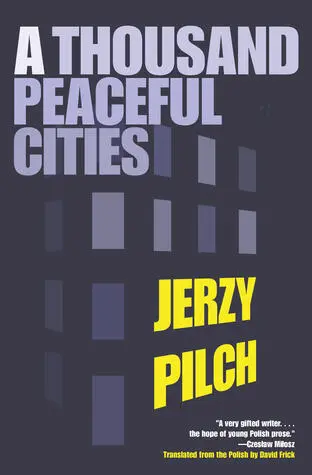
- Название:A Thousand Peaceful Cities
- Автор:
- Издательство:Open Letter
- Жанр:
- Год:2010
- ISBN:нет данных
- Рейтинг книги:3 / 5. Голосов: 1
-
Избранное:Добавить в избранное
- Отзывы:
-
Ваша оценка:
A Thousand Peaceful Cities: краткое содержание, описание и аннотация
Предлагаем к чтению аннотацию, описание, краткое содержание или предисловие (зависит от того, что написал сам автор книги «A Thousand Peaceful Cities»). Если вы не нашли необходимую информацию о книге — напишите в комментариях, мы постараемся отыскать её.
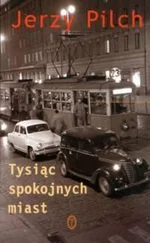
takes place in 1963, in the latter days of the Polish post-Stalinist “thaw.” The narrator, Jerzyk (“little Jerzy”), is a teenager who is keenly interested in his father, a retired postal administrator, and his father’s closest friend, Mr. Trąba, a failed Lutheran clergyman, alcoholic, would-be Polish insurrectionist, and one of the wildest literary characters since Sterne’s Uncle Toby. One drunken afternoon, Mr. Trąba and the narrator’s nameless father decide to take charge of their lives and do one final good turn for humanity: travel to distant Warsaw and assassinate the de facto Polish head of state, First Secretary of the Polish United Workers’ Party, Władysław Gomułka — assassinating Mao Tse-tung, after all, would be impractical. And they decide to involve Jerzyk in their scheme…
A Thousand Peaceful Cities — читать онлайн бесплатно полную книгу (весь текст) целиком
Ниже представлен текст книги, разбитый по страницам. Система сохранения места последней прочитанной страницы, позволяет с удобством читать онлайн бесплатно книгу «A Thousand Peaceful Cities», без необходимости каждый раз заново искать на чём Вы остановились. Поставьте закладку, и сможете в любой момент перейти на страницу, на которой закончили чтение.
Интервал:
Закладка:
“One way or another, the operation will have to involve a sniper,” said Mr. Trąba. “Unfortunately the use of firearms is out of the question. It’s out of the question for a thousand various reasons, among which, however, one seems sufficient to me: namely, I don’t know how to use a firearm. Yes,” Mr. Trąba became gloomy, “on the list of my numerous inabilities, you will find this inability as well. . And even if,” he continued, full of melancholy disgust for himself, “even if, by some miracle we were able to acquire, let’s say, a shotgun, all the same there’s too little time for me to master the art of marksmanship with the required precision. In a word, gentlemen,” Mr. Trąba’s voice again became the voice of the seasoned field officer, “in a word, gentlemen, there remains. .”
“In a word, gentlemen, there remains the bow.” Father’s voice vibrated with mad fury. “Mr Trąba, enough of these jokes. If this is what you want, I can say that I refuse obedience as of this moment, I leave the detachment, I refuse to carry out any orders whatsoever, I leave the army, I join civilian ranks. I can utter any one of these scurrilous formulas. And I utter,” it seemed to me that the light-blue glow on Father’s face lightened even further on account of his deathly paleness, “and I utter this formula, and I utter all these buffoonish formulas at once, and at the same time,” Father grabbed the bottle from the table, “I suspend in perpetuity all rewards for even the most breathtaking phrases. . You go beyond the bounds of taste.” Father spoke a bit more quietly, but he didn’t calm down at all. On the contrary, the fury constantly growing in him now seemed to stifle his voice. “The very idea of an assassination attempt, the very idea of an assassination attempt is a risky one. This whole story constantly questions itself. But now we have the nail in the coffin of all plausibility. . You, Mr. Trąba, offend this whole unhappy nation. . Don’t you know how debased people are? Don’t you know that it really is necessary to kill him ? And you? If you intend to kill him at all, before you get around to killing him, you’ll talk yourself to death. Don’t you understand this, or what?”
“I understand it, I understand it well,” Mr. Trąba said with a hollow voice.
“Since you understand it, why in the world do you mock us with your toys? By a billion barrels of beer! An assassin with a bow! A policeman with a ladies’ umbrella! Meanwhile people are being carted off to Siberia. Hi diddly dee, the bowman’s life for me.” Dots of foam appeared in the corners of Father’s mouth. “With a bow! Or how about a sling-shot! Or how about just like that!”
And gathering monstrous momentum, Father threw the bottle with all his might. Whether the ostentatious gesture was inversely proportional to his strength, or whether the power of Mr. Trąba’s hypnotic and redeeming gaze, which never left the bottle, was so great, or whether this was a rare conjunction of various coincidences — whatever it was, nothing happened. If there was a target, the projectile missed its target. The bottle made a short and remarkably slow flight in the direction of the window. The blanket blacking out the window deadened the blow. Like a plane on approach, it slipped down along the gray surface and, bouncing off the bench under the window, landed safely on the ground, and it drowsily, with its final impulses, rolled in the direction of my feet. For a moment we stared at it in silence, perhaps in fear that at any moment it would explode all the same and be blown to pieces, flow away in glass mixed with juniper vodka; or perhaps in the hope that some sort of energy or force would enter into it and that, as if turned by someone’s invisible hand, it would twirl roguishly and illicitly? But nothing happened. It was quiet, and the bottle, filled with the feverish and silent tussling of light-blue lights, rested at my feet.
“Chief,” Mr. Trąba’s voice had taken on an atypically realistic tone, “Chief, I really will kill him. Not with a simple bow, of course. I intend to shoot him with an arrow from a Chinese crossbow.”
Chapter V
When I finally understood my role in the attempt on the life of First Secretary Władysław Gomułka, black flames of betrayal and shame flared up within me. It was a sultry August morning. Through the open window you could hear the missionary orchestra. I put on my Sunday clothing in a fury. I hurried. I intended to become a turncoat before the worship service started. I slipped out of the house furtively, with the slippery step of the traitor.
“My beautiful Jesus! Shining King of the world!” the members of the women’s chorus sang in the garden by the church, and they glanced at me with contempt. The missionary musicians pulled their trombones from their mouths and, looking in my direction in reproof, began to whisper something to each other.
“Hallucinations, Jerzyk, those are hallucinations. Hallucinations caused by your panicky fear,” I whispered to myself. I crouched, my steps became heavier and heavier, the black foam of fear rocked in my entrails more and more dangerously, and right by the Lutheran church I had to stop. For the first time in my life I understood that if I weren’t given wings, I wouldn’t be able to go a step further. Later on that conviction was to become more and more frequent. The number of actions I was unable to carry out without wings grew. Finally, I was unable to do anything in life without wings. Even now I must constantly give myself wings in order to write this story.
I looked around me, and although the selection was considerable for the beginning of the sixties, and although all the taverns — Piast and The House of the Spa and Café Orbis — all of them were already open, and although all three were within sight, the fact that I was a minor was an insurmountable obstacle. Manly shoulders are one thing, a manly voice is one thing, but there wasn’t the least chance that one of the three waitresses — that Helenka Morcinkówna (Piast), Krysia Kotulanka (The House of the Spa), or Marysia Jasiczek (Café Orbis) — would offer me schnapps. And so, led by something other than my own will, I turned left and hastened my step, and shortly after passing the Market Square I knocked at the gate of Mr. Trąba’s house, which was hidden in the shadow of the ski jump. No one answered. I pressed the door handle. The door gave way. From the depths, from the dark vestibule, came individual words stifled by feverish spasmodic breathing.
Mr. Trąba lay on an iron bed, which was standing in the middle of a huge chamber that was even larger than our kitchen. Except for the bed, and the bottle that was standing by the bed, there were no pieces of furniture or any other objects, nothing. Just the numbed vastness of the waters, the castaway adrift in the middle, and a bottle full of disastrous news. Blood oozed from Mr. Trąba’s cut forehead. Saliva flowed from his lips as they parted again and again. The green army pants he wore were completely soaked. The room was in the grip of the deathbed odor of a body that was passively floating in all its substances, although it was, in fact, filled with only one substance. Mr. Trąba said something, whispered, gibbered nonsense, but at first I wasn’t able to catch even a single word, not even one intelligible sound. Still, I strained. I mobilized my secret talent for guessing words that had not yet been spoken, and after a moment — to tell the truth, after a very long moment — I knew more or less what it was about. The key word in Mr. Trąba’s delirious narration was the word “tea,” and the entire narration was about love. It was the sentimental complaint of a man lamenting the fact that he couldn’t drink tea at the side of his beloved, since she was drinking tea at the side of another. The whole thing abounded in innumerable digressions, unintentional interjections, and unintelligible ornaments. Perhaps the general thrust of the lament — that drinking tea at the side of one’s beloved was the single dream in the life of a man — was a too-incessantly-repeated refrain, but, taking Mr. Trąba’s state into consideration, everything came out amazingly fluently. After all, it was as it always was with him: the sense of his story was the basic, and perhaps the only, tie linking him with the world. The beloved’s name didn’t come up even once. Perhaps I wasn’t able to guess it, or perhaps I didn’t want to guess it. I produced a white handkerchief from the pocket of my Sunday clothes. I poured a little vodka on it from the bottle standing by the bed. I applied the dressing made in this fashion to Mr. Trąba’s forehead, and I wiped the slowly drying blood.
Читать дальшеИнтервал:
Закладка:
Похожие книги на «A Thousand Peaceful Cities»
Представляем Вашему вниманию похожие книги на «A Thousand Peaceful Cities» списком для выбора. Мы отобрали схожую по названию и смыслу литературу в надежде предоставить читателям больше вариантов отыскать новые, интересные, ещё непрочитанные произведения.







Обсуждение, отзывы о книге «A Thousand Peaceful Cities» и просто собственные мнения читателей. Оставьте ваши комментарии, напишите, что Вы думаете о произведении, его смысле или главных героях. Укажите что конкретно понравилось, а что нет, и почему Вы так считаете.