Andre Aciman - Eight White Nights
Здесь есть возможность читать онлайн «Andre Aciman - Eight White Nights» весь текст электронной книги совершенно бесплатно (целиком полную версию без сокращений). В некоторых случаях можно слушать аудио, скачать через торрент в формате fb2 и присутствует краткое содержание. Год выпуска: 2010, ISBN: 2010, Издательство: Farrar, Straus and Giroux, Жанр: Современная проза, на английском языке. Описание произведения, (предисловие) а так же отзывы посетителей доступны на портале библиотеки ЛибКат.
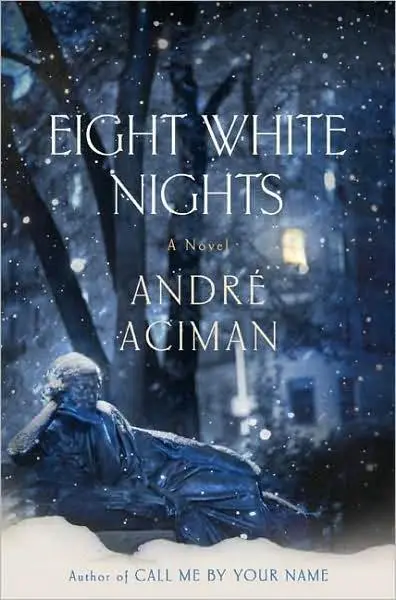
- Название:Eight White Nights
- Автор:
- Издательство:Farrar, Straus and Giroux
- Жанр:
- Год:2010
- ISBN:9780374228422
- Рейтинг книги:3 / 5. Голосов: 1
-
Избранное:Добавить в избранное
- Отзывы:
-
Ваша оценка:
Eight White Nights: краткое содержание, описание и аннотация
Предлагаем к чтению аннотацию, описание, краткое содержание или предисловие (зависит от того, что написал сам автор книги «Eight White Nights»). Если вы не нашли необходимую информацию о книге — напишите в комментариях, мы постараемся отыскать её.
Eight White Nights is an unforgettable journey through that enchanted terrain where passion and fear and the sheer craving to ask for love and to show love can forever alter who we are. A man in his late twenties goes to a large Christmas party in Manhattan where a woman introduces herself with three words: "I am Clara." Over the following seven days, they meet every evening at the same cinema. Overwhelmed yet cautious, he treads softly and won’t hazard a move. The tension between them builds gradually, marked by ambivalence, hope, and distrust. As André Aciman explores their emotions with uncompromising accuracy and sensuous prose, they move both closer together and farther apart, culminating on New Year's Eve in a final scene charged with magic and the promise of renewal. Call Me by Your Name, Aciman's debut novel, established him as one of the finest writers of our time, an expert at the most sultry depictions of longing and desire. As The Washington Post Book World wrote, "The beauty of Aciman’s writing and the purity of his passions should place this extraordinary first novel within the canon of great romantic love stories for everyone." Aciman’s piercing and romantic new novel is a brilliant performance from a master prose stylist.
Eight White Nights — читать онлайн бесплатно полную книгу (весь текст) целиком
Ниже представлен текст книги, разбитый по страницам. Система сохранения места последней прочитанной страницы, позволяет с удобством читать онлайн бесплатно книгу «Eight White Nights», без необходимости каждый раз заново искать на чём Вы остановились. Поставьте закладку, и сможете в любой момент перейти на страницу, на которой закончили чтение.
Интервал:
Закладка:
All this in one little word that went far back to a language no one had probably ever spoken: *kand —. The candor of women.
Yet I knew nothing about her. I knew her first name, could not spell her last, and I’d seen her kiss a man and then a woman. Who was she? What did she do? What was she like? What did others think of her? What did she think of herself, of me? What did she do when she was alone and no one was looking?
Perhaps all I wanted was to sit and think, and think of nothing, sink into myself, dream, find all things beautiful, and, as I’d never allowed myself to do during the entire evening, to long for her, the way we long for someone we know we don’t stand a chance of meeting again, or of meeting on the exact same terms, but are all the same determined to long for, because longing makes us who we are, makes us better than who we are, because longing fills the heart.
Fills the heart.
The way absence and sorrow and mourning fill the heart.
I didn’t know what all this meant, nor did I trust myself with this, but as I mused over these stray thoughts, I didn’t move, as though something timeless and solemn was taking place, not only in the park itself as I sat there on a cold bench, but in me as well for having entered this deserted, solitary spot called Straus Park, where people like me come to be one with themselves and with everything around them. With the city, the night, and the park, and the loud neon sign hanging over the pharmacy across the park and over the fried-chicken restaurant to the right. The way she stubbed her cigarette and then gently pushed it off the ledge with her shoe, the haunting image of her crimson shirt with its buttons so visibly undone past the sternum that one could guess, and was meant to guess, the shape of her breasts as she spoke to me and tweaked me gently when I’d spoken of love in quags and trenches, only to lure me back into the selfsame quags and trenches and remind me that, with all her confiding airs, she was, in case I forgot, very much the off-limits party girl who just happened to place her elbow on your shoulder when she spoke to you and let you think you and she were one and the same, but not the same, but yet the same and never the same.
I wanted to feel sorry for myself, wanted to feel sorry for always wanting, wanting, wanting, and never knowing what to do or where to go beyond wanting. I wished to light a candle in Straus Park, as one does in church when one isn’t sure whether one’s praying to ask for something or to give thanks for having gotten it, or just for knowing it exists, for seeing it at such close quarters for the short time it is given us to see that the simple wish to hold on to the memory of its passage in our lives bears all the features, not of longing, or of hope, or even love, but of worship.
Tonight she was the face I put on my life and how I live it. Tonight she was my eyes to the world looking back at me.
Tonight I had come so close — one more glance and I’ll kiss you, Clara, as you kissed Beryl, your tongue in her mouth, which is why I kissed Beryl, my tongue, her tongue, your tongue, everyone’s tongue.
If I had my way, I would plant this imaginary votive taper right here and dig it into the snow as Clara had dug her glass in on the terrace, and I’d let it stand there. And I would light not just one but many such tapers, and stand each one along the rim of the dried flower bed girding the statue of Memory, and I would cover the statue itself, from head to toe, with slim tapers, as they do with Madonnas and saints in tiny street altars in the villages of Spain, Italy, and Greece, till they all glimmered around Straus Park like will-o’-the-wisps on those damp and marshy cemetery grounds where the souls of the dead rise up at night and wander about like glowworms clustering together to stay warm until daybreak, because the dead are good to one another.
I would sit here and never budge. I would freeze for her. Because tonight she was the face that I put on my life and how I hadn’t learned to live it.
•
Perhaps it was the cold that finally brought tears to my eyes; perhaps I’d had too much to drink to know the difference. But as I stared at one of the streetlights nearest me, I began to see double, and the lamppost, from seeming to lean, began to sway, as if it were trying to dislodge itself and would eventually drag itself toward me, shuffling like a beggar on misbegotten limbs, doing what could only seem an imitation moonwalk. He stood there, leaned to and fro, as if to make sure it was indeed me he had spotted, then withdrew and shuffled back and became a streetlamp again. Who was he? And what was he doing on this senseless night? What was I doing out in the cold? Was he another me trundling about here, saying he was taking over, seeing how I’d messed things up for us? Or was he an unfinished me, and how many of these were there who hadn’t seen the light of day yet and might never see it, and how many ached to come back from the past if only to give me garbled solace and distempered advice, not realizing that the crib notes we sneak through time are written in invisible ink, all of these selves thronging around me like a penned-up legion from the underworld thirsting to taste what was so effortlessly and perhaps undeservedly given to me and only me: lifeblood.
Perhaps I’d light candles around Straus Park for them as well, as ritual stand-ins for what I couldn’t see within me and wished to behold as candles outside of me.
Then I saw it and touched the speckling twig hanging just above my head. It was crystallized. I tried to pull at it, but it was impossible to break off. What would happen if I pulled harder? The twig might tear somewhat, and I’d probably cut myself. I pictured the blood welling up on my finger and spilling on the snow. I leaned my head all the way back and thought of what my father would say: This isn’t new. You’ve been like this for years. And there’s no one can help you. Life in my blood, soul of my life.
What would Clara say if she’d seen the state of my bleeding finger? I pictured her coming up to me in her maroon shoes and standing right before me in the snow.
What is it with you? Let me take a look at this.
It’s nothing.
But you’re bleeding.
Yes, I know. Soldier in the trenches, you know.
Feeling sorry for yourself?
I did not answer. But, yes, feeling sorry for myself. Hating myself.
She rips off a swatch of cloth from her red blouse and swaddles it around my finger, then around my wrist. I am thinking of the Princesse de Clèves wrapping a yellow ribbon around a wooden cane that belonged to the man she loves. That swatch around my stick, my flesh, my Guido, my everything on your hem, on your hand, on your wrist, your wrist, your wrist, your sweet, stained, blessed, God-given wrist. Now look what you did — she smiles — I’m trying to concentrate. You could get a serious infection.
And if I did?
Let me focus here — as she tends to my wound.
Then, when she’s done being my nurse: So why did you do it? she asks.
Because of everything I wanted and never had.
Because of everything you wanted and never had. You’ll catch your death of cold sitting here.
So? To sit out this cold night and in the morning be found frozen blue, think I’d mind if it’s for you?
For me or for you?
I shrugged my shoulders. I didn’t know the answer. Both answers were right.
Amphibalence, she says.
Amphibalence, I say.
And it hits me that more was being said in this short conversation between our shadow selves in this lonely park than anything we’d spoken all night. A lovers’ colloquy, as in Verlaine’s poem, where both our shadows touch, the rest just waits, and waits, and waits. This wasn’t new. I’d been doing this for years.
Читать дальшеИнтервал:
Закладка:
Похожие книги на «Eight White Nights»
Представляем Вашему вниманию похожие книги на «Eight White Nights» списком для выбора. Мы отобрали схожую по названию и смыслу литературу в надежде предоставить читателям больше вариантов отыскать новые, интересные, ещё непрочитанные произведения.





Обсуждение, отзывы о книге «Eight White Nights» и просто собственные мнения читателей. Оставьте ваши комментарии, напишите, что Вы думаете о произведении, его смысле или главных героях. Укажите что конкретно понравилось, а что нет, и почему Вы так считаете.