Bill Morris - Motor City Burning
Здесь есть возможность читать онлайн «Bill Morris - Motor City Burning» весь текст электронной книги совершенно бесплатно (целиком полную версию без сокращений). В некоторых случаях можно слушать аудио, скачать через торрент в формате fb2 и присутствует краткое содержание. Год выпуска: 2014, Издательство: Pegasus, Жанр: Современная проза, на английском языке. Описание произведения, (предисловие) а так же отзывы посетителей доступны на портале библиотеки ЛибКат.
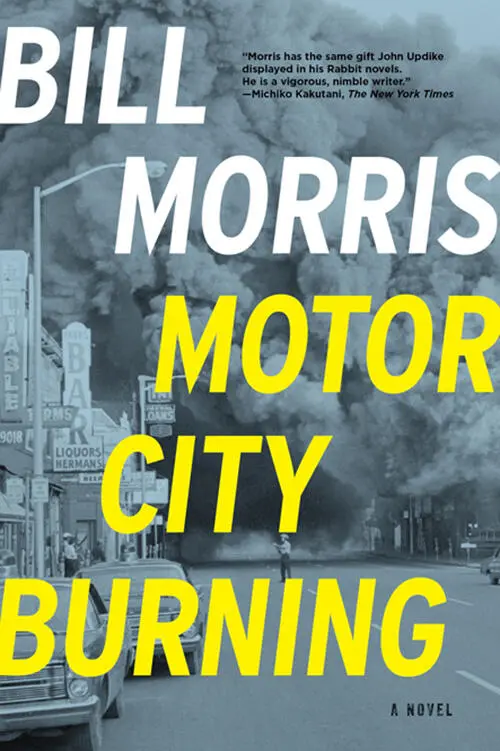
- Название:Motor City Burning
- Автор:
- Издательство:Pegasus
- Жанр:
- Год:2014
- ISBN:нет данных
- Рейтинг книги:3 / 5. Голосов: 1
-
Избранное:Добавить в избранное
- Отзывы:
-
Ваша оценка:
Motor City Burning: краткое содержание, описание и аннотация
Предлагаем к чтению аннотацию, описание, краткое содержание или предисловие (зависит от того, что написал сам автор книги «Motor City Burning»). Если вы не нашли необходимую информацию о книге — напишите в комментариях, мы постараемся отыскать её.
The surprise return of his Vietnam veteran brother in the spring of 1967 gives Willie a chance to drive a load of smuggled guns to the Motor City — and make enough money to jump-start his stalled dream of writing his movement memoir. There, at Tiger Stadium on Opening Day of the 1968 baseball season — postponed two days in deference to the funeral of Martin Luther King, Jr. — Willie learns some terrifying news: the Detroit police are still investigating the last unsolved murder from the bloody, apocalyptic riot of the previous summer, and a white cop named Frank Doyle will not rest until the case is solved. And Willie is his prime suspect.
Motor City Burning — читать онлайн бесплатно полную книгу (весь текст) целиком
Ниже представлен текст книги, разбитый по страницам. Система сохранения места последней прочитанной страницы, позволяет с удобством читать онлайн бесплатно книгу «Motor City Burning», без необходимости каждый раз заново искать на чём Вы остановились. Поставьте закладку, и сможете в любой момент перейти на страницу, на которой закончили чтение.
Интервал:
Закладка:
At last Doyle saw it: the slight widening of the eyes, the flinch. He’d finally hit a nerve, and the longer it took for the answer to come back the more certain he was that it was going to be a lie. After a long while Bob Brewer said, “I’m trying to think. . I can’t. . I can’t think of anyone in that building who’s ever been in the service. No sir, I’m sorry.” Then the clincher: “Why do you ask?”
“No special reason.” And now Doyle was doing the lying, and he knew Bob Brewer knew it. It was no secret that many of the guns used in the riots in Detroit and dozens of other American cities had once been used against the Viet Cong in Southeast Asia, then smuggled stateside and sold on the black market. For now, Doyle was satisfied that he’d caught Bob Brewer in a lie. He was convinced Helen Hull was killed by a Vietnam veteran who lived at the Larrow Arms and knew how to shoot guns accurately from great distances. Now all Doyle and Jimmy had to do was find the guy.

Half an hour later Doyle was lost in thought as he sailed past Northland shopping center on the deserted Lodge Freeway, headed back downtown. He did his best thinking alone in a car late at night. The light rain helped, the monotonous slap of the windshield wipers mesmerizing him just like the metronome used to mesmerize him during his boyhood piano lessons. Four years of that torture established that he had no musical talent, but it gave him enough of an ear to recognize and appreciate genius, from Chopin to Fats Waller, Brubeck and Brahms. Thinking of Chopin reminded him he needed to get back in touch with Cecelia Cronin.
Whap, whap, whap went the wipers, lulling Doyle, urging him to make a “pickup,” something that would link two seemingly unrelated fragments of the Helen Hull story. It didn’t help that he was still unsure exactly what this story was about, but at least his conversations with Charlotte Armstrong and Bob Brewer had convinced him there were pickups out there, waiting to be made.
He glanced at the vast empty Northland parking lot as he passed. Northland always made Doyle think of his old patrol partner, Jerry Czapski, who’d started moonlighting as a security guard at Northland a couple of years ago and made the front page of the papers when he broke up an armed robbery by firing a single bullet into the perp’s brain as the guy was exiting Kay Jewelers with a sawed-off shotgun in one hand and a gym bag full of swag in the other. Czapski, known in-house as the worst shot on the Detroit police force, was famous for a whole day. Of course it went straight to his head.
And now, as Doyle splashed toward downtown, he couldn’t get Jerry Czapski out of his head. Doyle spent his last two years in a uniform stuck in a radio car with the guy. Zap branded Doyle a nigger-lover the day he broke up an armed robbery in a party store without drawing his gun. Doyle talked the perp, a black hoops prospect from Pershing High School named Reggie Boyd, into laying down his shitty little pawnshop piece. “Only a nigger-lover would do a thing like that instead of shooting the little scrote,” Zap said afterwards. Hell, Doyle didn’t even carry a drop piece, which was more or less standard equipment among Detroit cops at the time, a spare weapon that could be planted on a dead or wounded man to make a bad shooting look good.
Those two years riding with Jerry Czapski felt like twenty. Every day he seemed to come up with a new ethnic slur. He started with the obvious ones — nigs, jigs, smokes, spooks, spades, darkies, coons. Then he went for the slightly more exotic — spics, yids, dagos, kikes, chinks, A-rabs, wetbacks, towel-heads, camel jockeys, micks, guineas. Whites from the rural South were hillbillies, rednecks, crackers, yokels, dirt-eaters, hicks and trash. He didn’t shy away from his own kind, either — polacks, bohunks, no-necks. One day he wanted to pull over a car because it had Ontario plates. When Doyle pointed out that the driver hadn’t done anything wrong, Zap said, “Yeah, but he’s from Canada . What the fuck’s he doing over here?” Looking back, Doyle realized Zap was an equal-opportunity racist. He hated the human race.
He told Doyle at least once a day that his dream assignment was pulling wheel duty on a Big Four, the scourge of the Detroit ghetto, a squad car with a uniform at the wheel and three plainclothes cops packing shotguns, tear gas and a ton of bad attitude. “Ain’t nobody gives any shit to a Big Four,” Zap said dreamily.
As Doyle passed the West Grand Boulevard turnoff, the one he’d taken to get to the Larrow Arms, his thoughts drifted back to his last night as Zap’s partner. His promotion to Homicide had come through and he was counting off his last hours in a uniform, praying for a quiet shift. They were cruising west on Davison in a radio car, Czapski at the wheel. It was muggy for a spring evening, a lot of people out. Czapski turned left on Wildemere, taking it slow, drinking in every movement on the street the way he always did, hoping something would catch his eye.
“My, my, my, what have we here?” he’d said, letting off the gas so the car was barely crawling. A young Negro male had come hurrying out of an apartment building and climbed into a car and pulled away from the curb.
“What is it, Zap?”
“That nigger.”
“What about him?”
“He’s got out-of-state plates.”
“So?”
“So how you suppose some jig from Alabama paid for that nice cherry Buick? Chopping cotton?”
“I wouldn’t know, Zap, but something tells me you’re going to find out.”
“Damn straight I am.” He turned on the roof flasher and pulled the Buick over.
Doyle stayed in the radio car listening to the murmur of call-out codes while Czapski went to question the driver. It was only after he heard Czapski berating the guy that Doyle got out of the car and stood with his hands resting on the roof. People were coming out of buildings, standing on porches, waiting. This had become a major Motor City spectator sport — watching The Man hassle the brothers. Doyle wished Czapski would hurry up. A woman on one of the porches shouted, “What the fuck he do wrong? Leave him be!” Doyle heard a bottle break. From where he was standing he could see the driver’s right arm, long and brown, resting across the top of the Buick’s front seat.
And now, sailing down the deserted Lodge Freeway in the rain, Doyle saw it, the memory as vivid as a snapshot: the tops of the seats in that old Buick were red.
When he got back to headquarters he went straight to the musty records cage on the second floor and woke up the night clerk and got him to dig out the run sheets from the first week of May, 1967. Run sheets recorded every move every cop made in the course of every shift. They were not always complete or in chronological order, and Doyle couldn’t remember the exact date of his last shift. But he was convinced there was a pickup waiting for him in that stack of paper.
Three hours later he found it: At 6:43 P.M. on May 4, 1967, Patrolmen G.L. Czapski and F.A. Doyle, in Car 77, made a routine traffic stop of a 1954 two-door Buick Century at the corner of Wildemere and Tuxedo. After questioning by Patrolman Czapski, according to the run sheet, motorist was allowed to go on his way. No summons was issued. The driver’s name was William Brewer Bledsoe. His local address in Detroit was the Algiers Motel. His home address was 2412 Greenwood Dr. in Tuskegee, Alabama.
Doyle made a photocopy of the run sheet and circled the driver’s middle name and his hometown. He could hear Bob Brewer describing Andalusia, Alabama: It’s a little dot on the map bout halfway between Tuskegee and Mobile.
Читать дальшеИнтервал:
Закладка:
Похожие книги на «Motor City Burning»
Представляем Вашему вниманию похожие книги на «Motor City Burning» списком для выбора. Мы отобрали схожую по названию и смыслу литературу в надежде предоставить читателям больше вариантов отыскать новые, интересные, ещё непрочитанные произведения.




Обсуждение, отзывы о книге «Motor City Burning» и просто собственные мнения читателей. Оставьте ваши комментарии, напишите, что Вы думаете о произведении, его смысле или главных героях. Укажите что конкретно понравилось, а что нет, и почему Вы так считаете.