Bill Morris - Motor City Burning
Здесь есть возможность читать онлайн «Bill Morris - Motor City Burning» весь текст электронной книги совершенно бесплатно (целиком полную версию без сокращений). В некоторых случаях можно слушать аудио, скачать через торрент в формате fb2 и присутствует краткое содержание. Год выпуска: 2014, Издательство: Pegasus, Жанр: Современная проза, на английском языке. Описание произведения, (предисловие) а так же отзывы посетителей доступны на портале библиотеки ЛибКат.
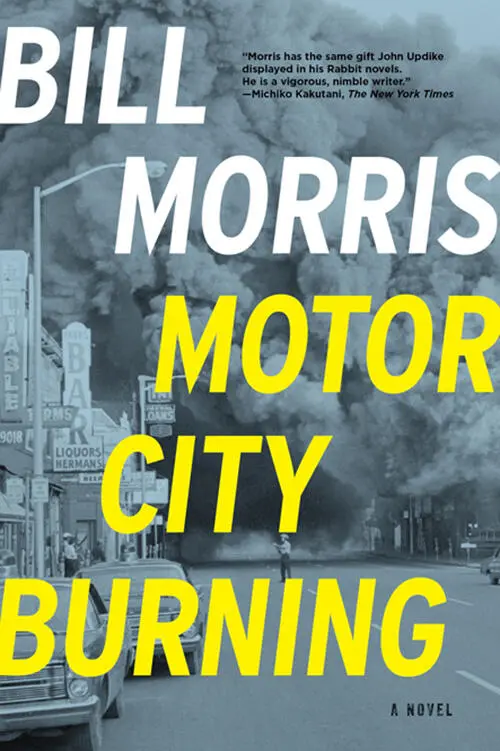
- Название:Motor City Burning
- Автор:
- Издательство:Pegasus
- Жанр:
- Год:2014
- ISBN:нет данных
- Рейтинг книги:3 / 5. Голосов: 1
-
Избранное:Добавить в избранное
- Отзывы:
-
Ваша оценка:
Motor City Burning: краткое содержание, описание и аннотация
Предлагаем к чтению аннотацию, описание, краткое содержание или предисловие (зависит от того, что написал сам автор книги «Motor City Burning»). Если вы не нашли необходимую информацию о книге — напишите в комментариях, мы постараемся отыскать её.
The surprise return of his Vietnam veteran brother in the spring of 1967 gives Willie a chance to drive a load of smuggled guns to the Motor City — and make enough money to jump-start his stalled dream of writing his movement memoir. There, at Tiger Stadium on Opening Day of the 1968 baseball season — postponed two days in deference to the funeral of Martin Luther King, Jr. — Willie learns some terrifying news: the Detroit police are still investigating the last unsolved murder from the bloody, apocalyptic riot of the previous summer, and a white cop named Frank Doyle will not rest until the case is solved. And Willie is his prime suspect.
Motor City Burning — читать онлайн бесплатно полную книгу (весь текст) целиком
Ниже представлен текст книги, разбитый по страницам. Система сохранения места последней прочитанной страницы, позволяет с удобством читать онлайн бесплатно книгу «Motor City Burning», без необходимости каждый раз заново искать на чём Вы остановились. Поставьте закладку, и сможете в любой момент перейти на страницу, на которой закончили чтение.
Интервал:
Закладка:
As Willie went back to work clearing and resetting the last table, Chick thought about how the members of Oakland Hills sometimes grew attached to people on the staff, to favored waiters and bartenders, even busboys and caddies. Many of the club’s members had had humble beginnings themselves, and no matter how rich and powerful they’d become, they liked to feel they were still in touch with the common man, still knew the taste of the salt of the earth. In a lunch-pail town like Detroit, it was important to remember where you came from. Chick Murphy started out washing Packards at a dealership on Gratiot during the Depression, then graduated to shoving booze in his father’s bar on Dequindre. And he wasn’t going to let himself or anyone else forget it.
Thinking about how far he’d come, Chick considered asking Willie about his life back home, what it was like being a Negro in a place like Alabama, a place that might as well have been on the cold side of Mars to a guy who’d never traveled farther south than the Notre Dame football stadium in Terre Haute, Indiana. Chick reached for his drink, missed it — and almost pitched off the barstool.
“Meester Murphy,” Chi Chi said, appearing out of nowhere to grab his elbow and wrestle him back onto the stool.
“Thanks, Cheech. Musta slipped. . ”
“Is berry late. Maybe is time to go home?”
“Righto, Cheech.”
“You are dribing?”
“Actually. . ”
That was when it hit him — one of his brilliant ideas. He turned just as Willie placed the last water goblet upside-down on the table, gave it a final inspection, and started to remove his bow tie.
“Say, Willie,” Chick called to him, “you think you could do me a huge favor?”
“Uh, sure, Mr. Murphy.”
“You got a driver’s license?”
“Yessir.”
“You think you could run me home in my car? I really don’t need to be driving.” He rattled the ice cubes in his glass, surprised to see it was already empty. He would run his brilliant idea by Willie on the way home. “You can bring my car back here tonight — and my wife’ll bring me by to pick it up in the morning.”
“Uh, sure.”
“If it’s too much trouble I could call a—”
“It’s no trouble, Mr. Murphy. I’m spending the night here anyway. Gotta work the lunch shift tomorrow.”
“Well, then, I’ll have a short one for the road and we’ll go.” He turned toward the bar but Chi Chi had vanished. “Ah, what the hell.” He set his empty glass on the bar. “Let’s roll.”

Minutes later Willie found himself sliding behind the wheel of a 1968 Deuce and a Quarter, silver with a black vinyl top and black leather seats that smelled like sex itself. He could see there were only 67.8 miles on the odometer, which meant the car was a demo. Chick Murphy probably drove a different one every day.
“Take a right,” Chick said, lighting a cigarette. They headed east on 15 Mile, the same route Uncle Bob had taken the day he took Willie for a spin in his new Deuce. It was well past midnight, traffic was light. “Go ahead and see what she’ll do,” Chick Murphy said. Then, seeming to read Willie’s mind, he added, “Don’t worry. If a cop pulls you, I’ll do the talking. Give her the gas.”
Willie eased his right foot down on the big accelerator pedal and the car gathered itself and broke into a gallop, a throaty, thrilling, groin-tingling gallop. He glanced at the speedometer and was astonished to see he was doing eighty-five.
“You like that pickup?” Chick Murphy said.
“Hell yes I like it, Sur — Mr. Murphy.” He’d almost slipped and called him Surf. All the clubhouse staff, even the white guys, called him Murph the Surf behind his back because his glossy yellow hair could only have come from a beach or a bottle.
It was not that Willie and the other black guys on the clubhouse staff disliked Chick Murphy. He was not one of those members who told nigger jokes in the men’s grill and then lowered their voices if a black waiter or busboy approached, thinking they were being discreet. If anything, the Surf tried too hard in the opposite direction, tried to be chummy in a way that made most of the black staff uncomfortable. Willie could remember the night when the Surf came down to the basement, drink in hand, and popped his head into the Quarters to see if anyone could use four tickets to an upcoming Tigers game. Someone turned the radio down. Waiters looked up from their craps games — what they called African golf — and the dice stopped flying. Everyone was obviously uneasy, and it got worse the longer the Surf lingered, trying to make small talk and act like one of the guys. There was nothing wrong with the gesture, it was just that he had crossed the invisible line and it was obvious he was unaware that the line even existed. Like so many white people, he assumed that good intentions — in this case, an offer of free baseball tickets — was enough. Watching him there in the doorway of the Quarters, feeling how tight the air had suddenly become, Willie thought of how his mother had drilled into him never to trust white people, especially the ones who profess to have good intentions. Racist peckerwoods were easy to deal with, she said, because they were so predictable; it was the white people with good intentions who will ambush you every time.
“You need to drop by the dealership,” the Surf was saying as they sailed along 15 Mile. “Take a test drive. You look real sharp behind the wheel of a Deuce, if I do say so myself.”
Deuce, Willie thought. White guys never talked like that. “Aw, Mr. Murphy, no way in hell I could afford a ride this nice.”
“Take a left at the light, on Lahser. Money’s no problem. What’re you driving now?”
“The DSR.”
“The what?”
“Detroit Street Railway. The bus. Or I catch a ride to work with my uncle or one of the guys.”
“You mean to tell me you live in Detroit and you don’t even own a fucking car?”
Willie thought of his ’54 Buick parked out of sight in the garage behind his apartment. He considered telling the Surf the standard lie about the Buick’s leaky Dynaflow transmission, but that would lower the car’s value at trade-in time. Besides, there was no future in letting a white man know more about yourself than he needed to know.
“Course I got a car, Mr. Murphy. Matter of fact, it’s a Buick — a mint-condition ’54 Century. Restored it myself.” The lie began to beget more lies. “It’s in the shop for a tune-up is all. The mechanic working on it’s slower’n molasses in January, says he’s having trouble finding a set of points. So for now I have to catch rides with friends — or take the good old DSR.”
The Surf launched into a spiel about some nice clean used Skylarks he just got in, but Willie didn’t hear much of it. He was too busy enjoying the power of this Buick, how easy it was to handle. He could control it with his thumb. It was like driving a 400-horsepower stick of butter.
“Okay, easy does it,” the Surf was saying. “Take your next right, on Long Lake.”
They took a quick left after that, onto a smooth silver street that ran between the biggest houses Willie had ever seen. They were fortresses tucked back off the road, behind stone walls and tall hedges and thickets of trees, immense houses with four-car garages. Chick told him to turn up a driveway, a long serpent of blacktop that deposited them in front of a brick mansion with exposed wooden beams and a slate roof. The word Tudor came to Willie, and he thought of his mother’s description of Uncle Bob’s new house. That house would fit into this place’s garage. Every light was burning, which made the house seem even larger, more unreal.
Читать дальшеИнтервал:
Закладка:
Похожие книги на «Motor City Burning»
Представляем Вашему вниманию похожие книги на «Motor City Burning» списком для выбора. Мы отобрали схожую по названию и смыслу литературу в надежде предоставить читателям больше вариантов отыскать новые, интересные, ещё непрочитанные произведения.






Обсуждение, отзывы о книге «Motor City Burning» и просто собственные мнения читателей. Оставьте ваши комментарии, напишите, что Вы думаете о произведении, его смысле или главных героях. Укажите что конкретно понравилось, а что нет, и почему Вы так считаете.