Bill Morris - Motor City Burning
Здесь есть возможность читать онлайн «Bill Morris - Motor City Burning» весь текст электронной книги совершенно бесплатно (целиком полную версию без сокращений). В некоторых случаях можно слушать аудио, скачать через торрент в формате fb2 и присутствует краткое содержание. Год выпуска: 2014, Издательство: Pegasus, Жанр: Современная проза, на английском языке. Описание произведения, (предисловие) а так же отзывы посетителей доступны на портале библиотеки ЛибКат.
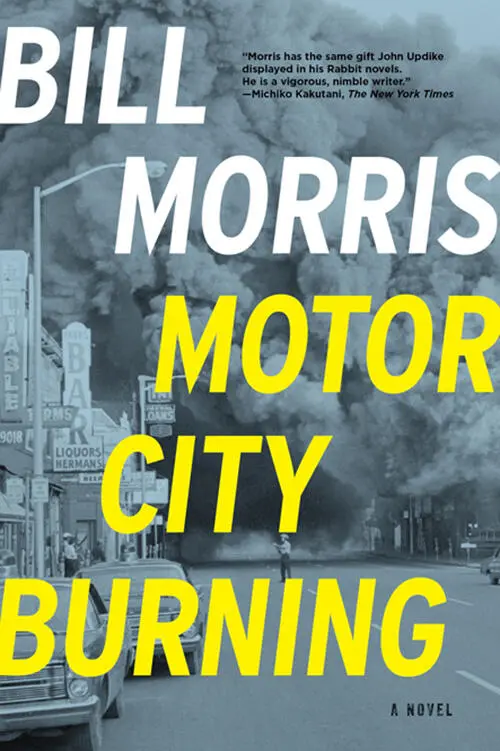
- Название:Motor City Burning
- Автор:
- Издательство:Pegasus
- Жанр:
- Год:2014
- ISBN:нет данных
- Рейтинг книги:3 / 5. Голосов: 1
-
Избранное:Добавить в избранное
- Отзывы:
-
Ваша оценка:
Motor City Burning: краткое содержание, описание и аннотация
Предлагаем к чтению аннотацию, описание, краткое содержание или предисловие (зависит от того, что написал сам автор книги «Motor City Burning»). Если вы не нашли необходимую информацию о книге — напишите в комментариях, мы постараемся отыскать её.
The surprise return of his Vietnam veteran brother in the spring of 1967 gives Willie a chance to drive a load of smuggled guns to the Motor City — and make enough money to jump-start his stalled dream of writing his movement memoir. There, at Tiger Stadium on Opening Day of the 1968 baseball season — postponed two days in deference to the funeral of Martin Luther King, Jr. — Willie learns some terrifying news: the Detroit police are still investigating the last unsolved murder from the bloody, apocalyptic riot of the previous summer, and a white cop named Frank Doyle will not rest until the case is solved. And Willie is his prime suspect.
Motor City Burning — читать онлайн бесплатно полную книгу (весь текст) целиком
Ниже представлен текст книги, разбитый по страницам. Система сохранения места последней прочитанной страницы, позволяет с удобством читать онлайн бесплатно книгу «Motor City Burning», без необходимости каждый раз заново искать на чём Вы остановились. Поставьте закладку, и сможете в любой момент перейти на страницу, на которой закончили чтение.
Интервал:
Закладка:
10
DOYLE SPENT THE MORNING RESEARCHING REAL-ESTATE RECORDS, then ate a salad and moussaka alone in Greektown before heading north. Normandy Street was flanked with solid, well-maintained houses, not far from U. of D. High School, Doyle’s alma mater. He parked the unmarked Plymouth two doors down from 3417, a tidy two-story brick with a slate roof and exposed timbers, about a seven iron from the fence of the Detroit Golf Club, if Doyle remembered distances correctly from his boyhood summers spent caddying there. He hadn’t called ahead — he was hoping the element of surprise would work in his favor — and he sat in the car for a while trying to read the street. There were For Sale signs on half a dozen front lawns on this block. So even out here on the leafy northern fringe of the city, miles removed from ground zero, whitey was packing it in.
A black woman answered the door. She had smooth butterscotch skin, straight hair and a toothy Diana Ross smile. Doyle showed her his shield and asked if Mr. Bob Brewer was in.
The smile disappeared. “My husband’s at work,” she said, hugging the door.
“You’re Mrs. Brewer?”
“That’s right. I’m Mary Brewer.” Not cold, but a long way from warm. Like she thought he’d assumed she was the maid. Christ, he thought, you step on a land mine in this town every time you try to move.
“What time do you expect your husband?”
“Bob’s not in any trouble, is he?”
“Oh no, ma’am, nothing like that.” Doyle gave it a little chortle, as though the very thought was ridiculous. “I just need to ask him a few questions about one of his tenants.”
“Oh.” She relaxed, but only a little. About a third of Diana Ross’s warmth returned. “Well, he’s working late tonight. He’ll probably spend the night since he has to work a double shift tomorrow. I’ll tell him you came by. Do you have a card?”
“Where does he work?”
The eyes narrowed a notch, the smile disappeared again. “He’s a waiter.”
“I see. And where does he do his waiting?”
Now she was glaring. “At Oakland Hills.”
“Oakland Hills?” He’d never heard of the place.
“The country club.”
“I’m sorry, I’m drawing a—”
“It’s out in Birmingham.”
“Do you know where in Birmingham?”
“West 15 Mile, near Telegraph.”
Like pulling fucking hen’s teeth, Doyle thought as he nursed the Plymouth farther north out Woodward, through Ferndale and Royal Oak, all the way to Birmingham. It was a notch below Bloomfield Hills but still plush, the sort of place where the people with For Sale signs in front of their houses on Normandy Street surely dreamed of winding up, almost a whole Detroit away from Detroit, a village of pricey shops and well-scrubbed children where it hardly seemed possible that human beings were capable of torching their own neighborhoods and climbing up on rooftops to shoot at policemen and firemen. Doyle had to remind himself that this was how America had always worked: When places like Detroit made you rich enough, you took the money and you ran and you didn’t look back. The only difference nowadays was that nobody could run far enough, or fast enough.
It was late afternoon when he finally pulled onto the parking lot at Oakland Hills Country Club. The massive white clubhouse looked like something off a movie set. Gone with the Fucking Wind, Doyle thought, tuning the radio until he picked up WJR and the voice of Ernie Harwell. The first game of the Tigers’ twi-night double-header had just started and the Red Sox already had two men on base. No wonder — Mickey Lolich was pitching, and he was as famous for his shaky starts as he was for his strong finishes. Carl Yastrzemski proceeded to park the next pitch in the center field bleachers, and the Red Sox owned a 3–0 lead before the Tigers had even come to bat. Better get the shower hot for Lolich, Doyle thought, snapping off the radio in disgust.
The arrival of a shit-brown Plymouth went unnoticed by the people straggling in off the golf course, by the men drinking gin and playing cards in the cozy grill, by the elegantly dressed couples pulling up under the portico in Cadillacs and Chrysler Imperials to meet other elegantly dressed couples for drinks and dinner. These people thought their money made them immune. Doyle had bad news for them.
The manager received him in his cluttered office off the front lobby. He was a harried little terrier in a cheap suit named Dick Kowalski, a St. Stanislaus grad like Cecelia Cronin, and he pleaded with Doyle to come back around ten o’clock because Bob Brewer was working a very important private cocktail party and banquet for some big shots from Ford Styling. Dick Kowalski pinched the bridge of his nose and said, “If I have to pull him off the floor now it’ll fuck everything up. Believe me.”
Doyle believed him. They were a couple of city boys marooned out here in far suburbia. Doyle told himself he could work with this guy, then told Kowalski he’d return around ten.
He drove farther north, all the way to Bloomfield Hills. He found Cranbrook Road without too much trouble and parked across from 1030 and cut the engine. He could hear cicadas whining in the tall trees, and he could see that his brother’s house was lit up like Christmas. Every light in the place was on, upstairs and down, an extravagance that seemed designed to tell the world that the family in the big Dutch colonial didn’t have to worry about electricity bills or anything else. Doyle was sure it was Kat’s idea of class. His old man would have given his brother hell.
A shape passed by the window on the bottom left. One of the girls? Doyle felt a spasm in his chest and reached for the door handle, but then he remembered the last time he had come here. It was late last summer, everyone still stunned by the riot. Rod grilled steaks on the patio and they ate at the picnic table with the family from next door. The neighbor was a stockbroker who worked downtown and bragged about the three guns he’d just bought in Ohio, a common practice in the suburbs of Detroit that summer. “Just let some nigger try to carjack me,” he said. It was all Doyle could do not to pimp-slap the pudgy little fuck in the pink shirt with an alligator on his left tit.
After the guests went home, Rod took the girls up to bed and Kat fixed fresh drinks — she always seemed to be fixing fresh drinks — and brought them out to the patio. Fireflies were winking above the back lawn that rolled like a carpet to the edge of the lake. Kat handed Doyle his drink — Jack Daniel’s, a couple of ice cubes — then she sat on the arm of his Adirondack chair. He was instantly uncomfortable. She started in with the music about how Rod was married to his job, not to her. Doyle was thinking she should get together with Vicki Jones and start a sob sisters club. Just then he felt Kat’s fingernails gently raking his right thigh, starting at the knee and heading north. She said, “You know, Frank, sometimes I think I married the wrong brother. I went for the responsible one instead of the cute one. I can’t help but wonder. . ”
He was rescued by his brother bounding out of the house, chuckling about something the girls had said upstairs. Kat jumped to her feet and strolled back to her chair. They never said another word about it because he never went back to the house. He realized, sitting there in the Plymouth, that of all the things he despised about the woman, the worst was that she’d taken his nieces out of his life on the night of that cookout.
He waited until the lights in two of the upstairs rooms went out. The girls were safe in bed and there was no longer any reason for him to sit there alone in the dark feeling bitter. If he wanted to have the girls back in his life, he realized he would have to figure out a way to get around their mother. It shouldn’t be all that complicated. Like so many things, all you had to do was want it bad enough.
Читать дальшеИнтервал:
Закладка:
Похожие книги на «Motor City Burning»
Представляем Вашему вниманию похожие книги на «Motor City Burning» списком для выбора. Мы отобрали схожую по названию и смыслу литературу в надежде предоставить читателям больше вариантов отыскать новые, интересные, ещё непрочитанные произведения.





Обсуждение, отзывы о книге «Motor City Burning» и просто собственные мнения читателей. Оставьте ваши комментарии, напишите, что Вы думаете о произведении, его смысле или главных героях. Укажите что конкретно понравилось, а что нет, и почему Вы так считаете.