Bill Morris - Motor City Burning
Здесь есть возможность читать онлайн «Bill Morris - Motor City Burning» весь текст электронной книги совершенно бесплатно (целиком полную версию без сокращений). В некоторых случаях можно слушать аудио, скачать через торрент в формате fb2 и присутствует краткое содержание. Год выпуска: 2014, Издательство: Pegasus, Жанр: Современная проза, на английском языке. Описание произведения, (предисловие) а так же отзывы посетителей доступны на портале библиотеки ЛибКат.
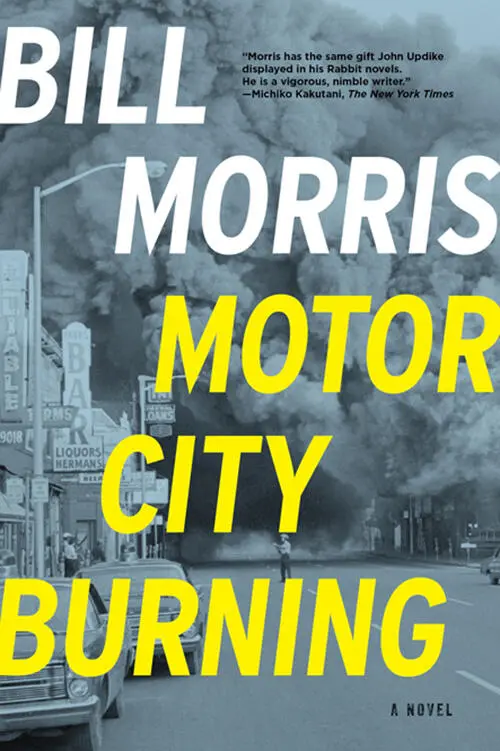
- Название:Motor City Burning
- Автор:
- Издательство:Pegasus
- Жанр:
- Год:2014
- ISBN:нет данных
- Рейтинг книги:3 / 5. Голосов: 1
-
Избранное:Добавить в избранное
- Отзывы:
-
Ваша оценка:
Motor City Burning: краткое содержание, описание и аннотация
Предлагаем к чтению аннотацию, описание, краткое содержание или предисловие (зависит от того, что написал сам автор книги «Motor City Burning»). Если вы не нашли необходимую информацию о книге — напишите в комментариях, мы постараемся отыскать её.
The surprise return of his Vietnam veteran brother in the spring of 1967 gives Willie a chance to drive a load of smuggled guns to the Motor City — and make enough money to jump-start his stalled dream of writing his movement memoir. There, at Tiger Stadium on Opening Day of the 1968 baseball season — postponed two days in deference to the funeral of Martin Luther King, Jr. — Willie learns some terrifying news: the Detroit police are still investigating the last unsolved murder from the bloody, apocalyptic riot of the previous summer, and a white cop named Frank Doyle will not rest until the case is solved. And Willie is his prime suspect.
Motor City Burning — читать онлайн бесплатно полную книгу (весь текст) целиком
Ниже представлен текст книги, разбитый по страницам. Система сохранения места последней прочитанной страницы, позволяет с удобством читать онлайн бесплатно книгу «Motor City Burning», без необходимости каждый раз заново искать на чём Вы остановились. Поставьте закладку, и сможете в любой момент перейти на страницу, на которой закончили чтение.
Интервал:
Закладка:
As he weaved back to his apartment, Willie considered how rich the day had been. How many days do you learn new things about H. Rap Brown, Ernest Hemingway, Ty Cobb, Dwight Eisenhower, Hank Greenberg and Ralph Ellison? As rich as the list was, he had the nagging feeling he was forgetting something. When he got home and turned on the late news, he remembered what it was.
A Channel 2 reporter, a sharp-looking black lady with a big Afro and a red silk scarf, was interviewing two detectives in front of 1300 Beaubien Street — a fat, silver-haired white guy and a dapper black dude. They were explaining that Alphonso Johnson, a paroled felon, had confessed to the murder of Detroit fireman Carlo Smith, who was shot by a sniper during last summer’s riot.
Then there was a picture on the screen of a white woman identified as Helen Hull, a lumpy old doughball with harlequin glasses, her gray hair pulled back into a bun. The reporter was saying that the Detroit grocer, shot dead while looking out a window in the Harlan House Motel, was now the victim of the last unsolved homicide from the riot. She signed off with: “Police say their investigation into her death is continuing. This is Sylvia King reporting live from Detroit police headquarters for WJBK.”
Willie snapped off the TV and swallowed four aspirin and took a long hot shower. But when he lay down in bed the ceiling started spinning and he spent an hour waiting for it to stop. The whole time a question ate at him: What had become of those last three guns from the trunkload he and Wes had brought up to the city a year ago? There was only one person who knew the answer. In the morning Willie would make a long-distance phone call he dreaded.
As he lay there in the dark, he kept seeing the two detectives, the white one with the silver hair and the black one with the crisp suit, and he kept seeing the doughy dead white woman named Helen Hull. The sight of her made the stone of guilt in his gut bigger and harder and colder than ever. The tree outside his window shivered in the breeze. A siren howled. He could feel the big city getting smaller, closing in.
PART TWO. TINDERBOX
8
DOYLE WAS GUNNING THE PLYMOUTH OUT THE LODGE FREEWAY, weaving through traffic, honking the horn, gripping the steering wheel like he was trying to break the thing in two. Jimmy Robuck, not one to get nervous in the passenger seat of a car or anywhere else, said, “You might want to ease off that gas pedal, Frank. The lady ain’t goin nowhere.”
Doyle slowed the car and blinked at Jimmy, seeming to come back from another world. “That a new suit you’re wearing?” Doyle said.
“Yeah, poplin. Picked it up at Brooks Brothers when Flo and I were in New York. The bow tie, too. You like?”
“Very nice. Makes you look positively pro-fuckin-fessorial.”
“Pro-fuckin-fessorial.” Jimmy chuckled. “You really somethin, man.”
“You know you’re not suppose to wear white bucks before Memorial Day, don’t you?”
“Course I do, but weather this fine, I decided to bend the rules. How bout you? That silk suit don’t look cheap.”
“Can’t afford to buy cheap clothes. I got an Italian guy out on Livernois making my suits for me now.”
“Bespoke?”
“Got no choice. Nothing off the rack fits me.”
“The shirt too?”
“Oh yeah. You ever seen a shirt in a store with a fifteen-inch neck and thirty-seven-inch sleeves?”
“Not as I recall.”
“That’s because they don’t make them. I’m telling you, Jimmy, I’m a freak.”
“I dig them cuff links.”
“Thanks, they’re opals.” He shot his cuffs, pleased by the compliment. “Got to do my part to keep up our rep as the sharpest dressers on the force.”
“Ain’t sayin much. Most a them chumps look like they sport coats made out of car upholstery.”
“Or wallpaper.”
They laughed, not because it was funny but because it was so true. Most of their fellow detectives thought a sport coat was something you put on when you needed to cover the hairy forearms sticking out of your short-sleeved shirt. Not all of Doyle’s shirts had French cuffs, but he wouldn’t dream of wearing a short-sleeved shirt with a necktie, any more than he would dream of wearing one of those wide cop neckties made out of synthetic shit — the better to keep gravy and soup off your shirt, the better to cover your nose if you had to pop a car trunk on a hot day knowing that the body in there had been marinating at least a week.
Jimmy said, “You really think this Armstrong woman’s gonna tell us somethin we don’t already know?”
“I got no idea, Jimmy, but we can’t afford not to check her out, can we? You heard Sarge. He’s got people all the way up to Cavanagh breathing down his neck to make this case go down.”
“You must think she gonna be good, way you been buggin me to ride out here with you.”
They both knew why Doyle wanted Jimmy to ride along. Henry Hull said the woman was black, and the detectives knew that they were more likely to get something out of her if there was another black face — Jimmy Robuck’s — in the room. It usually helped to have a black face in the room when a Detroit police interviewed a black witness or interrogated a black suspect, and it always helped when a black defendant went on trial. A black judge on the bench, a black detective on the witness stand, even a couple of black bailiffs could help put a jury at ease, give a boost to the prosecution, convince the jurors that a black defendant actually had a chance of getting justice inside the Frank Murphy Hall of Justice.
Doyle parked at the corner of Pallister and Hamilton, and the partners got out and stood looking up at a yellow brick pile with Larrow Arms carved in stone above the front door. They could hear the round-the-clock whoosh of the Lodge Freeway off to their right.
Doyle pushed the button marked ARMSTRONG and opened the buzzing foyer door. Jimmy followed him up one flight of stairs. The stairwell smelled like collard greens that had been boiling in fat back for years. The steam had become part of the wallpaper and carpets. While Doyle was no great fan of soul food, he found the smell reassuring, a sign of permanence. And the building was clean, in good repair. The Negro middle class, fighting the good fight.
The woman who opened the door was what Doyle had been led to expect by their phone conversation. She was all the way Southern — a rust-colored wig, flowered dress, gold-rimmed bifocals, her arms as soft as bread dough with brown flesh sagging from her biceps. She was wearing perfume, good, strong, nose-hair-curling perfume. She looked like she was on her way out to church, which was actually a possibility because this was Wednesday and Southern Baptists took Wednesdays almost as seriously as they took Sundays. She had a bosom like a queen-size mattress, and Doyle had a hunch she sang in the church choir and could really belt it out.
“Mrs. Armstrong,” he said, “I’m Detective Doyle and this is Detective Robuck from the Detroit Police Department. We spoke on the phone.” The men showed her their shields.
“Come in, gentlemen, come in,” she said with a slight drawl, like this was a long-awaited social visit and not a homicide investigation. “You gentlemen make yourselves to home while I fix us a cup a tea. Y’all drink tea, don’t you?”
“Yes, ma’am,” they said in unison.
She went into the kitchen but the detectives didn’t sit down. They both shuffled around the living room, looking at things, trying to read the woman. The apartment was immaculate, the rug worn but swept so hard and so often it made Doyle’s arms ache just to look at it. The hardwood floor glowed. The walls and tabletops were cluttered with framed pictures of babies, old people, teenagers in caps and gowns, football players, an ironworker dancing and grinning on a skyscraper’s I-beam, and then the two pictures you knew were coming: the dead saints, John F. Kennedy and Martin Luther King.
Читать дальшеИнтервал:
Закладка:
Похожие книги на «Motor City Burning»
Представляем Вашему вниманию похожие книги на «Motor City Burning» списком для выбора. Мы отобрали схожую по названию и смыслу литературу в надежде предоставить читателям больше вариантов отыскать новые, интересные, ещё непрочитанные произведения.





Обсуждение, отзывы о книге «Motor City Burning» и просто собственные мнения читателей. Оставьте ваши комментарии, напишите, что Вы думаете о произведении, его смысле или главных героях. Укажите что конкретно понравилось, а что нет, и почему Вы так считаете.