Bill Morris - Motor City Burning
Здесь есть возможность читать онлайн «Bill Morris - Motor City Burning» весь текст электронной книги совершенно бесплатно (целиком полную версию без сокращений). В некоторых случаях можно слушать аудио, скачать через торрент в формате fb2 и присутствует краткое содержание. Год выпуска: 2014, Издательство: Pegasus, Жанр: Современная проза, на английском языке. Описание произведения, (предисловие) а так же отзывы посетителей доступны на портале библиотеки ЛибКат.
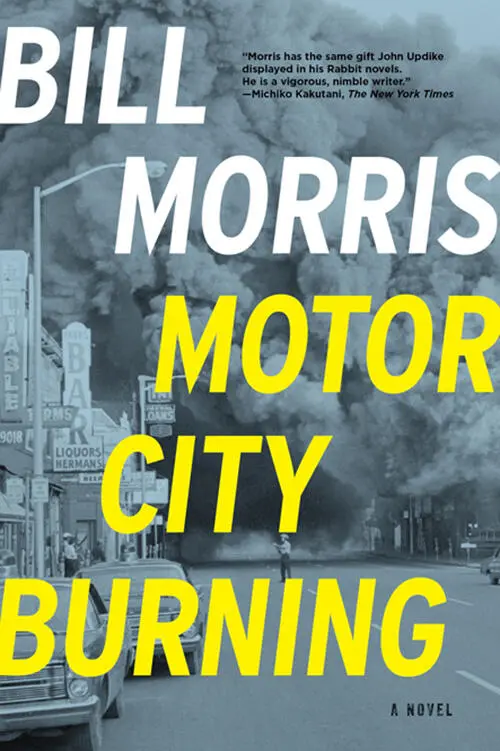
- Название:Motor City Burning
- Автор:
- Издательство:Pegasus
- Жанр:
- Год:2014
- ISBN:нет данных
- Рейтинг книги:3 / 5. Голосов: 1
-
Избранное:Добавить в избранное
- Отзывы:
-
Ваша оценка:
Motor City Burning: краткое содержание, описание и аннотация
Предлагаем к чтению аннотацию, описание, краткое содержание или предисловие (зависит от того, что написал сам автор книги «Motor City Burning»). Если вы не нашли необходимую информацию о книге — напишите в комментариях, мы постараемся отыскать её.
The surprise return of his Vietnam veteran brother in the spring of 1967 gives Willie a chance to drive a load of smuggled guns to the Motor City — and make enough money to jump-start his stalled dream of writing his movement memoir. There, at Tiger Stadium on Opening Day of the 1968 baseball season — postponed two days in deference to the funeral of Martin Luther King, Jr. — Willie learns some terrifying news: the Detroit police are still investigating the last unsolved murder from the bloody, apocalyptic riot of the previous summer, and a white cop named Frank Doyle will not rest until the case is solved. And Willie is his prime suspect.
Motor City Burning — читать онлайн бесплатно полную книгу (весь текст) целиком
Ниже представлен текст книги, разбитый по страницам. Система сохранения места последней прочитанной страницы, позволяет с удобством читать онлайн бесплатно книгу «Motor City Burning», без необходимости каждый раз заново искать на чём Вы остановились. Поставьте закладку, и сможете в любой момент перейти на страницу, на которой закончили чтение.
Интервал:
Закладка:
“He’s not my buddy. And no, this is too nice.”
She didn’t press, and he was grateful for that. Vicki Jones never stopped peppering him with questions when he got home from work. He still wasn’t sure which she hated more — the hours he kept or his refusal to answer her questions.
“But tell me one thing,” Cecelia said.
“Sure.”
“Tell me you don’t really approve of the way those Chaldean guys deal with things.”
“No, of course I don’t. It’s just that sometimes this job makes me feel like we’re losing the war.”
“And this is one of those times?”
“Maybe. I’m not sure yet.”
At the door he kissed her goodnight, a long kiss that hinted at things to come. Driving home, he could taste her lipstick, could hear her whistling like a sailor when Al Kaline drilled a home run into the upper-deck porch in right field. But as sweet as those memories were, by the time he reached his house they were crowded out by the knowledge that Helen Hull’s murder was now the only one still unsolved from the riot. That meant the hot seat was hotter than ever. It was time to go talk to that Armstrong woman.
7
AFTER THE LONG NIGHT WHEN HE UNEARTHED THE PICTURES OF the Farce on Washington and the burning bus outside Anniston, Willie’s life took on a sense of purpose and urgency it had lacked for years. He spent his free days in the microfilm room at the Detroit Public Library, methodically reading back issues of the Free Press , the Michigan Chronicle and the New York Times , beginning in January of 1960. He made photocopies of important articles and pictures, took copious notes. If he had to work a night shift at Oakland Hills, he slipped on his Snick uniform as soon as he got home and worked into the small hours at his desk, combing through the contents of his Alabama box. The harder he worked, the more energy he had and the less sleep he needed. Like his mother used to say, if you need to get a job done, give it to a busy man. He even found time to catch a few Tigers games.
Late one Saturday night Willie sat at his desk, his only companions the distant purr of the Lodge Freeway and the burble of Miles Davis’s trumpet. He had just found something near the bottom of his Alabama box — a dozen neatly typed, single-spaced pages held together by a paper clip. It was the outline of the first three chapters of his book, written in Tuskegee after his return from Atlantic City in the fall of 1964. His plan was to write a memoir of his time in the movement, a foot soldier’s intimate story. The only thing he knew about the book’s title was that it would contain the word whirlwind .
He had worked on the book steadily until his departure for Detroit in the spring of 1967, yet all he had to show for two and a half years of toil was these dozen pages. He read them with a rising sense of dismay. Chapter One, “Wake-Up Call,” was to tell the story of the day when, at the age of nine or ten, he walked into the Andalusia Public Library and asked for a library card and the white librarian, Mrs. Satterfield, told him, almost sadly, “I’m sorry, young man, but Nigras aren’t allowed to check out books.” Those were her exact words, and he would remember them as long as he lived. It was the first time he saw that white people saw him as different — that is, inferior. It was his baptism, the wake-up call that comes sooner or later to every black person in America. Chapter Two, “First Feud,” was to tell the story of the first time his parents argued in his presence — over Rev. Martin Luther King’s radio address supporting the Montgomery bus boycott. “Foolishness!” Willie’s father had roared at the radio. His mother disagreed: “Bout time somebody in a pulpit talked about the here and now instead of all that pie in the sky in the bye-and-bye.” And Chapter Three, “Taking Leave,” was to tell the story of Willie’s decision to leave Tuskegee Institute and walk into the whirlwind.
A dozen skimpy pages and then — nothing. Not a single scrap of flesh on the bones of that outline. Not a single page of prose despite all the notes and pictures and clippings inside the Alabama box. Why? Why had that pathetic trickle of words dried up?
He gazed out the window, listened to the traffic and the trumpet and the whisper of the trees. He started walking through those two and a half years in Tuskegee, trying to remember how a project begun with such high energy and high hopes could sputter, stall, and die.
He remembered that in Tuskegee he’d tried to take inventory of all the jails he’d been in, the beatings he’d absorbed, the fire-bombings he’d survived. But he couldn’t do it. His concentration and his memory were shot. He was having trouble falling asleep, and when he did sleep he had wicked nightmares. A car back-firing on the street made him jump. After finishing the outline of Chapter Three, he simply didn’t have the strength to start Chapter Four. A sense of paralysis came over him. Then panic.
And then his brother came back into his life.
Wes materialized on Willie’s front porch on a rainy night in the fall of 1966, dripping like a dog. Willie was shocked that the chiseled killing machine had allowed himself to get fat and sloppy. Wes said he’d come to claim the pieces of the guns he’d been mailing from Saigon, but instead of picking up the stuff and leaving town, he installed himself on the sofa in Willie’s living room and proceeded to spend the winter watching TV, drinking beer, eating pork rinds and fried-oyster po’ boys. He roared at the morons on “The Beverly Hillbillies” and “Gilligan’s Island,” he bit his fingernails during “The Wild, Wild West,” and, unable to sleep, he stayed up late watching re-runs of Alfred Hitchcock and “The Twilight Zone.” On Saturday mornings he watched cartoons with the rapt glee of a child.
Willie, meanwhile, went into his bedroom and closed the door and tried to keep working on his book. But the drone of the TV and his brother’s laughter made it impossible for him to move beyond those dozen skimpy pages. He was still having trouble sleeping, and on many of those long nights he could hear his brother screaming as he sprang off the sofa, drenched from another jungle nightmare.
Now Willie understood that he and Wes had been crushed by the same thing. Some people called it shell shock, or battle fatigue, or stress. Willie thought of it as something else: the violent dismantling of the belief that it was possible to make a better world.
Their only relief came on the rare days when Wes rose from the sofa and loaded the trunk of Willie’s ’54 Buick with guns and ammunition and they rode out into the country together for a little target practice. Blasting away at Jax beer cans was the only time they were both engaged in the moment, able to concentrate, free of the numbness and the nightmares from their very different but very similar wars. It was the only time they were both fully alive. But by then Willie’s book was graveyard dead.

He awoke in his desk chair at dawn. The Miles Davis record was spinning silently on the turntable. He showered and shaved and walked the four blocks to Twelfth Street to buy a Free Press from Aziz, the Syrian who ran the corner newsstand.
“Good news and bad news today,” Aziz said, taking Willie’s dollar.
“We lost.”
“Yes, by a score of 8 and 4 to the Senators of Washington. Lolich does not look so sharp. But still we are in first place!”
“Got a double-header today.”
“Two games for the price of one. A most excellent idea.”
“I’m going to the park, Aziz. Want to come along?”
Читать дальшеИнтервал:
Закладка:
Похожие книги на «Motor City Burning»
Представляем Вашему вниманию похожие книги на «Motor City Burning» списком для выбора. Мы отобрали схожую по названию и смыслу литературу в надежде предоставить читателям больше вариантов отыскать новые, интересные, ещё непрочитанные произведения.








Обсуждение, отзывы о книге «Motor City Burning» и просто собственные мнения читателей. Оставьте ваши комментарии, напишите, что Вы думаете о произведении, его смысле или главных героях. Укажите что конкретно понравилось, а что нет, и почему Вы так считаете.