Arnon Grunberg - The Jewish Messiah
Здесь есть возможность читать онлайн «Arnon Grunberg - The Jewish Messiah» весь текст электронной книги совершенно бесплатно (целиком полную версию без сокращений). В некоторых случаях можно слушать аудио, скачать через торрент в формате fb2 и присутствует краткое содержание. Год выпуска: 2008, Издательство: Penguin Group US, Жанр: Современная проза, на английском языке. Описание произведения, (предисловие) а так же отзывы посетителей доступны на портале библиотеки ЛибКат.
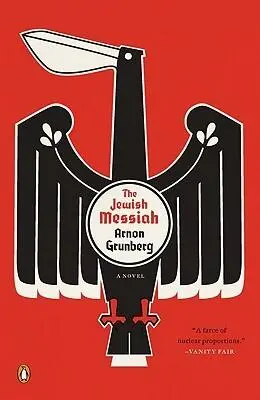
- Название:The Jewish Messiah
- Автор:
- Издательство:Penguin Group US
- Жанр:
- Год:2008
- ISBN:нет данных
- Рейтинг книги:4 / 5. Голосов: 1
-
Избранное:Добавить в избранное
- Отзывы:
-
Ваша оценка:
The Jewish Messiah: краткое содержание, описание и аннотация
Предлагаем к чтению аннотацию, описание, краткое содержание или предисловие (зависит от того, что написал сам автор книги «The Jewish Messiah»). Если вы не нашли необходимую информацию о книге — напишите в комментариях, мы постараемся отыскать её.
) Arnon Grunberg is one of the most subtly outrageous provocateurs in world literature.
, which chronicles the evolution of one Xavier Radek from malcontent grandson of a former SS officer, to Jewish convert, to co- translator of Hitler's
into Yiddish, to Israeli politician and Israel's most unlikely prime minister, is his most outrageous work yet. Taking on the most well-guarded pieties and taboos of our age,
is both a great love story and a grotesque farce that forces a profound reckoning with the limits of human guilt, cruelty, and suffering. It is without question Arnon Grunberg's masterpiece.
The Jewish Messiah — читать онлайн бесплатно полную книгу (весь текст) целиком
Ниже представлен текст книги, разбитый по страницам. Система сохранения места последней прочитанной страницы, позволяет с удобством читать онлайн бесплатно книгу «The Jewish Messiah», без необходимости каждый раз заново искать на чём Вы остановились. Поставьте закладку, и сможете в любой момент перейти на страницу, на которой закончили чтение.
Интервал:
Закладка:
The rabbi muttered under his breath and poured himself a glass of cola.
“I could just as easily have said,” his wife went on, “that you fooled around on me for years with my own sister, until she died of a horrible illness that I don’t wish to name out loud right here. My own sister, and if she’d been prettier than me, okay, but, no, she was older and uglier, God rest her soul. And her personality was worse, too. It’s a mystery to me what you saw in her, but I don’t go around saying things like that, because that’s no one else’s business. All I said was that you’re autistic. And that’s the truth. That’s all I’m saying.”
“No, no,” the members of the Committee of Vigilant Jews said to each other, “we don’t want to hear this, we don’t want to know. We came here to help look for Awromele.”
The rabbi said nothing more, only shook his head and took little sips of cola. Between sips, he muttered furious curses at his wife and his family. “Okay, so tell them,” he shouted at last. “Tell them everything. Tell them I embezzled funds, for all I care — you can’t keep your mouth shut anyway.”
Rochele, who was standing in one corner of the room with a doll in her hand, said, “I know for sure that the Messiah is a bird.”
Her brothers and sisters laughed at her. “What kind of a bird?” they wanted to know. “A parrot, I bet it’s a parrot, or is he a sparrow? Or a pigeon?” They named all the kinds of birds they knew and laughed wildly. There was never much laughter in this household, so when the opportunity presented itself they took full advantage of it.
“No,” Rochele said, “a tropical bird. I know for sure. I dreamed about it.”
The rabbi’s wife put the baby back in the cradle, picked up Rochele, and said to her guests: “Maybe the Messiah is a tropical bird. Who knows what kind of tricks the Almighty is willing to play on us? Maybe He’ll send us a messiah in the form of a tropical bird, because of our sins.” As she said that, she stared pointedly at her husband.
The committee member who had signed up only because no other association or club in Basel would have him, asked: “But what kind of tropical bird? Doesn’t the Torah give us a clue about what kind of tropical bird we should be looking for?”
Then the rabbi pounded on the wall a third time and shouted: “Enough of this nonsense! Enough, or I’ll throw you all out of the house. How dare you talk about the Messiah like that on the day the anti-Semite has struck? The Almighty is not going to send us a messiah in the form of a tropical bird, no matter how much we’ve sinned — He would never do that. The Messiah is a man of flesh and blood, not a bird, not a hippopotamus, and not an elephant, either. Don’t ever talk like that again, not if you hope for a long and prosperous life.”
At one-thirty in the morning, the members of the committee left the house to look for Awromele in groups of two or three. Some of the members took the search seriously. They waved big flashlights back and forth and shouted at a few automobilists, “Dirty anti-Semites in your fat BMWs!”
Three other members, including Bettina, felt that a search only made sense if you had a plan. They stopped in at a kebab place run by an Egyptian. They hung out at the bar of Jerusalem Kebabs, waiting for a plan to come to them. But it didn’t come.
The Egyptian had chosen that name for his restaurant because he was planning to liberate Jerusalem, once he had earned enough money selling kebabs. The place he’d had before was called Bethlehem, the one before that Nazareth, and before that he’d even had a restaurant called Jericho. The time was ripe, he believed, for doing things in a big way: Jerusalem Kebabs. Twenty seats, standing room for thirty.
Like Bettina, the Egyptian was a virtuous person. Part of his profits he donated to Hamas charities. His conscience bothered him on occasion, and when it did he tried to soothe it by supporting Hamas, which did a lot of good work in and around the Occupied Territories.
After making a donation like that, he would feel better, and could go back to boosting his market share in Basel without being bothered by scruples. He had to work hard, because the competition was capable of almost anything. His donations to Hamas were really only symbolic, a couple of thousand Swiss francs here, a couple of thousand Swiss francs there. He had opened a Swiss bank account for them. No self-respecting charity could get by these days without one of those. In Switzerland the Egyptian’s donations wouldn’t have gone far, but in Gaza you could buy a couple of Uzis for that money, from Israeli soldiers who didn’t mind a reprimand in return for a month’s supply of hash. Any soldier serving in the Occupied Territories needed hash as badly as he needed a weapon.
Many of the Egyptian’s best customers were Jews, and he got along wonderfully with them. Money doesn’t discriminate. He had even made friends with some of them. He sent them cards at the Jewish New Year. He could even speak a few words of Yiddish.
Three members of the Committee of Vigilant Jews were now sitting at his bar, talking about the Middle East and the exchange rate for the dollar, as though both the Middle East and the exchange rate were some wayward woman who refused to listen to their good advice.
One of the committee members, a bald man who had dropped out of law school and now worked in an office as an archivist, said to the Egyptian, “Hey, pal, how about a few of those M&Ms?”
The Egyptian tapped on the counter the way croupiers do in the casino, to show that he’d understood the code. He went to the back room, opened the refrigerator where the M&Ms were kept hidden behind a big bottle of condensed milk, and brought back a few. The bald man handed the Egyptian a pile of banknotes and retired to the men’s room.
“What are you people doing out so late?” the Egyptian asked. He poured himself a glass of tea. “Is it already time for carnival?”
Bettina said, “We’re looking for a boy.” She was from a staunch Catholic family, and had been raised in a village, Ilanz, not far from the town of Chur, before her family had moved to Basel when she was twelve. She said proudly: “The anti-Semite has struck. We’re looking for our rabbi’s son.”
“Oh,” the Egyptian said. “That’s terrible. That breaks my heart. We’re cousins, did you know that? We come from the same family. You’ve heard that before, I guess?”
The Egyptian’s wife ironed his shirts. He liked to wear white ones, with the top buttons always open, even in winter. The hair on his chest was grayer than the hair on his head; he was pleased with the hair on his chest, felt that it lent him a certain authority, something mystical, something he couldn’t quite put his finger on. In any case, women seemed impressed by it.
“Abraham was your patriarch, but he was ours, too. So we’re family,” he said.
He took Bettina’s head in his hands, pressed it to his chest, and said in his deep voice: “I feel for you. What’s your name?”
“Bettina,” she whispered. In a short time, she had learned so much about Jewish history that she could relate ten-minute anecdotes about famous Jews at the drop of a hat.
The Egyptian felt the urge to stick his tongue in Bettina’s ear, but restrained himself. “Bettina,” he whispered, “would you like a couple of M&Ms too?”
“How much does it cost?” she asked. She had heard from other members of the committee that Jerusalem Kebab sold more than just skewered lamb. Happiness, pure happiness, with nothing to be said against it except, perhaps, that it lasted only briefly. The Egyptian named a price. She was stunned. You didn’t get rich by supporting and protecting Jews, or by adopting Indian villages, but if the other members of the committee were trying M&Ms, how could she refrain?
Читать дальшеИнтервал:
Закладка:
Похожие книги на «The Jewish Messiah»
Представляем Вашему вниманию похожие книги на «The Jewish Messiah» списком для выбора. Мы отобрали схожую по названию и смыслу литературу в надежде предоставить читателям больше вариантов отыскать новые, интересные, ещё непрочитанные произведения.











Обсуждение, отзывы о книге «The Jewish Messiah» и просто собственные мнения читателей. Оставьте ваши комментарии, напишите, что Вы думаете о произведении, его смысле или главных героях. Укажите что конкретно понравилось, а что нет, и почему Вы так считаете.