Arnon Grunberg - The Jewish Messiah
Здесь есть возможность читать онлайн «Arnon Grunberg - The Jewish Messiah» весь текст электронной книги совершенно бесплатно (целиком полную версию без сокращений). В некоторых случаях можно слушать аудио, скачать через торрент в формате fb2 и присутствует краткое содержание. Год выпуска: 2008, Издательство: Penguin Group US, Жанр: Современная проза, на английском языке. Описание произведения, (предисловие) а так же отзывы посетителей доступны на портале библиотеки ЛибКат.
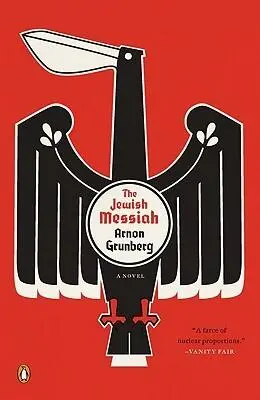
- Название:The Jewish Messiah
- Автор:
- Издательство:Penguin Group US
- Жанр:
- Год:2008
- ISBN:нет данных
- Рейтинг книги:4 / 5. Голосов: 1
-
Избранное:Добавить в избранное
- Отзывы:
-
Ваша оценка:
The Jewish Messiah: краткое содержание, описание и аннотация
Предлагаем к чтению аннотацию, описание, краткое содержание или предисловие (зависит от того, что написал сам автор книги «The Jewish Messiah»). Если вы не нашли необходимую информацию о книге — напишите в комментариях, мы постараемся отыскать её.
) Arnon Grunberg is one of the most subtly outrageous provocateurs in world literature.
, which chronicles the evolution of one Xavier Radek from malcontent grandson of a former SS officer, to Jewish convert, to co- translator of Hitler's
into Yiddish, to Israeli politician and Israel's most unlikely prime minister, is his most outrageous work yet. Taking on the most well-guarded pieties and taboos of our age,
is both a great love story and a grotesque farce that forces a profound reckoning with the limits of human guilt, cruelty, and suffering. It is without question Arnon Grunberg's masterpiece.
The Jewish Messiah — читать онлайн бесплатно полную книгу (весь текст) целиком
Ниже представлен текст книги, разбитый по страницам. Система сохранения места последней прочитанной страницы, позволяет с удобством читать онлайн бесплатно книгу «The Jewish Messiah», без необходимости каждый раз заново искать на чём Вы остановились. Поставьте закладку, и сможете в любой момент перейти на страницу, на которой закончили чтение.
Интервал:
Закладка:
He saw Awromele’s body, lying rolled up, like a fetus. The clothes were torn. The ear, topped with clotted blood like a cherry on a cake, stared at him.
“Awromele,” he said, kneeling down beside him. “Awromele.” He took his head in his hands, held it, and kissed it carefully. He sat down beside Awromele, laid his head in his lap. Awromele’s body felt so wet and cold, as though it had ceased to exist.
It couldn’t end like this; nothing could end like this. If people died like this, it was better for them never to have lived at all.
“Don’t die,” Xavier said. “Awromele, please don’t die.” He took the boy’s hair in his hands and kissed it.
Xavier remained sitting there like that for a few minutes, with Awromele’s head in his lap. He had taken off the jacket of his jogging suit and draped it over Awromele’s chest. As though he were holding a drowned man in his arms, as though he had arrived too late, hadn’t run into the surf in time — that was how he sat there. Every once in a while he asked, “Can you hear me, Awromele?”
Xavier tried to hum. Humming always soothes. He felt as though his own life had come to an end. Xavier felt numbed, far removed from everything, without hope, without faith in the future. He rocked back and forth, the way devout Jews do. “Please say you can hear me, Awromele.” As though this was all he needed to do, as though this was what comforting was all about, stroking a few hairs, wiping away a little blood, humming senselessly beneath a pine tree.
He didn’t know what to do, where to go, whom to ask for help. Xavier, who otherwise always knew what to do, who was never at a loss for words in the classroom, who had even, he felt, responded appropriately when he caught his mother in the kitchen with the knife, didn’t have a clue. All he knew was that he had run away from the boys, that he had taken a shower, and that he had arrived too late.
Xavier used the hem of his T-shirt to wipe the dirt and blood from Awromele’s forehead. “Dear Awromele,” he said, “don’t worry, I’m here now, I won’t go away again.” He didn’t dare to touch the wounds: experts would have to do that later on. He murmured, “You’re safe now, they won’t come back.”
Awromele began shivering. He wasn’t dead. His wounds were throbbing like an overheated steam turbine. But when Xavier asked him to stand up, or when he shook him gently by the leg, Awromele didn’t react. “You can’t stay here,” Xavier said. “You’ll get sick. This place will be the end of you.”
Xavier carefully lifted Awromele’s swollen left hand and laid it on his stomach. There was mud and blood sticking to it, but he didn’t dare wipe it clean. The hand looked too mangled.
“It’s me, Xavier,” he said again. He thought that if he said it often enough Awromele would finally hear. “You helped me get circumcised; we’re going to translate Mein Kampf together. We belong together, and I swear to you, I don’t feel a thing, and you don’t feel anything, either, Awromele. That’s why we belong together. Do you hear me? Awromele?”
After a few minutes had passed, when Xavier noticed that he, too, had started shivering, just like Awromele, he saw that staying in this place was not a good idea. There was no use waiting for a reply any longer. He tried to pick Awromele up. First he pulled on his legs, but the body didn’t budge. He heard a joint pop. Xavier put his hands under Awromele’s back and tried to pick him up, as though the Jew were a sack of flour, but that didn’t help, either. He tugged on his arms, to get him to sit up. Awromele didn’t move; his body was unwieldy. His back rose from the ground a little bit, just a few centimers. But when Xavier heard bones cracking again, he was so afraid of breaking anything else that he let the body fall back onto the ground. It fell like a dead thing.
Xavier knelt and murmured: “I’m sorry, Awromele, sorry. I was startled — your bones were making so much noise. That’s why I dropped you. Don’t be angry.”
He laid the swollen left hand back on Awromele’s stomach. He put his mouth up close to Awromele’s good ear. “I’m sorry,” Xavier said. Even in this condition, Xavier could see how gorgeous Awromele was. “I’ll be right back. Stay here. Wait for me.”
Xavier walked away slowly, remembering when he had run from this spot while the boys were standing around Awromele. He thought he was leaving a corpse behind. When he arrived at a path, Xavier started shouting: “Help, help, there’s been an accident.”
It had stopped raining at last, although the wind was still blowing. But it was too early for people to be out walking in the park. Even the dog owners had decided to avoid the park for the moment. No one heard him. Xavier ran through the park again, looking for help. An inexplicable rage took hold of him. He saw Awromele’s face, the swollen hand, and again, each time anew, the ear that had bled — the ear that had stared at him like a madman’s eye. An eye that seemed to demand only one thing: Why did you run away, why you? Why did you have to run away?
And for as long as the ear continued to ask Xavier that unanswerable question, he ran on through the park, screaming for help.
IN THE RESTROOM at Jerusalem Kebabs, Bettina tore open the little bag and looked at the powder for which she had paid so much. She had never done this before. She had seen it in movies, in documentaries, too, and she had read about it in books. She had been planning to do it for a long time — she wanted to experience everything. But now that the time had come, she hesitated. The hesitation was suddenly more powerful than her desire.
She remembered her father’s advice, her mother’s worries, the prayers of her grandmother who had gone to church every day until she broke her hip, and had then turned her bedroom into a chapel. The real world was suddenly a bit too real for Bettina. Yet she knew there was no going back. You can leave Ilanz for the real world, but once you’ve arrived there’s no going back to Ilanz.
In the end, she won out over her hesitation. It would be a waste of all that money — she could hardly trade it back in for kebabs. Feeling a slight aversion, she sniffed deeply, as though sampling a rare wine.
It tickled. This expensive stuff, which had cost her almost as much as she earned in a month of waitressing two afternoons a week, reminded her of sneezing powder. Maybe it was sneezing powder. Maybe she’d been tricked; maybe the Egyptian had sold her something from the trick shop. Bettina’s parents had done their best to encourage their daughter’s wariness, and they had succeeded. People were waiting everywhere to cheat you; on every street corner, in every kebab shop, they waited to press counterfeit goods on trusting souls, and she was trusting, because she knew nothing about cocaine. That thought made her cry.
The torn-open sack of M&Ms was lying beside the sink; some powder still clung to the back of her left hand. “It’s sneezing powder,” she whispered, sitting on the toilet. “It’s just sneezing powder. No one takes me seriously.”
XAVIER RAN THROUGH the park and screamed: “Help, there’s been an accident! Police!” He was running in circles. He didn’t dare go too far away from Awromele. Only at the start of his fourth lap around the park did he notice the shed belonging to the Municipal Parks Service. It had once housed two men whose job it was to keep up the park, but as of late there was only one. The parks service was having trouble making ends meet. Beside the shed was a vegetable garden. In the garden Xavier saw a couple of shovels, a few bags of earth, five garbage cans, and a wheelbarrow. He stopped at the fence and stared at the wheelbarrow the way a child stares at creampuffs in a baker’s window. The wheelbarrow was rusty, but that didn’t matter. With that wheelbarrow, Xavier could roll Awromele all the way to the doctor.
Читать дальшеИнтервал:
Закладка:
Похожие книги на «The Jewish Messiah»
Представляем Вашему вниманию похожие книги на «The Jewish Messiah» списком для выбора. Мы отобрали схожую по названию и смыслу литературу в надежде предоставить читателям больше вариантов отыскать новые, интересные, ещё непрочитанные произведения.




Обсуждение, отзывы о книге «The Jewish Messiah» и просто собственные мнения читателей. Оставьте ваши комментарии, напишите, что Вы думаете о произведении, его смысле или главных героях. Укажите что конкретно понравилось, а что нет, и почему Вы так считаете.